Imagine building a retail strategy around a tradition that is hundreds of years old. Now, imagine finding out that the biggest, most profitable part of that tradition is completely fake. It is a Hollywood invention.
This is the reality of the modern experience economy. Today, entertainment dictates consumer spending. If people see something on a screen, they want to buy it in real life.
In this special report, we will look deep into one of the most successful cultural and retail transformations in modern history: Mexico’s Day of the Dead (Día de Muertos). We will analyze the shocking numbers, the supply chain controversies, and the strategies used by global brands. Most importantly, we will provide direct, actionable tips for Fast-Moving Consumer Goods (FMCG) and retail managers. How can you use these lessons to boost your own sales? Let us find out.
The Origin of the Spectacle: James Bond and the 500,000 USD Investment
Before the year 2015, the Day of the Dead was a quiet, intimate family holiday. People celebrated it at home. They built small altars (ofrendas) to remember dead family members. They went to cemeteries at night to light candles and pray. It was a beautiful, ancient tradition, but it was not a massive tourist event. There was no big street parade in Mexico City.
Then came James Bond.
For the 2015 movie Spectre, the visual demands of a Hollywood blockbuster necessitated a grander spectacle. Encouraged by tax incentives provided by the Mexican government, British director Sam Mendes staged a massive, fictional Day of the Dead parade in Mexico City’s historic Zócalo square for the film’s opening sequence. The production enlisted 1,500 extras dressed in elaborate skeleton costumes. They created a highly stylised, carnivalesque atmosphere.
When the film debuted in 182 countries, international audiences perceived this manufactured spectacle not as cinematic fiction, but as an authentic, annual Mexican tradition. Almost immediately, the Mexican tourism industry experienced a surge in flight and hotel bookings from international travellers. They all wanted to attend a parade that did not actually exist.
Faced with the dual prospect of a monumental public relations failure and an unprecedented economic opportunity, the Mexico City government executed a rapid strategic pivot. In October 2016, municipal authorities invested 500,000 USD to manifest the cinematic fiction into reality. The government hired 650 volunteers, commissioned the construction of dozens of floats and giant skeleton marionettes (alebrijes), and held the first actual Day of the Dead parade in the city’s history.
The inaugural event drew 250,000 attendees. A decade later, this single event has evolved into a cornerstone of the national tourism strategy, attracting between 1.3 and 1.7 million tourists annually.
The Economic Impact: 45.3 Billion Pesos in 2025
Today, the financial numbers are simply staggering. For retail and hospitality businesses, the end of October is now one of the most important periods of the year.
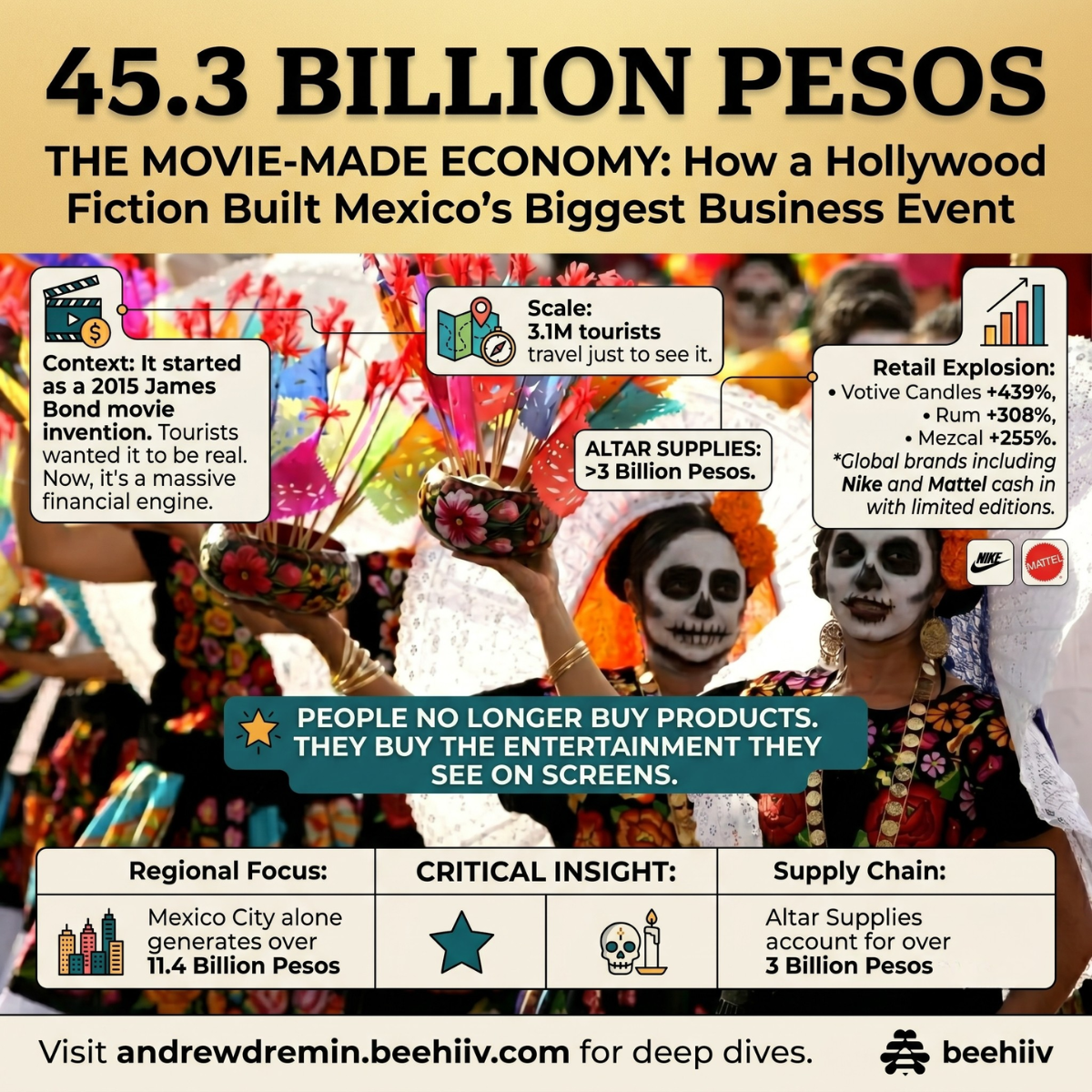
In 2025, the total economic impact (derrama económica) of the Day of the Dead celebrations in Mexico reached a record 45.31 billion Mexican pesos. This represents a massive 9.2% growth compared to the previous year. The government anticipates the movement of 3.12 million tourists across the country, with over 1.6 million staying in formal hotels.
Mexico City remains the epicentre of this economic explosion. The city government combined the Day of the Dead events with the Formula 1 Grand Prix weekend. This created a super-weekend for retail and hospitality. The Day of the Dead festivities alone generated an estimated 11.44 billion pesos for Mexico City’s commerce.
Let us look at the macro data:
| Economic Indicator (2025 Data) | National Level (Mexico) | Mexico City (CDMX) Level |
| Total Economic Impact | 45.31 Billion MXN | 11.44 Billion MXN |
| Year-over-Year Growth | +9.2% | +4.2% |
| Total Tourist Movement | 3.12 Million | > 1.3 Million (Parade) |
| Average Hotel Occupancy | 60.8% | 69% – 73% |
| Domestic vs. International | 73% Domestic / 27% Int. | Highly mixed |
The Retail and FMCG Explosion: What Consumers Are Buying
For a retail expert, the macro numbers are interesting, but the micro numbers are where the real lessons lie. The shift from a quiet family holiday to a massive party has completely changed consumer buying habits.
The average Mexican family now allocates a budget of 1,435.50 pesos just to buy supplies for their home altar. On a national scale, families spend more than 3 billion pesos on altar components.
Supermarkets and retail chains see massive spikes in very specific categories. According to retail data from 2025:
- Candles: The demand for illumination is huge. Votive candles (veladoras) see an unbelievable 439% increase in sales in self-service stores. Standard candles jump by 180%.
- Chocolates and Sweets: Wholesale channels report a 68% increase in table chocolate sales and a 67% increase in marshmallow chocolate. Online sales of children’s candy grow by 56%.
- Alcohol: This is the clearest sign of the holiday’s transformation. Because the holiday is now a party, online alcohol sales explode. Rum and brandy sales increase by 308%, mezcal by 255%, vodka by 227%, and wine by 204%.
The Controversial Reality: Supply Chain Struggles
Expert Insight: Behind every massive retail success, there is often a hidden supply chain crisis.
The symbol of the Day of the Dead is the cempasúchil (marigold) flower. The bright orange colour and strong smell are believed to guide the dead back home. Millions of these flowers are sold every year. You would think this is a perfect situation for local Mexican farmers.
The reality is controversial. The demand is so high that local production cannot keep up. Today, an estimated 90% of the cempasúchil seeds planted in Mexico for commercial production are actually imported from China and the United States.
Local farmers, like the García family in the Xochimilco district of Mexico City, face terrible struggles. They try to grow the traditional, native Mexican flower. But they have to fight against bad weather, floods that destroy their greenhouses, and the flood of cheap, imported Chinese seeds. The traditional Mexican flower has a stronger smell, but supermarkets and consumers often just want the cheapest, brightest flower that looks good in photos.
This is a classic FMCG problem: when demand explodes because of a trend, authenticity is often replaced by mass-produced, imported alternatives.
The “Pizza Effect” in Business
How does a country accept a fake, Hollywood parade as its own real tradition? Anthropologists call this the “Pizza Effect”.
The theory is simple. A cultural item leaves its home country. In a foreign country, it gets modified, commercialised, and made more popular. Then, it is exported back to the original country. The original country sees how successful and cool the modified version is, and they adopt it as their own.
It happened with pizza. Pizza was a basic, cheap street food in Italy. Immigrants took it to America. In America, it became a massive commercial product with lots of toppings. American tourists then went to Italy and asked for this type of pizza. Italian restaurants adapted to make money. Today, it is a global Italian icon.
The exact same thing happened with the Day of the Dead. It left Mexico as a quiet ritual. It went to Hollywood. Hollywood made it a loud, colourful parade. It came back to Mexico, and the Mexican government and people adopted it. Now, it is a multi-billion peso industry.
How Global Brands Capitalise on the Spectacle
Global brands are very smart. They know that consumers want to participate in this cultural event. Brands use “Premiumisation” to sell limited-edition products at high prices.
1. Nike’s Sneaker Strategy Nike uses its “Global Express Lane” strategy to design products based on local culture very quickly. Every year, they release a Day of the Dead collection (like “Con Mi Familia”). They take famous shoes, like the Air Jordan 1 or the Dunk Low, and add cultural symbols like marigolds, the moon, and hummingbirds. They even use special paint that wears away over time to show bright colours underneath, symbolising the memories of the dead. Nike releases these first in Mexico to build hype, then globally. The shoes sell out instantly.
2. Mattel’s Premium Barbie Dolls Mattel turned a basic children’s toy into a high-end cultural product. Every year, they release a “Barbie Signature Día De Muertos” doll. These dolls cost between 80 USD and 100 USD. They are dressed in beautiful traditional dresses with skull face paint. Mattel even hires famous Mexican fashion designers, like Benito Santos, to design them. Mattel tells consumers that these dolls are perfect to place on their family altars. This is brilliant marketing: they positioned a plastic toy as a respectful, sacred item.
3. Clase Azul’s Luxury Tequila In the premium alcohol sector, Clase Azul releases a special edition Añejo tequila. It comes in a beautiful ceramic bottle painted by Mexican artists. The bottle features a 24-karat gold-plated locket made by local craftsmen. By combining high-end luxury with authentic cultural storytelling, they can charge thousands of dollars per bottle.
Screen Tourism: A Global Retail Engine
The Mexico City parade is just one example. Around the world, “Screen Tourism” is creating entirely new retail ecosystems. When a location appears in a famous movie or TV show, it acts as a permanent, global advertisement.
Let us look at the global landscape:
New Zealand (The Lord of the Rings) Peter Jackson’s movies turned New Zealand into Middle-earth. The “Hobbiton” movie set expects 570,000 visitors this season, 85% of whom are international tourists. These tourists spend an average of $5,377 during their stay, which is much higher than normal tourists. Overseas visitors to the Hobbiton tours are expected to inject an incredible 2.6 billion dollars into the New Zealand economy in a single season.
Northern Ireland (Game of Thrones) The TV show Game of Thrones changed the economy of Northern Ireland. During its production, the show brought 251 million pounds into the local economy. In 2018, one out of every six tourists visited Northern Ireland specifically because of the show, bringing in 50 million pounds that year. To keep the money flowing, they opened a permanent Game of Thrones Studio Tour in 2021.
Spain (La Casa de Papel / Money Heist) The Netflix show La Casa de Papel made Madrid a major filming destination. Tourists visited the CSIC building (which was used as the Royal Mint) and Nuevos Ministerios (used as the Bank of Spain) to take photos. Recognising this massive retail and tourism potential, the Spain Film Commission launched the “Spain Screen Grand Tour” to systematically promote screen tourism across the country. Even smaller cities, like Reus, use their historical and cinematic connections to promote high-value products like “Vermut de Reus” to international tourists.
| Screen Franchise | Primary Location | Key Economic & Retail Impact | Long-Term Retention Strategy |
| 007: Spectre | Mexico City, Mexico | 11.44bn MXN local festive spend; 1.3-1.7m tourists. | Government creation of an annual municipal parade. |
| The Lord of the Rings | Matamata, New Zealand | $2.6bn NZD contribution; 570k visitors. | Preservation of Hobbiton set as a permanent retail/tourist site. |
| Game of Thrones | Northern Ireland | £251m production injection; £50m/year from tourists in 2018. | Creation of permanent Studio Tour and public art trails. |
| La Casa de Papel | Madrid, Spain | Massive footfall to specific buildings in Madrid. | Launch of the Spain Screen Grand Tour to guide tourists. |
Actionable Advice for Retail and FMCG Professionals
So, what does this mean for you? How can a supermarket manager in Europe, a retail director in Asia, or an FMCG marketer in America use these lessons? Here is my professional consulting advice:
1. You Must Create Entertainment, Not Just Aisles
People do not buy products anymore. They buy experiences. They buy the entertainment they see on their screens. If your physical store is just a boring aisle with boxes on shelves, you will lose to online shopping. You need to build a spectacle. Host an event. Create a visual display that people want to photograph. If a fake spy movie parade can generate 45 billion pesos, think about what a real entertainment strategy can do for your store.
2. Anticipate the “Screen” Effect on Your Inventory If a product or a lifestyle is featured in a hit Netflix show, the demand will explode instantly. You must make your supply chain agile. When the Day of the Dead became a global trend, votive candle sales jumped 439%. Retailers who ordered their normal stock based on last year’s data ran out of products. You must monitor pop culture and media trends. Adjust your algorithms to account for viral media moments.
3. Cross-Merchandise for the “Party” Aspect Traditions change. The Day of the Dead went from a quiet, sad memorial to a loud, happy party. Retailers must adapt. Do not just put the traditional bread next to the candles. Put the rum, the mezcal, and the vodka there too. With online rum sales spiking 308%, smart retailers will bundle alcohol, snacks, and decorations together in one easy “party package” display.
4. Localise the Global Product (Glocalization) You can sell mass-produced products at a premium price if you wrap them in local culture. Nike and Mattel do this perfectly. They do not just put a skull sticker on a shoe. They study the culture, use specific symbols (like the hummingbird), and hire local designers. If you are launching a global product in a local market, partner with local artists. It makes the product feel authentic, and you can charge a much higher margin.
5. Secure Your Supply Chain Early Remember the Xochimilco farmers and the Chinese seeds. If your marketing depends on a specific physical product (like a specific flower, a specific fruit, or a local material), make sure your supply chain can handle the volume. If it cannot, you will be forced to buy cheap imports, which can ruin your brand’s story of “authenticity.”
6. Do Not Cross the Line into Disrespect If you are using a cultural or religious holiday to sell products, show respect.Give part of the profits back to them. Ensure your marketing explains the meaning behind the tradition, rather than just using it as a colourful background to sell alcohol or shoes.
Conclusion
The story of the Mexico City parade is the ultimate lesson in modern retail. The line between reality, fiction, entertainment, and commerce does not exist anymore.
Consumers are looking for a story to belong to. Sometimes, that story comes from hundreds of years of history. Sometimes, it comes from an eight-minute scene in a James Bond movie. As retail and FMCG leaders, your job is to be ready when the story hits. Build the experience, secure your stock, respect the origin, and give the customer the spectacle they are willing to pay for.


Leave a Reply