
£140 million. That is the average surge in consumer spending on chips, beer, and carbonated soft foods during a single major football tournament month.
When a sporting event dominates the cultural calendar, consumer behavior shifts toward high-calorie, low-friction impulse buys. To capture a fraction of this momentum, major FMCG brands routinely spend millions on official sponsorships, tier-one advertisements, and complex supply chain allocations.
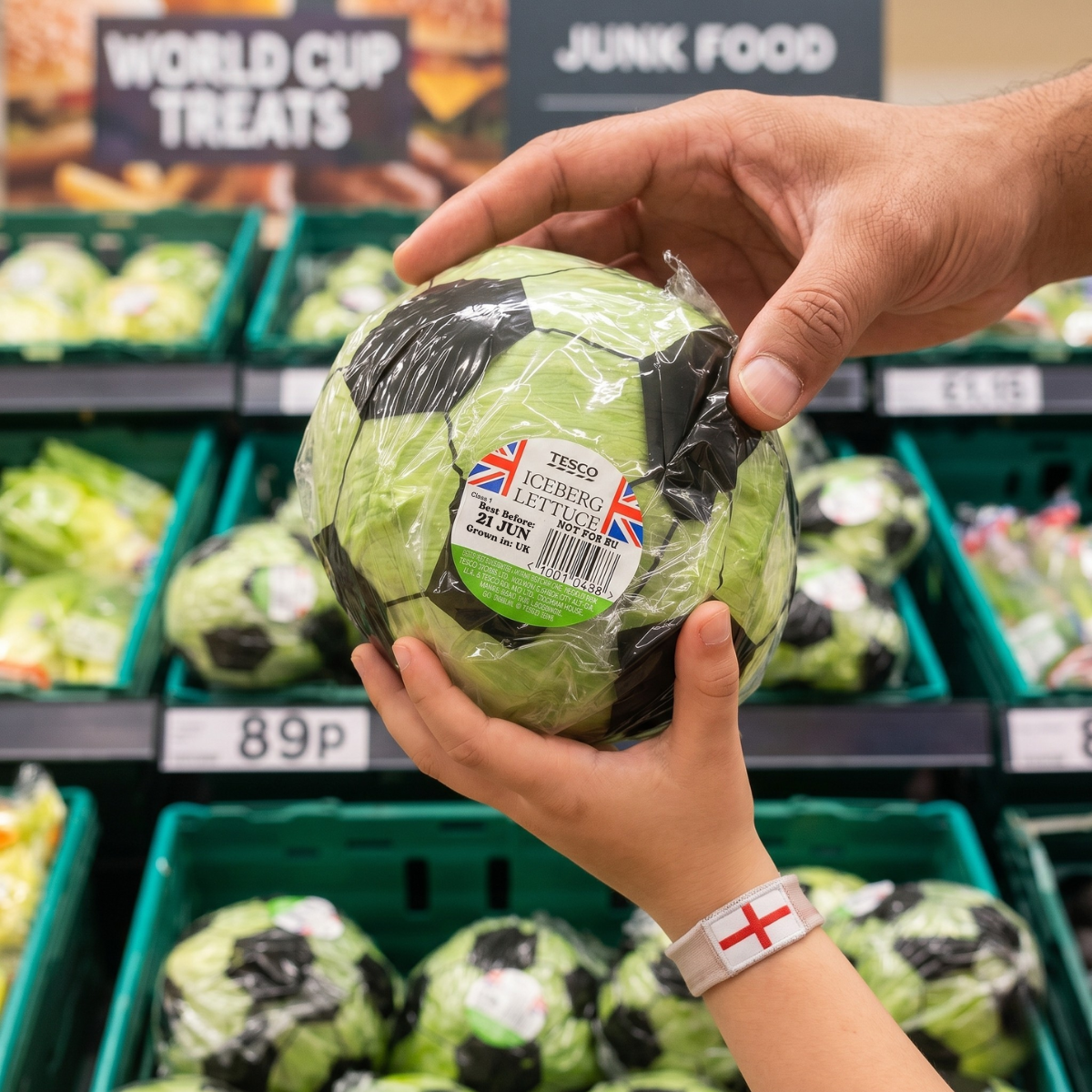
Then there is Tesco. Instead of buying official tournament rights or launching an expensive multi-channel campaign, they printed classic black-and-white football panels directly onto the standard plastic wrapper of their private-label iceberg lettuce.
Some industry commentators dismissed it as a cheap gimmick. My professional assessment is different: it is an execution of high-ROI reactive marketing that highlights a fundamental truth about retail category management.
The Illusion of Innovation vs. Contextual Execution
In retail and FMCG, marketing teams frequently overcomplicate innovation. They operate under the assumption that driving incremental volume requires entirely new product formulations, prolonged R&D cycles, or massive capital expenditure on new manufacturing lines.
This approach misses the core driver of impulse purchasing: context.
Tesco did not alter the core product. An iceberg lettuce remains a low-margin commodity with high price elasticity and a short shelf life. Instead, working alongside their supplier, G’s Group, they modified the visual infrastructure of the existing packaging film.
By substituting the standard clear wrapper with a themed design, they achieved two critical commercial objectives simultaneously:
- Zero-Formulation Innovation: The production line speed, product weight, and supply chain logistics remained identical to standard operations.
- Low-Cost Event Hijacking: They established an immediate cognitive link between a fresh vegetable and a major sporting event, completely bypassing the financial barrier of official sponsorship compliance.
Structural Breakdown: Gimmick vs. Strategic Utility
To understand why this works – and where the financial risks lie – we must break down the commercial reality of this execution.
1. Disrupting the Grocery Choice Architecture
Consider the standard consumer journey in the fresh produce aisle. Produce is traditionally purchased rationally, driven by meal planning or baseline health motivations. It rarely triggers high-emotion impulse buying.
When a child or a casual shopper sees a commodity shaped visually like a football, the item shifts from a functional grocery requirement to a novelty choice. It removes the friction of “selling” health. The packaging does the heavy lifting at the precise point of sale, converting a low-interest commodity into a high-visibility item without requiring an promotional price markdown.
2. Operational Efficiency and Cost Asymmetry
The unit economics of this change are highly favorable. Altering a printing plate on a standard BOPP (Biaxially Oriented Polypropylene) film run incurs minimal marginal cost when amortized across volume.
| Metric | Official Sponsorship Strategy | The Packaging Variant Strategy |
| Capital Allocation | Millions in licensing & media rights | Low marginal cost for print plate adjustment |
| Time-to-Market | Months/Years of contract negotiations | Weeks of packaging design and approval |
| Supply Chain Risk | High (Leftover specialized stock) | Moderate (Standard product, localized wrapper) |
| Shelf Visibility | Dependent on secondary display units | Built directly into primary shelf placement |
The Operational Blind Spots: A Critical View
While the execution is highly efficient, a critical analysis reveals distinct operational vulnerabilities that category managers cannot ignore.
- The Tournament Expiration Risk: Fresh produce moves fast, but packaging inventories do not always align perfectly with tournament timelines. If a national team is eliminated early, consumer sentiment drops instantly. The themed packaging immediately loses its relevance and can actively depress sales, turning a fast-moving item into dead stock.
- The Scale Dilemma: This tactic relies heavily on the element of surprise. If every grocery retailer printed football panels on their onions, celery, and cabbage, the shelf would revert to visual noise. It is a tactical move that yields high returns for the first mover but faces steep diminishing returns upon replication.
- Lack of Precise Conversion Data: While visual disruption on the shelf logic dictates an increase in casual pick-ups, clear data is required to prove whether this drove net-new category buyers or simply cannibalized sales from standard loose lettuce options.
Key Frameworks for FMCG and Retail Leaders
For brands operating in highly commoditized categories, the football lettuce offers three distinct strategic principles:
- Commodities Require Visual Personality: When your product looks identical to your competitor’s product, the packaging is your only point of differentiation. If you do not give your commodity a distinct identity, you are forced to compete solely on price.
- Agility Beats Raw Spend: High-budget campaigns take months to clear legal, compliance, and executive hurdles. Low-cost packaging variations allow a brand to react to cultural shifts quickly, liquidating the inventory before the trend goes cold.
- Context Dictates Value: You do not always need to change what the product is. Often, you only need to change how the product connects to the consumer’s immediate environment.
The Bottom Line
Tesco’s football lettuce demonstrates that creative constraints often yield more practical solutions than massive marketing budgets. It bypassed the noise of traditional advertising by altering the final six inches of the consumer journey right at the shelf edge.
Is this hyper-localized packaging adaptation the future of agile fresh food marketing, or is it merely a temporary operational distraction that introduces unnecessary complexity to the supply chain?


