
€3 billion. That is the amount of money the Spanish supermarket chain Mercadona made in 2025 just from selling prepared food. To put that number in perspective, it is more than the combined annual Spanish sales of fast-food giants McDonald’s and Burger King.
Meet Carlos. He runs a small, traditional bar in the center of Valencia. For twenty years, Carlos opened his doors at 6:00 AM. His business survived on a simple morning routine. Construction workers, office clerks, and teachers would come in for a quick espresso and a piece of toast before work. Today, his bar is half empty. His regular customers have not stopped drinking coffee. They just stopped buying it from him. Instead, they walk across the street into a supermarket. They tap their bank card on a glowing screen, grab a hot, fresh coffee from a wooden kiosk, and walk out. It costs them nearly half the price.
This is not just a Spanish story. I have covered the retail and FMCG industry for a long time. And I can tell you this is a global shift. Supermarkets are no longer just places to buy raw ingredients. They are transforming into “grocerants” – a hybrid between a grocery store and a restaurant. They want to feed you right now.
In this article, I will explain why supermarkets are hunting for restaurant profits, how automated coffee machines are driving this change, and what retail professionals must do to survive.
The Brutal Math of Selling Groceries
To understand why a supermarket wants to sell you a hot cup of coffee, you have to understand the math of the grocery business.
Traditional grocery retail is a hard business. It relies on selling massive volumes of products at tiny profit margins. If you look at the financial reports of publicly listed supermarkets, you will see that their net profit margins usually sit between a tight 1% and 3%. It is a brutal game. You fight suppliers for pennies. You optimize truck routes to save a few dollars on gas. Finding new ways to make money in the dry food aisles is almost impossible.
But prepared food and hot drinks are different. The margins in food service are much higher. A standard self-service vending machine might give an operator a net profit margin of 20% to 25%. But hot coffee is a different story. The gross margin on a cup of coffee can easily exceed 200% over the cost of the raw ingredients.
Let us break that down. When a supermarket sells a basic espresso, the cost of the coffee beans, the paper cup, the wooden stirrer, and the water is tiny. It usually costs between €0.15 and €0.25 to make. If they sell it for €1.30, the profit is huge compared to a can of beans or a box of cereal.
Retailers offering fresh prepared options also see an average check increase of 15% to 20%. Customers who buy a coffee tend to walk around the store slower. They look at more items. They buy more things.
The Death of the Weekly Shop
Consumer habits are changing. In the past, the supermarket model was built around “pantry loading”. A family would drive to the store once a week, fill a large trolley with raw ingredients, and cook at home for seven days. The entire store design was built for this behavior.
Today, people have less time. Work hours are long. Remote work has blurred the lines between the office and the living room. Cooking a full meal from scratch every day is now a luxury for many people. Consumers, especially Millennials and Generation Z, want speed and convenience. In fact, 72% of consumers in these younger groups say they prefer “grocerant” prepared foods over traditional restaurant takeout. They view supermarket food as fresher and healthier than traditional fast food.
Retailers realize they are no longer just competing with the supermarket across town. They are competing with cafes, quick-service restaurants, and delivery apps. They are fighting for “share of stomach.” A customer might only do a big grocery shop once a week. But that same customer might buy a coffee, a quick lunch, and a prepared dinner three or four times a week.
Mercadona: The Blueprint for the Modern Grocerant
If you want to see the future of retail, look at Mercadona. Under the leadership of its president, Juan Roig, the company is changing how people eat in Spain.
Mercadona had a historic year in 2025. The company reported a total business volume of €41.9 billion. Its net profits jumped 25% to reach €1.729 billion. How did they do it? A massive part of this success comes from their “Listo para Comer” (Ready to Eat) section.
Mercadona is investing heavily in a new store layout called “Tienda 9”. They plan to invest €3.7 billion into this new model by 2033. The goal is to move from a traditional store layout to a “store by processes.” This means speeding up the shopping trip for customers and making internal logistics more efficient. A key feature of Tienda 9 is a central in-store workshop where workers cut, cook, and package food right in front of the customer.
The numbers for this prepared food division are staggering.
| Metric | Mercadona Financial Data (2025) |
| Total Corporate Revenue | €41.9 Billion |
| Corporate Net Profit | €1.729 Billion (+25% YoY) |
| “Listo para Comer” Revenue | €3.0 Billion |
| Prepared Food Market Share | 51.2% (Spain) |
| Estimated Prepared Food Margin | ~20% |
| Tienda 9 Investment Target (2033) | €3.7 Billion |
| “Listo para Comer” Stores (2025) | 1,469 Stores |
This prepared food division operates with a profitability margin close to 20%. It is growing at 8.9% year-over-year. Mercadona now holds a massive 51.2% market share in the modern distribution of prepared foods in Spain. The closest competitor, Carrefour, only holds about 10%.
Inside the Coffee Corner: A Masterclass in Retail Design
Mercadona’s strategy to dominate the coffee market is simple but highly effective. They are rolling out self-service coffee machines across their network. They plan to have this service in over 500 supermarkets by 2026.
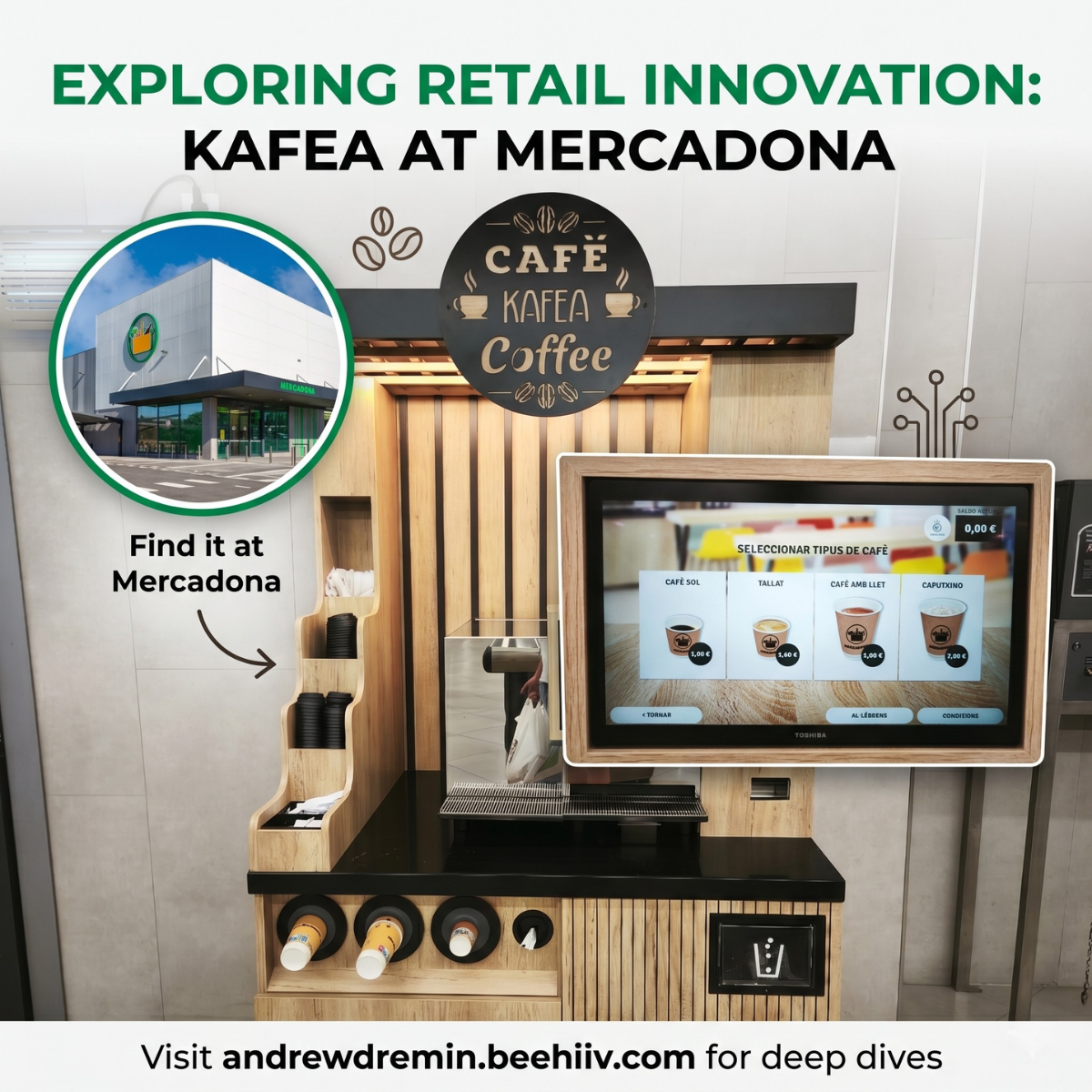
I have seen these new coffee installations at my local store. The design is very intentional. It does not look like a cheap vending machine. The station uses a warm, wooden-slatted backboard. It has ambient LED lighting. A large, circular sign reads “CAFÉ KAFEA Coffee.” Using regional languages like Basque and Catalan is a smart move. It makes the large corporation feel local and connected to the community.
To the left of the screen, the wooden fixture holds different sizes of paper cups, lids, and wooden stirrers. To the right, there is a built-in trash bin. Everything is clean and organized.
But the most important part of the machine is the payment system. Mercadona attached the card reader directly to the front of the machine. The customer must tap their card and pay before the machine makes the coffee. This is a critical detail. In some other supermarkets, customers print a ticket at the coffee machine and pay at the main exit checkout. This causes huge problems with theft. People drink the coffee while walking the aisles and leave the empty cup on a shelf. Mercadona’s direct-payment system completely eliminates this loss.
The machine uses a large Toshiba touchscreen. The menu is simple. They do not offer complicated syrups or iced drinks. They focus on the basics. Here is the pricing matrix I observed on a machine in a Catalan-speaking region:
| Beverage Option (Catalan / English) | Retail Price (€) | Beverage Profile |
| Cafè Sol (Espresso) | €1.30 | Short, intense extraction. Black. |
| Tallat (Macchiato) | €1.40 | Espresso “cut” with a small amount of milk. |
| Cafè amb Llet (Latte/Flat White) | €1.60 | Espresso with a larger volume of steamed milk. |
| Caputxino (Cappuccino) | €2.00 | Espresso with heavy steamed milk foam. |
This pricing is aggressive. At €1.30 for an espresso and €1.60 for a latte, Mercadona is heavily undercutting the market. In a normal Spanish cafe, a standard café con leche (latte) costs around €2.30. Mercadona is offering a fresh, hot coffee for 30% less than the local bar.
And the quality is good. These modern machines use 15 to 20-bar pressure ULKA pumps. They grind whole beans on the spot. They extract the coffee just like a trained human barista would.
The War with Traditional Hospitality (HORECA)
The traditional hospitality sector is not happy about this. In Spain, the HORECA industry (Hotels, Restaurants, and Cafes) is furious.
Spain has a deep coffee culture. For 74% of Spanish consumers, a latte is their favorite drink outside the home. Going to a bar for coffee is a social ritual. But inflation and rising costs are hurting regular people. When money is tight, a €1.30 supermarket coffee looks much better than a €2.30 cafe coffee.
Hostelería de España is the national association for the hospitality industry. Their president, José Luis Álvarez Almeida, recently attacked supermarkets in public. He called the “Listo para Comer” model unfair competition.
“Now we have gas stations, hypermarkets, or supermarkets that want to be bars,” he said. “That is unfair competition”.
The anger comes from the rules. Supermarkets set up tables, chairs, and microwaves inside their stores. They act exactly like a fast-casual restaurant. But they operate under different licenses. They face different tax structures and labor laws. The restaurant owners feel the game is rigged. They want the government to step in and make the rules equal for everyone.
The threat goes beyond coffee. For 60 years, Spanish workers relied on the “menú del día” (the fixed-price daily lunch menu) at local bars. It was cheap and reliable. But inflation pushed the price of a restaurant lunch menu to €12 or €15. Today, a worker can walk into Mercadona, buy a fresh portion of paella or roast chicken, grab a €1.30 espresso, and eat a full meal for €6. The traditional restaurant simply cannot compete with that price. Mercadona owns its entire supply chain. They buy direct. They prep in bulk. The local bar owner cannot match those costs.
Beyond the Machine: The “Sock Coffee” Innovation
Mercadona is also attacking the coffee market inside the home. They partnered with their supplier, UCC Coffee Spain, to create a highly innovative product. It is called “Café Filtro Americano Hacendado.” People call it “Café Calcetín” or sock coffee.
It is a single-serve paper filter filled with ground coffee. You open the packet, anchor the paper handles to the sides of a mug, and pour hot water through it. It drips fresh filter coffee right into the cup. You do not need a machine. You do not need a French press. It costs €1.90 for a box of ten. That is just €0.19 per cup.
This shows a dual strategy. They capture the customer on the go with cheap, automated machines. And they capture the customer at home with ultra-cheap, machine-free filter bags. It is a complete takeover of the coffee routine.
How the Rest of the World is Playing the Game
Mercadona is leading in Spain, but other retailers are taking different approaches.
The United States: Firing the Baristas
In the US, the trend is about cutting labor. Wegmans is a premium grocery chain known for amazing customer service. For years, they ran “Buzz Coffee Shops” inside their stores with real human baristas.
But things changed. The pandemic caused a massive shift to remote work. Morning commuter traffic dropped. At the same time, labor costs went up. Paying a human to stand behind a counter waiting for coffee orders stopped making financial sense.
So, Wegmans is replacing the humans. They are testing self-serve automated machines to replace the full-service shops. The machines use the same beans and offer the same lattes, but require zero labor. The risk here is losing the human touch. Will customers still pay a premium price if they have to push a button instead of talking to a friendly barista?
The United Kingdom: Renting the Brand
In the UK, Tesco took a different path. Instead of building their own coffee brand from scratch, they partnered with Costa Express. Costa is a massive coffee brand owned by Coca-Cola.
Tesco simply puts Costa Express machines inside their stores. Costa owns the machines. Tesco gets the foot traffic and a share of the sales. This is brilliant because Tesco spent zero money on research and development. They instantly gained the trust of Costa’s loyal customers. There are now over 6,000 Costa Express machines in the UK.
The Netherlands: True Pricing and Guilt
Albert Heijn is the largest supermarket in the Netherlands. They are using their “AH to go” coffee machines to test something radical. It is called “True Pricing”.
When a customer goes to buy a coffee, the screen shows two prices. There is the normal retail price. And there is the “True Price.” The True Price adds the hidden costs of carbon emissions, water use, and the lack of a living wage for coffee farmers in Brazil and Ethiopia.
For example, a normal black coffee is €2.00. The True Price is €2.08. If you add cow’s milk, the True Price jumps by 36 cents. But if you choose oat milk, it only goes up by 11 cents, because oat milk is better for the environment. The customer can choose which price to pay. The extra money goes to the Rainforest Alliance.
This is a clever marketing tool. It educates the consumer. It pushes them to buy plant-based milk. And it makes Albert Heijn look like a hero for the environment.
Germany: Hyper-Value and Ethics
Lidl is known for discount prices. They use a brand called “Way To Go”. It guarantees that the coffee beans are Fairtrade. They pay a premium directly to farmers.
But they still keep prices incredibly low. In some Eastern European markets, a Lidl coffee from a machine costs just 2.5 lei (about €0.50). They use cheaper Robusta beans mixed with vanilla syrups to hide the bitter taste. They target the customer who just wants cheap caffeine fast.
| Retailer | Region | Strategic Approach to Coffee | Key Differentiator & Innovation |
| Mercadona | Spain/Portugal | Proprietary low-cost self-serve within “Listo para Comer” | Aggressive price undercut (€1.30 espresso); point-of-sale integrated payments. |
| Tesco | UK | Costa Express Partnership | Leverages established brand equity; zero hardware R&D cost for retailer. |
| Albert Heijn | Netherlands | “True Pricing” ESG Pilot | Calculates and charges for environmental/social externalities; nudges oat milk use. |
| Lidl | EU Wide | “Way to Go” Fairtrade & Budget | Hyper-budget pricing (~€0.50) coupled with ethical sourcing guarantees. |
| Wegmans | USA | Transition to Automation | Replacing full-service baristas to combat crippling labor costs and WFH shifts. |
Lessons for Retailers
If you run a supermarket or convenience store, you cannot ignore this trend. The old rules are gone. Here is what you need to do:
- Stop treating food-to-go as a side project. It is the main event. You must build proper seating areas. Add free Wi-Fi. Add charging ports. Make the lighting warm. If you make the space comfortable, customers will stay longer and spend more money.
- Automate to protect your margins. Labor costs will only go up. Finding good staff is hard. Modern machines can pull a perfect espresso and froth milk automatically. Use the technology. It turns an unpredictable labor cost into a fixed machine cost.
- Fix your payment flow. Do not let customers walk away with unpaid coffee. Put the card reader directly on the coffee machine. Make them pay before the drink pours. It solves the theft problem instantly.
- Own the supply chain. Mercadona makes 20% margin on prepared food because they control the process. If you rely entirely on third-party kitchens, your margins will vanish. Bring the final assembly into the store.
- Look beyond horizontal competitors. Stop just watching other supermarkets. Your real competitors are the fast-food chains and the local cafes. Steal their customers.
Lessons for FMCG Brands and Restaurants
If you are a traditional food brand or a restaurant owner, the supermarket is your biggest threat. Here is how you fight back:
- Do not fight on price. You will lose. A supermarket has billions of dollars in buying power. You cannot sell a coffee for €1.30 and survive. You must sell something else.
- Sell the human connection. A machine is fast, but it does not know my name. It does not ask about my day. Independent cafes must become community hubs. You are selling hospitality, not just caffeine.
- Premiumize everything. If you charge €2.50 for a coffee, it must be incredible. Stop using cheap commercial beans. Use single-origin specialty coffee. Tell the story of the farmer. Make the customer feel they are buying a craft product, not a commodity.
- Change the lunch menu. If a supermarket sells cheap paella, do not sell paella. Sell things that are hard to reheat in a microwave. Sell slow-smoked meats, complex fresh salads, or intricate seafood. Make food that requires real skill.
- Lobby for fair rules. The hospitality sector must push local governments to regulate supermarket dining areas. If a store acts like a restaurant, it should face the same health inspections and labor rules as a restaurant.
The Bottom Line
The line between the grocery store and the restaurant is gone. Supermarkets have realized that the easiest way to grow profits is to feed people right now, not tomorrow.
With zero-labor coffee machines and massive prepared food sections, retailers have built a highly profitable trap. They capture the customer when they are hungry and in a rush. For the traditional hospitality sector, this is a wake-up call. The days of making easy money on a basic morning coffee are over. The machines have arrived, and they are not taking breaks.
If you work in this industry, you have a choice. You can adapt to the speed and convenience of the grocerant. Or you can focus on building a premium, human experience that a machine can never replicate. But standing still is no longer an option. Let’s take a chance and embrace the change
Related posts:
 Tesco and Football championship
 Inditex Q1 2026 Performance
 The €3.90 Gourmet Threat: How Supermarket Meal Kits are Disrupting Fast Casual Dining
 The Billion-Dollar Illusion: How a Fake Movie Parade Transformed Global Retail and Tourism
 The Small Appetites Economy: How Weight-Loss Drugs Are Rewriting the Rules of Retail
 EU international trade 1Q 2026