
Last week, I sat down with an FMCG client. They launched a premium line of ready-meals in Catalonia. Sales were terrible. The stock just sat on the shelves. The client blamed inflation. They blamed the lack of consumer budget. I looked at their regional sales data and told them the truth. Inflation is a lazy excuse. The real problem is simpler: their FMCG market strategy was flawed: they copy-pasted their Madrid strategy into Catalonia.
3. Fight local with local sourcing If you want to win space on Catalan shelves, look at your supplier network. Shift a percentage of your sourcing to local producers. These local sourcing solutions can be used to build local identity in your marketing. Do not rely solely on national branding.
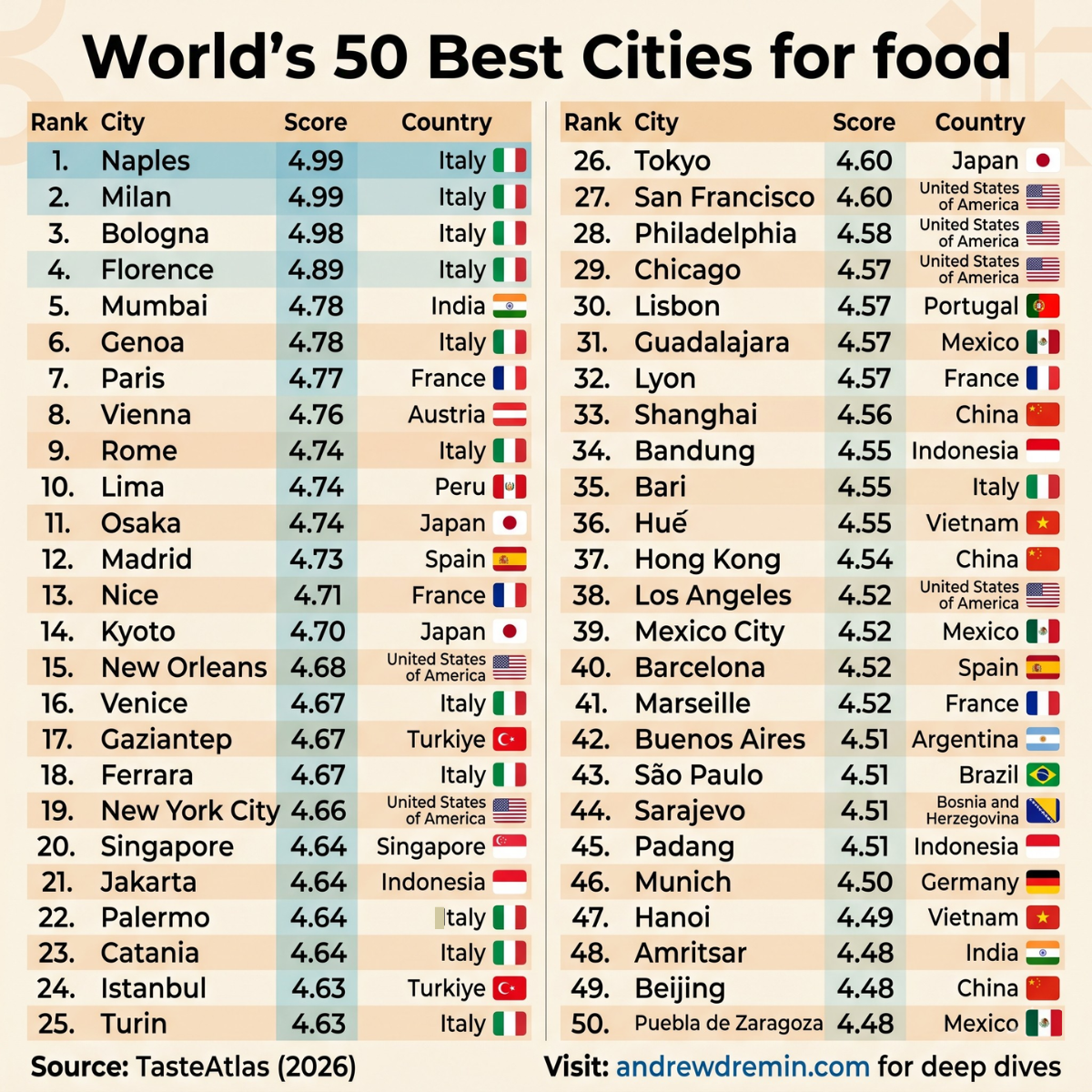
World’s 50 Best Cities for Food (TasteAtlas 2026)
| Rank | City | Score | Country |
|---|---|---|---|
| 1 | Naples | 4.99 | Italy |
| 2 | Milan | 4.99 | Italy |
| 3 | Bologna | 4.98 | Italy |
| 4 | Florence | 4.89 | Italy |
| 5 | Mumbai | 4.78 | India |
| 6 | Genoa | 4.78 | Italy |
| 7 | Paris | 4.77 | France |
| 8 | Vienna | 4.76 | Austria |
| 9 | Rome | 4.74 | Italy |
| 10 | Lima | 4.74 | Peru |
| 11 | Osaka | 4.74 | Japan |
| 12 | Madrid | 4.73 | Spain |
| 13 | Nice | 4.71 | France |
| 14 | Kyoto | 4.70 | Japan |
| 15 | New Orleans | 4.68 | United States of America |
| 16 | Venice | 4.67 | Italy |
| 17 | Gaziantep | 4.67 | Turkiye |
| 18 | Ferrara | 4.67 | Italy |
| 19 | New York City | 4.66 | United States of America |
| 20 | Singapore | 4.64 | Singapore |
| 21 | Jakarta | 4.64 | Indonesia |
| 22 | Palermo | 4.64 | Italy |
| 23 | Catania | 4.64 | Italy |
| 24 | Istanbul | 4.63 | Turkiye |
| 25 | Turin | 4.63 | Italy |
| 26 | Tokyo | 4.60 | Japan |
| 27 | San Francisco | 4.60 | United States of America |
| 28 | Philadelphia | 4.58 | United States of America |
| 29 | Chicago | 4.57 | United States of America |
| 30 | Lisbon | 4.57 | Portugal |
| 31 | Guadalajara | 4.57 | Mexico |
| 32 | Lyon | 4.57 | France |
| 33 | Shanghai | 4.56 | China |
| 34 | Bandung | 4.55 | Indonesia |
| 35 | Bari | 4.55 | Italy |
| 36 | Huế | 4.55 | Vietnam |
| 37 | Hong Kong | 4.54 | China |
| 38 | Los Angeles | 4.52 | United States of America |
| 39 | Mexico City | 4.52 | Mexico |
| 40 | Barcelona | 4.52 | Spain |
| 41 | Marseille | 4.52 | France |
| 42 | Buenos Aires | 4.51 | Argentina |
| 43 | São Paulo | 4.51 | Brazil |
| 44 | Sarajevo | 4.51 | Bosnia and Herzegovina |
| 45 | Padang | 4.51 | Indonesia |
| 46 | Munich | 4.50 | Germany |
| 47 | Hanoi | 4.49 | Vietnam |
| 48 | Amritsar | 4.48 | India |
| 49 | Beijing | 4.48 | China |
| 50 | Puebla de Zaragoza | 4.48 | Mexico |
Many international brands make this mistake. They look at Spain as one single market. It does not exist. Spain is a collection of Spain regional markets, or ‘regional retail republics’. When you manage categories from a single central office, you become blind to these regional realities.
Many international brands make this mistake. They look at Spain as one single market. It does not exist. Spain is a collection of regional retail republics. When you manage categories from a single central office, you become blind to regional realities.
Let us look at the market structure. Madrid is a battlefield for large national and international chains. High-street rents in Madrid hit around €245 per square meter. Retailers there must push high-margin, premium, gastro-retail experiences to survive. The Madrid consumer buys into this lifestyle. They want heavy, traditional, premium options on the shelf. They spend money on food as a weekend experience or a formal social event.
Barcelona and the wider Catalonia region operate differently. The market here is a defensive fortress. It is dominated by powerful regional giants like Bon Preu, which does over €2.1 billion in local sales. Add Caprabo and Condis to the mix. These regional players have deep, generational loyalty. A consumer in Reus or Barcelona trusts Bon Preu because it feels local and familiar. They buy from people who speak their language and understand their regional calendar.
Furthermore, Barcelona’s retail ecosystem shifts faster toward functional quick commerce, urban convenience formats, and tourist-heavy profiles. The city lifestyle demands speed. The typical urban worker in Barcelona wants healthy, fast, and international options. If you try to sell the exact same heavy, traditional premium assortment in both cities, you waste capital. You burn your shelf space.
Italy holds the top four spots: Naples, Milan, Bologna, and Florence. Why does Italy dominate this ranking? It is not just because the food tastes good in restaurants. It is because Italian retailers know how to commercialize heritage. They standardize local culinary culture into powerful private labels.
In Milan, a traditional regional recipe is quickly turned into a high-quality, beautifully packaged supermarket brand. In Naples, small local producers are integrated directly into the regional supply chain of major store networks. They do not dilute the quality. They scale the identity. Spanish retailers often fail here. We either keep products purely local and small, or we industrialize them until they lose their soul.
There is also a supply chain trap. Many FMCG brands run everything through a central warehouse in Madrid. They ship products to Catalonia from hundreds of kilometers away. This adds cost. It adds time. More importantly, it kills the “local” connection. When a regional chain like Bon Preu looks at your product, they check the origin. If your logistics are entirely centralized in Madrid, you lose flexibility. You cannot adapt to quick local trends or regional micro-seasons.
To fix this mismatch, you must change your operational model. Here are four steps you can take immediately:
1. Split your regional P&L completely
Stop aggregating your Spanish sales numbers into one spreadsheet. Separate Catalonia from Madrid. Track the margins independently. High-street operational costs differ. Your pricing tiers must reflect these regional realities.
2. Rebuild the shelf layout by city mission
Your category management cannot be uniform. Give Barcelona stores more space for quick-convenience, healthy, and international lines. Focus on the busy urban worker and the tourist. For Madrid, protect the space for traditional, premium, and experience-driven gastronomy.
3. Fight local with local sourcing
If you want to win space on Catalan shelves, look at your supplier network. Shift a percentage of your sourcing to local producers. Use this local identity in your marketing. Do not rely solely on national branding.
4. Test with a 3-month regional pilot
Do not launch a product nationally based on data from one city. Run an isolated 3-month pilot in Catalonia. Measure the rotation. Understand the regional barriers before you invest in national supply chain scaling.
The TasteAtlas ranking is a symptom of a deeper structural truth. Madrid and Barcelona require separate retail mindsets. If your regional sales are dropping, stop blaming macroeconomics. Look at your assortment.
Related posts:
 European Retail Self Checkout Shrinkage 2026: 22% Loss
 Tesco and Football championship
 Inditex Q1 2026 Performance
 Poland’s Growth Engine is a Margin Trap
 The €3.90 Gourmet Threat: How Supermarket Meal Kits are Disrupting Fast Casual Dining
 GLP-1 Retail Impact: How Weight-Loss Drugs Are Shrinking Supermarket Sales