The cross-border game is changing. If your entire strategy is to sit back and wait for the new EU small parcel tax to level the playing field, you are dreaming. My direct, professional opinion is that this tax reform is not the solution many traditional retailers believe it to be. If you do not adapt right now, you will lose. The game has already shifted, and your competitors are years ahead.
Last year, the equivalent of 46 mega-container ships, fully loaded with nothing but small parcels, arrived from China in the EU. Think about that for a second. 4.6 billion small parcels are not just packages; they are an economic flood that changed the very structure of global logistics. In the old days, any package under €150 imported from outside the EU was duty-free under the ‘de minimis’ rule. This rule created cross-border giants by giving them a powerful, built-in pricing advantage over local brands that had to pay all local taxes on every item. That rule is dead.
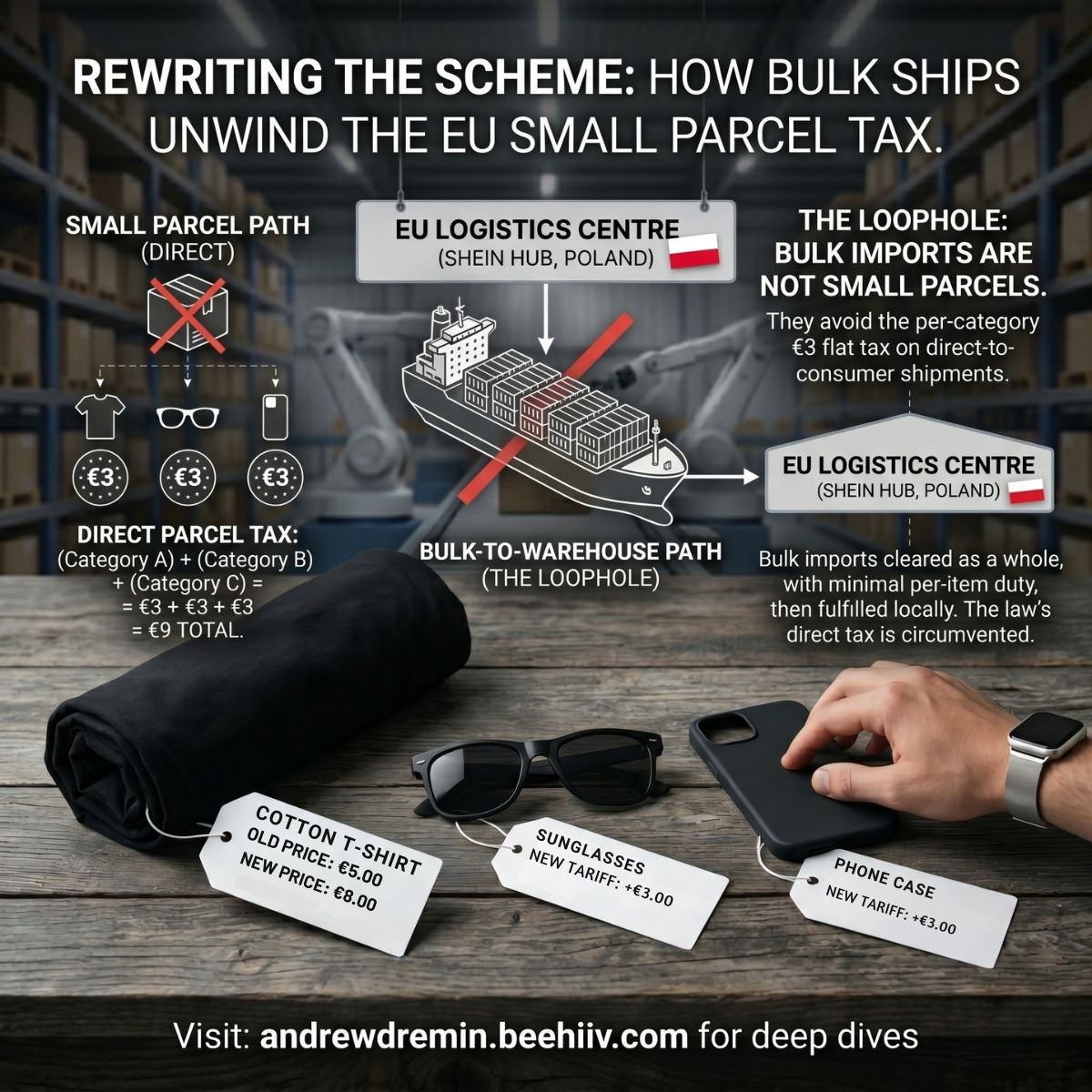
As of July 1st, 2026, the game is different. The EU introduced a flat €3 customs duty fee per item category, not per parcel. This distinction is critical and it is shown perfectly in the image I’ve included with this post. On the left side of the diagram, you see the path: a single parcel with a T-shirt, sunglasses, and phone case (three distinct categories) is hit with a €3 + €3 + €3 tax penalty. This mixed-cart model, which cross-border giants mastered, is now commercially dead for direct, small-parcel shipping from outside the EU. If you only order three of the exact same shirt, it is just one category fee. But a direct mixed shipment is crushed by the variety, not the volume. This is how the direct-import path gets closed.
But this is where your traditional competitors are wrong. European retail CEOs and politicians are smiling. They think this tax will kill Shein and Temu’s model. In a recent conversation with a retail consulting client who owns a chain of apparel stores, I had to be blunt: “Do not play the pricing game. The giants are not going anywhere. They saw this coming years ago. They are changing their supply chains. If you raise your prices, thinking you are now ‘fairly taxed’, you are just handing them more market share on a silver platter. They are lowering their fulfillment costs by coming inside.” He was stunned. Traditional brands are about to get hit with faster delivery, not higher competitor prices.
The competition has already pivoted. They are moving inside our borders. The diagram in the image shows the new logistical reality: “HOW BULK SHIPS UNWIND THE EU SMALL PARCEL TAX.” They are moving to a bulk-to-warehouse path (the loophole). Explain this logically: bulk imports are not cleared as direct-to-consumer parcels. They clear customs as large, containerized wholesale shipments, subject to standard tariffs (like 12% for clothing, or lower depending on the classification) based on the wholesale price, not the retail price. Wholesale prices are much lower. When a €5 T-shirt is imported in a bulk container, the actual per-item duty paid to get it into an EU hub is minimal (a few cents). They then pay the final local EU VAT when the product is sold and fulfilled locally from that same EU hub. The giants bypass the entire mixed-parcel direct tax logic.
Look at the specifics. Shein has already fully scaled a massive, automated 740,000 square meter logistics hub in Wrocław, Poland. To give you scale, that is equivalent to nearly 100 football pitches. This is not a warehouse; it is an industrial machine designed for massive B2C fulfillment. They are already domestic. Similarly, Temu is launching its ‘local-to-local’ model out of key logistics anchors like Rotterdam and Frankfurt. They are not shipping from China; they are shipping from your neighboring country. They target domestic fulfillment reaching up to 80% of European sales. They change their supply chains faster than governments can pass laws.
For traditional retailers and FMCG companies, the advice is simple: speed and efficiency are your only strategy. A local warehouse is no longer a strategic advantage. It is a baseline requirement. If your local fulfillment network takes three days to ship an order within your own city, and your competitor can do it from a regional hub in 24 hours with local carrier partners, you have failed. The advantage of being “local” means nothing if you are slower than a multinational logistics machine.
FMCG guys, listen: your distribution network is outdated. You are still thinking in B2B pallets. You need to think in B2C units. Your entire logic of distribution needs to look more like the automated hubs of your competition in Poland. Focus on supply chain optimization. The time to wait for regulators is over. I rechecked the facts on these hubs and the market activity. This shift is not a prediction; it is happening right now in real time.
The loophole has been closed, but the competitor has already logically and physically unwound that tax and is now in your market. They are your new local competitor. Stop waiting for Brussels and start working on your local speed and distribution efficiency. The cross-border era is dead. The domestic war for speed and actual brand value has begun.


Leave a Reply