
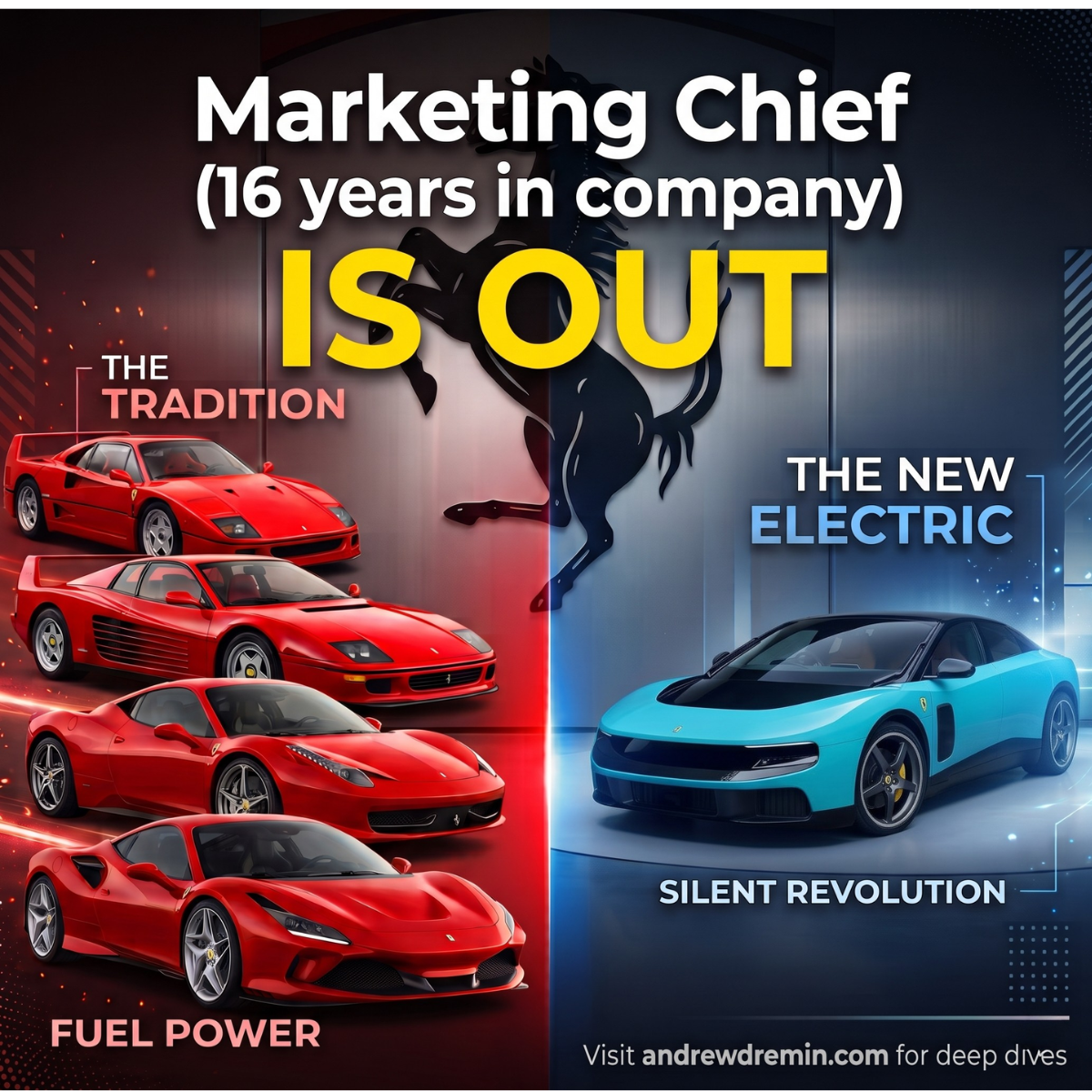
$4 billion in market value gone in 48 hours.
This is the exact price of a bad launch strategy.
Ferrari revealed its first electric car, the €550,000 “Luce.” The stock market reacted instantly, and the company value dropped. Days later, Enrico Galliera was out. He was Ferrari’s Chief Marketing Officer for 16 years.
Corporate PR calls it a “career transition.” Let’s speak plainly: this is classic damage control. The board needed someone to blame, and the marketing chief is always the easiest target.
But Galliera did not design the car. He just became the shield for a bad product strategy.
The Main Problem: You Cannot Sell a €550,000 “iPhone on Wheels”
Ferrari does not sell basic transportation. Ferrari sells status, emotion, and a loud, aggressive engine sound. That V12 roar is the main reason why people pay half a million euros.
When you take the engine away, you change the whole product category.
The internet reaction was instant and brutal. People looked at the new design and called it an “iPhone on wheels.”
This is a massive risk for a luxury brand:
- Tech gadgets get old very fast and lose value.
- Mechanical art stays valuable and grows in price.
By removing the traditional engine and focusing too much on technology, Ferrari made their car look like a temporary gadget. The luxury valuation broke completely.
The Launch Mistake: Hiding the Experience
The design was a risk, but the launch execution was a total failure.
Ferrari invited journalists to see the car, but banned them from driving it. They put a strict embargo on driving tests. Ferrari basically told their richest buyers: “Trust us. Buy it without knowing how it feels.”
This is a critical error. When you change a core product completely, you cannot hide it.
The modern media landscape hates a vacuum. If you do not give people facts and real test results, they will fill the gap with jokes, memes, and criticism. Ferrari stayed silent for 48 hours, letting the internet control the story. The $4 billion loss was the direct result of that silence.
C-Suite Reality: Tech CEOs vs. Traditional Buyers
To understand why the marketing chief was fired, look at the leadership dynamic.
Ferrari’s CEO, Benedetto Vigna, comes from the semiconductor industry. His background is chips, data, and technology. He is the one driving the electric transition.
But a tech-minded CEO often looks at data and misses human emotion. The marketing team was forced to sell an electric vehicle to traditional buyers who hate electric vehicles.
When the market panicked, the CEO did not step down. The marketing chief took the hit. That is how corporate reality works.
Takeaways for Retail and FMCG Brands
This is not just an automotive story. It is a clear lesson for any consumer or retail brand that wants to change a legacy product line.
- Give instant proof on day one: If you change your product formula, your taste, or your packaging, let people test it immediately. Do not hide it. Real experience stops negative rumors.
- Protect the product’s soul: Every premium brand has one non-negotiable feature. If you must remove it, you must replace it with another powerful emotion. A quiet, shiny gadget cannot command a premium price.
- Silence is dangerous: Do not think that keeping secrets creates excitement. During a big brand pivot, silence looks like fear. Transparency is your only defense.
The Bottom Line
Ferrari tried to make a massive technological leap but forgot why people buy their cars. They hid the product, the market panicked, and a veteran executive lost his job.
Are you planning a big product change or a brand pivot? Do not leave your buyers in the dark.
