
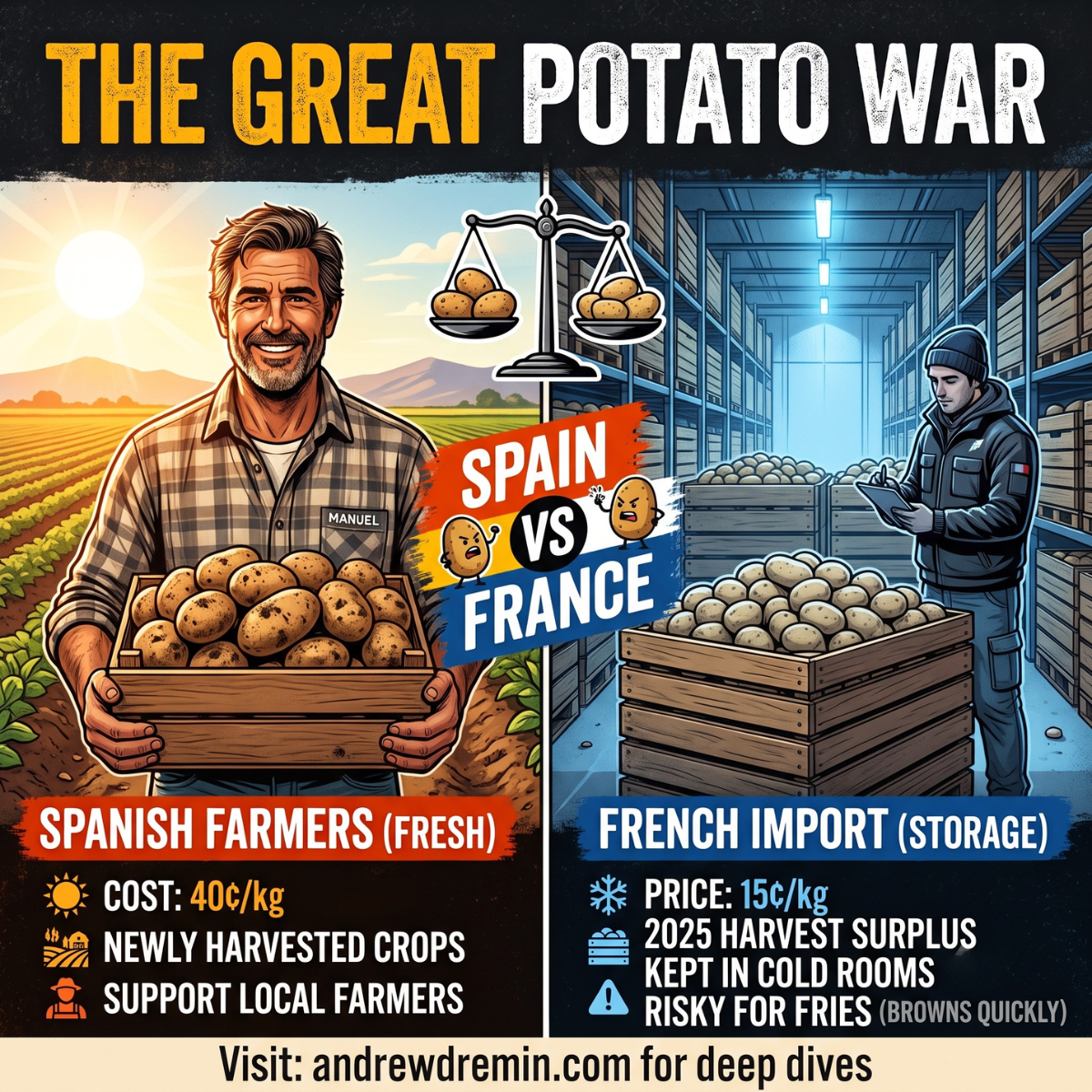
15 cents per kilo. That is the price of imported French potatoes in Spanish wholesale markets today.
At the same time, Spanish farmers face a completely different reality. They need at least 40 cents per kilo just to cover their basic production costs.
Let’s look at the math clearly. This is not a small variation. The local Spanish production cost is 166% higher than the price of the French import. For a wholesale buyer or a large restaurant purchasing manager, the spreadsheet shows a clear option. The French option looks like a massive cost reduction. But if you make this decision purely on price, you are walking into a major operational trap.
According to recent data from the Spanish agricultural union COAG, wholesale operators and hospitality suppliers are buying thousands of tons of last-season surplus from France. These are not fresh potatoes. These are leftovers from the 2025 harvest. They have spent many months inside industrial cold storage rooms.
Meanwhile, fresh, newly harvested Spanish crops in regions like Murcia are left in the fields. Farmers like Manuel are literally letting their crops rot in the dirt. Why? Because they cannot compete with old storage crops. If a Spanish farmer sells at the market price of 15 cents, he loses up to €150 per ton. It is economically smarter for him to destroy the crop than to harvest it, pack it, and transport it for nothing.
As a retail and sourcing consultant, I see many commentators call this a simple case of “corporate greed” or a “mistake.” But as business leaders, we need a deeper analysis. This is not a simple mistake. The reality is that the French potato is a perfect choice for one business model, and total destruction for another. The entire problem comes down to the chemical structure of the product and how your kitchen cooks it.
The Cold-Induced Sweetening Paradox
When you keep a potato inside a cold storage room at 2°C to 4°C for several months, its biology changes. The potato enters a survival state. It begins a process called cold-induced sweetening.
Inside the potato, the complex starches naturally break down and convert into reducing sugars, specifically glucose and fructose. The potato becomes structurally different from a fresh potato.
This chemical transformation creates a major operational dilemma for the food industry. The value of the product changes completely depending on the cooking temperature.
1. The Frying Problem (High-Heat Disaster)
When you drop these old storage potatoes into a deep fryer or a hot pan with oil, the temperature goes above 170°C. At this temperature, the high level of reducing sugars reacts violently with the amino acids inside the potato. This is the Maillard reaction, but it happens at maximum speed.
The result is an immediate visual and quality defect:
- The outside of the potato burns and turns a dark, muddy brown or black color almost instantly.
- The inside remains hard and undercooked because the outside burned too fast.
- The flavor becomes bitter and acrid because of the burnt sugars.
- The potato loses its structural integrity, absorbs too much oil, and becomes soggy.
If you operate a restaurant chain, a tapas bar, or a hotel in Spain, and your menu relies on patatas bravas, classic French fries, or the iconic tortilla de patatas, this potato is completely useless. If you serve a dark, bitter, soggy tortilla to your customers, you destroy your brand image. Customer trust disappears immediately. In this specific application, buying the 15-cent French potato to save money is a critical mistake.
2. The Boiling Loophole (Low-Heat Efficiency)
Now let’s look at the exact opposite scenario. Take the same 15-cent French storage potato and put it in a pot of water to boil, steam, or stew.
Water boils at 100°C. At this temperature, the physics change completely. The heat is not high enough to trigger the fast Maillard reaction. The sugars do not burn, and the potato does not turn black. Instead, the excess sugars simply dissolve into the cooking water or blend smoothly into the dish.
The potato cooks normally. The small increase in sweetness is easily covered by adding salt, butter, garlic, or the natural fats from meat and vegetables.
If you are an industrial caterer, a hospital kitchen manager, a school cafeteria provider, or a manufacturer of ready-made canned stews and frozen purées, the customer will never see or taste the difference. For these business models, the potato is structurally “good enough.”
The Breakdown of Sourcing Risk
To make a professional decision, a procurement leader must look at the product through an operational risk matrix:
| Final Product | Cooking Method | Temperature | Visual/Taste Risk | Sourcing Decision |
| French Fries / Bravas | Deep Frying | 170°C+ | Critical (Black color, bitter taste) | Must buy local fresh (40¢) |
| Spanish Tortilla | Pan Frying | 160°C+ | High (Uneven browning, poor texture) | Must buy local fresh (40¢) |
| Mashed Potatoes / Purée | Boiling / Steaming | 100°C | Low (Minor sweetness, easily masked) | Buy French storage (15¢) |
| Industrial Stews / Soups | Long Boiling | 100°C | Negligible (Sugars dissolve in broth) | Buy French storage (15¢) |
The Structural Corporate Blind Spot
Why do we see so many quality crises in restaurants and retail chains during these market situations? The answer is simple: the procurement silo.
In many medium and large food companies, the purchasing department operates completely separate from the kitchen operations or quality control teams. The purchasing manager sits in front of an Excel spreadsheet. His primary key performance indicator (KPI) is “cost per kilo” or “sourcing savings.”
When the French suppliers offer massive volumes at 15 cents, the buyer sees a major victory. He wins his bonus, signs the contract, and celebrates.
But the spreadsheet does not understand organic chemistry. The spreadsheet does not know about cold-induced sweetening. The buyer treats “potato” as a generic commodity code.
The crisis happens two weeks later when the stock arrives at the restaurants. The kitchen staff tries to fry them, the product fails, customers send plates back to the kitchen, and the brand reputation suffers. The short-term margin profit is completely eaten by the operational loss and the drop in customer visits.
This is a classic corporate blind spot. Cheap sourcing always has a hidden cost if you do not understand the technical limits of the raw material.
The Strategic Lesson for Retail and HORECA Leaders
The professional takeaway from this potato war is not that “cheap sourcing is always bad” or that “local sourcing is always good.” That is a sentimental argument, not a business argument.
The real lesson is that procurement cannot work in a silo. You must use a strategy of supply chain segmentation based on application.
If your brand identity or menu relies on the concept of “freshness,” “crispiness,” or “traditional quality,” you cannot let an Excel spreadsheet dictate your sourcing. You must pay the 40 cents for local, fresh Spanish crops. It is an insurance policy for your brand equity.
But if your final product is an industrial potato soup, a budget school puree, or a processed ready-meal, forcing your supply chain to buy premium fresh potatoes is a waste of money. In that case, utilizing the 15-cent French storage surplus is a completely logical, responsible cost optimization.
Stop buying raw materials purely by name and price. Segment your supply chain by how the product is cooked.
What is your experience with this? Do you see procurement departments ruining product quality to hit short-term cost targets in your sector?
Drop your thoughts below.
Related posts:
 Почему Tesco уходит из Центральной европы?
 The €3.90 Gourmet Threat: How Supermarket Meal Kits are Disrupting Fast Casual Dining
 Inditex Q1 2026 Performance
 Эспрессо против энергетика: почему регуляторы убивают алюминиевые банки и что делать FMCG
 The Supermarket That Wants to Be a Restaurant
 Ikea’s marketing football move
Leave a Reply