
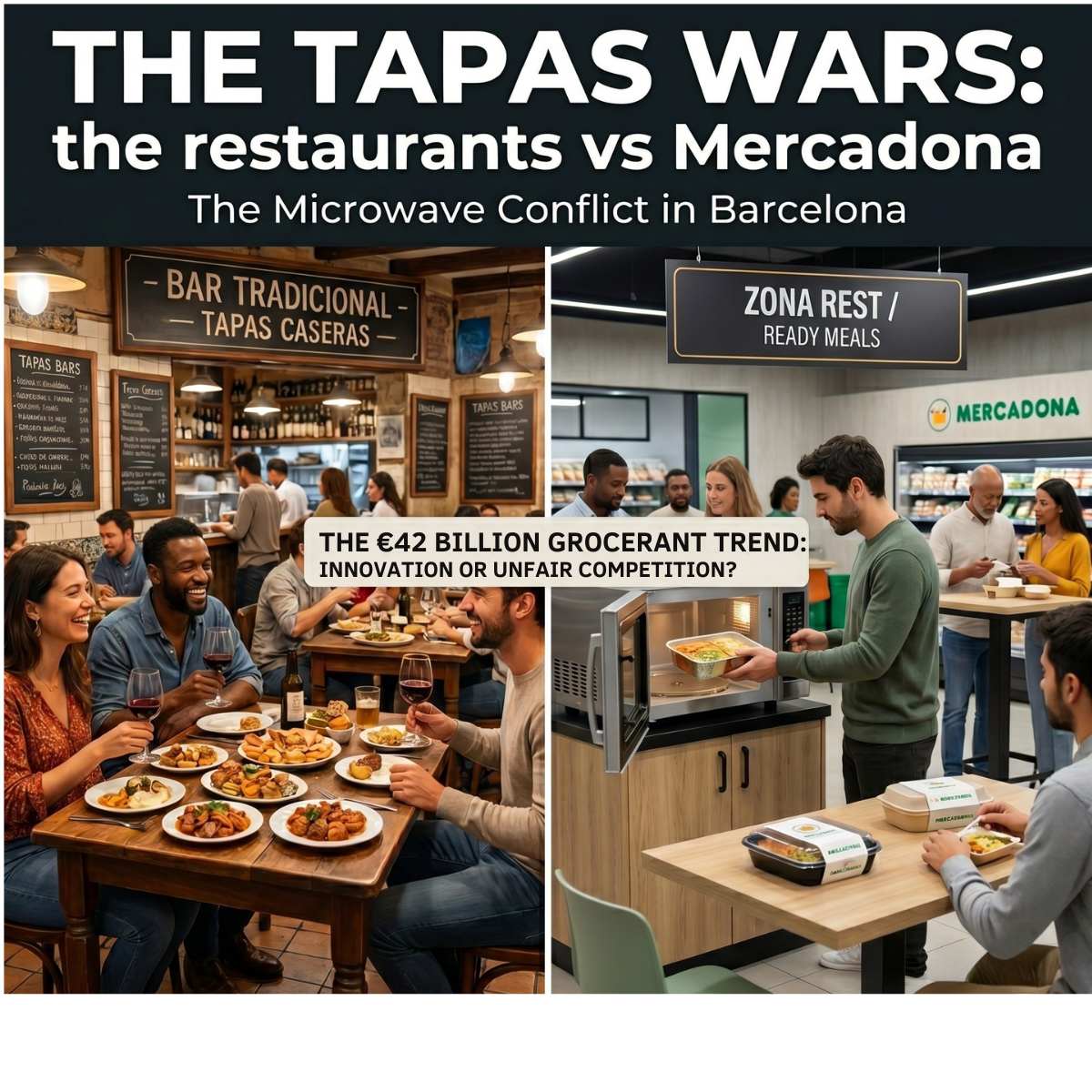
€42 billion in annual revenue is not enough for Mercadona. They want a piece of the restaurant business too. But local bars are fighting back, sparking a significant retail hospitality conflict.
Think about Carlos. He is an office worker in a high-rent district. A standard restaurant lunch – the traditional menú del día – now easily costs him €15 due to high raw material costs and inflation. At Mercadona, he walks to the Listo para Comer counter, buys a ready-to-eat hot meal for €5, heats it up himself in the store microwave, and sits down. For Carlos, this is an unbeatable economic hack, driven by the compelling consumer convenience price.
The legal technicality here is highly specific. According to the Barcelona municipal ordinance for food retail, the space located between the checkout counters and the street exit cannot host any active commercial activity or hospitality service. Mercadona is setting up these dining zones exactly in that gray area. Some of these spaces are large, accommodating 30 to 40 people. It is not just a basic bench to wait for a taxi; it is a low-cost cafeteria operating under a standard grocery store license.
The Economic Split: Carlos vs. The Neighborhood Bar
Think about Carlos. He is an office worker in a high-rent district. A standard restaurant lunch – the traditional menú del día – now easily costs him €15 due to high raw material costs and inflation. At Mercadona, he walks to the Listo para Comer counter, buys a ready-to-eat hot meal for €5, heats it up himself in the store microwave, and sits down. For Carlos, this is an unbeatable economic hack.
But look at the microeconomic reality downstairs. The traditional family-run bar is losing its livelihood. These small establishments survive on tight margins and the predictable routine of local lunch traffic. When a corporate giant uses massive purchasing power to sell a €5 lasagna next to a free microwave station, a neighborhood bar cannot match the price. The Guild argues this trend destroys the local commercial fabric.
However, you cannot fight consumer macro-trends with nostalgia. Ready-meals and grocerants are surging because the average worker has less disposable income and less time. Data shows that in 2025, the combined revenue from Mercadona’s prepared and fresh takeaway food sectors reached nearly €3 billion. This scale makes them a direct competitor to major fast-food chains and local traditional bars alike.
The T9 Operational Architecture: Industrializing the Floor
This push into dining spaces is not a random marketing experiment. It is a structural labor and operational play. Mercadona is currently rolling out its new “Tienda 9” (T9) model across Spain. The T9 strategy marks a fundamental shift: the supermarket transitions from being organized by independent “departments” (separate fishmongers, butchers, counters) to being organized strictly by “processes.”
The operational engine of this model is the Obrador Central (central workshop) built directly inside the store. Instead of having separate staff cutting meat, preparing fish, and handling the Listo para comer station at different counters, the store centralizes these preparation and packaging tasks into a single workspace.
This change allows Mercadona to streamline internal logistics, reduce empty movements by employees, and radically slash in-store labor requirements. Traditional staffed counters are replaced by lineales de libre servicio (self-service shelves). By adding adjacent dining spaces to this automated setup, Mercadona captures high-margin cafeteria revenue while removing the traditional operational overhead of running a full-service kitchen.
Regulatory and Labor Arbitrage
The real battleground here isn’t about food safety or simple restaurant taxes. It is a calculated play on zoning licenses and labor frameworks.
Opening a real restaurant in a major Spanish city requires complying with strict municipal hospitality regulations. You need specific smoke extraction systems, dedicated emergency exits, public toilets calculated by seating capacity, and complex accessibility infrastructure. Mercadona completely avoids these capital-intensive structural requirements by operating under its baseline retail grocery authorization.
More critically, this allows them to bypass the strict provincial hospitality collective bargaining agreements (convenios colectivos de hostelería). These agreements impose rigid wage scales, higher premiums for weekend work, limits on split shifts, and explicit overtime tracking.
Mercadona’s staff operates entirely under the retail commerce framework. The worker cleaning the table or restocking the microwave is a retail employee, not a hospitality professional. By serving hot food using a cheaper retail labor framework, Mercadona secures a structural cost advantage that no traditional restaurant can match.
Global Precedents and the FMCG Mandate
Look abroad. Whole Foods Market implemented this exact integration in the United States decades ago, filling stores with salad bars and large seating areas. Carrefour does it across France with dedicated ready-to-eat spaces. The convergence of grocery and food service is a global macroeconomic reality.
But Spain has incredibly rigid local regulations and aggressive regional guilds. You cannot bypass municipal ordinances indefinitely with clever semantic definitions like “rest zones.” The legal wall is real, and city councils will eventually have to draw a hard line where retail ends and hospitality begins.
My conclusions for the Retail and FMCG sectors:
- Regulatory Risk is Structural: Blurring the lines between retail licenses and hospitality labor agreements will bring direct conflict with local guilds and city councils. Companies must calculate the cost of prolonged legal battles when entering adjacent service sectors.
- FMCG Packaging Must Evolve for Autonomy: The grocerant model relies on zero-staff operation. Brands must design products specifically optimized for instant, unattended, in-store microwave consumption. This means self-venting lids, integrated heat guards so consumers do not burn their hands walking to the table, and materials that handle commercial microwave power variations perfectly.
- Convenience and Price Always Win: You can sue a supermarket chain, you can fine them, and you can force them to remove chairs. But you cannot legislate consumer behavior. You cannot force a cost-conscious worker back to a €15 menú del día when their wallet permits only a €5 alternative.
Is Mercadona exploiting a clear regulatory loophole, or are traditional bars simply failing to compete on convenience?
Related posts:
 The €3.90 Gourmet Threat: How Supermarket Meal Kits are Disrupting Fast Casual Dining
 Inditex Q1 2026 Performance
 The Ghost Wall: Why Mercadona is Killing the Fish Counter
 Ikea’s marketing football move
 Tesco and Football championship
 The Billion-Dollar Illusion: How a Fake Movie Parade Transformed Global Retail and Tourism