
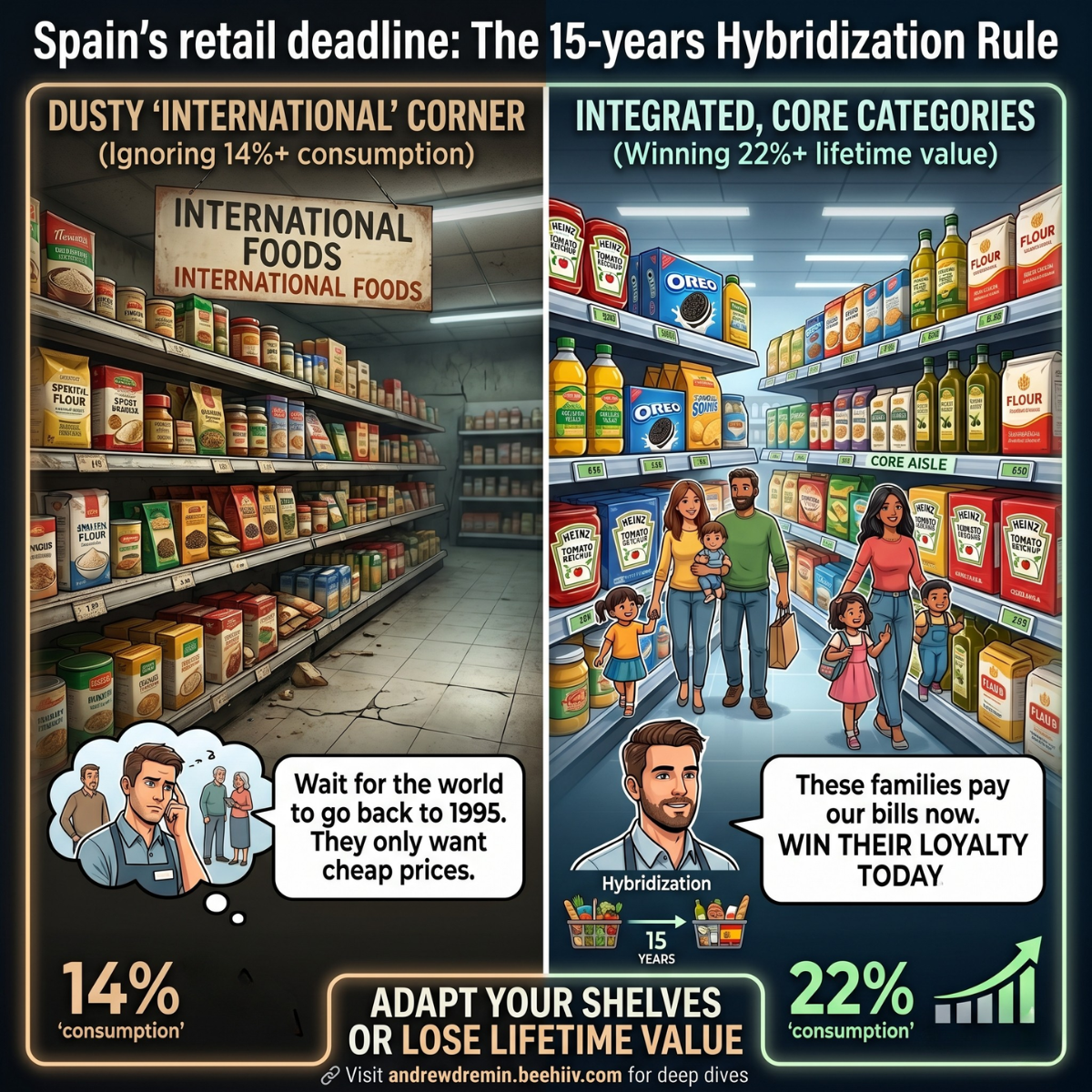
14% of all supermarket sales in Spain now come from foreign-born shoppers.
In ten years, that number will reach 22%. That is according to reports from Moncloa. That is one in five customers walking through the doors.
But if you walk into most Spanish supermarkets today, you do not see this reality reflected on the shelves. They still hide international food in a tiny, dusty “exotic corner.” Usually, it is a single rack near the back of the store. The products carry a 40% markup. The jars have dust on them because the turnover is so low.
This is a huge mistake. And it loses money every single day.
I heard the complains from a mid-sized retail chain. The management was sitting in a boardroom, stressing over stagnant sales in three specific urban districts. They showed me their spreadsheets. They blamed the economy. They blamed inflation. They blamed local competitors cutting prices on standard items like milk and eggs.
My advice to them was very direct: “Stop looking at the spreadsheet for a minute. Look at your parking lot. Look at who walks into your store. Look at who lives in the apartment buildings across the street.”
These neighborhoods have shifted completely. The demographics are different from ten years ago. A huge portion of his shoppers are now from Latin America, North Africa, and Eastern Europe.
These people are not walking in to buy premium Spanish ham or local olive oil. That is simply not their daily diet. They need bulk rice in 5-kilo bags. They need specific types of legumes. They look for halal meats, plantains, or certain spices they cannot find in his standard aisles.
And it is not just food. These same demographics spend heavily on premium personal care brands. They will buy Dove, Pantene, Colgate. They spend real money, but they spend it differently than the traditional local customer.
Here is the exact mechanism of how supermarkets lose cash in this situation. If you are not serving their core daily needs, these customers do not just buy their staple items somewhere else and come to you for the rest. No. They go to the small, independent “locutorios” or ethnic grocery shops nearby.
Once they are inside that small shop to buy their specific spices or flour, they buy their vegetables there. They buy their meat there. They buy their cleaning supplies there.
You do not just lose the sale of a three-euro bag of rice. You lose the entire weekly shopping basket. They take all their cash with them. The supermarket is left trying to sell traditional products to a shrinking pool of traditional locals, wondering why revenues are dropping.
We do not need to guess the solution. In the UK, supermarkets like Tesco and Sainsbury’s realized this a decade ago. They looked at the demographic numbers and adapted their physical spaces. They did not just add a “world food” shelf with an overpriced bottle of hot sauce and call the job done.
They integrated global staples right into the main aisles. If a specific neighborhood has a high South Asian population, the large bags of basmati rice and cooking oils sit right next to the standard baking flour. They made it easy to buy. Store managers have the autonomy to adjust inventory based on the exact postal code. They made the store reflect the street outside.
In Spain, we are still treating immigrant shoppers like tourists passing through. We keep their daily needs in a neglected corner. Or worse, we ignore them completely and expect them to adapt to our shelves. They will not do it. They will just go where they are served properly.
Retailers need to listen to this. This is not about corporate “diversity” initiatives. It is about math. It is about holding market share.
- Kill the ‘Exotic’ Tag: Stop putting useless labels on food. If 20% of your neighborhood wants a specific product, it is not exotic anymore. It is core inventory. Move it to the main shelf. Give it prime eye-level space. Treat it like your best-selling pasta.
- Use Global Anchors: Immigrant shoppers often arrive in a new country and look for familiar sights. They trust global brands they recognize from home. They look for Heinz, Coca-Cola, Oreo, or Pringles. You use these items as anchors. You stock them to pull the customer in. You build trust and loyalty early with products they know are exactly the same everywhere in the world.
- Fix Private Label: They buy “marca blanca” heavily. But they buy it for value, not just because it is cheap. The quality of your store brand needs to convince them. If your private label matches their budget and delivers solid quality, they will return every week.
And then you have to remember the 15-year rule. Consumer habits change over time. Data shows that after 15 years in Spain, half of an immigrant family’s shopping basket aligns with local Spanish tastes. The second generation grows up eating local food mixed with their home food.
This means the window to capture their loyalty is at the very beginning. If you win them when they arrive by providing their staples, they keep shopping with you as their tastes merge with the local culture. If you do not win them early, they form a habit of going to the independent shops. You lose their lifetime value. You lose the parents, and eventually, you lose the kids too.
The retail landscape is shifting fast. The numbers are clear. 22% is a massive segment you cannot ignore.
Are you adapting your shelves to the reality of the streets, or are you waiting for the world to go back to 1995? Because 1995 is not coming back.
Related posts:
 All posts
 The Billion-Dollar Illusion: How a Fake Movie Parade Transformed Global Retail and Tourism
 The €3.90 Gourmet Threat: How Supermarket Meal Kits are Disrupting Fast Casual Dining
 Inditex Q1 2026 Performance
 European Retail Self Checkout Shrinkage 2026: 22% Loss
 A Strategic Portfolio Analysis of the 2026 FIFA World Cup Contenders