
Executive Summary
The business world is going through a massive change in 2026. Traditional boundaries between different industries are completely disappearing. Companies are no longer asking how to sell more in their own category. Instead, they are asking what other services they can offer. A discount supermarket like Lidl now sells mobile phone plans, and its parent company runs a cloud computing business for governments and hospitals. In the United States, Amazon and Walmart are using weight-loss medicines to get deeper into the healthcare business. At the same time, banking apps like Revolut are turning into “super-apps” where you can buy almost anything. However, mixing different businesses doesn’t always work perfectly, as seen when the cheap clothing brand Shein tried to open a physical store in a high-end Paris mall. This report explains how shopping apps, customer data, and new technology are changing the rules of global business.
The Trojan Horse Strategy: Loyalty Apps
The most valuable thing a store has today is its loyalty app. In the past, these apps just gave out discount coupons. Now, apps like Lidl Plus have over 100 million active users all over the world. Because millions of people open the app every week, Lidl can offer new services—like phone plans—without spending millions of dollars on advertising. Their cost to get a new customer is almost zero.
The Lidl Plus loyalty program also changes how many points a shopper gets based on what they buy, which gives Lidl very valuable data about how people shop. They are even testing a new service where customers can reserve products in the app before they go to the physical store. By putting many different services into one app using flexible software called “mini-apps,” traditional stores are turning into powerful digital platforms.
Physical Stores Pay for Digital Growth
To build these huge digital platforms, companies need a lot of money. They get this cash from their large physical store networks. The Schwarz Group, which owns Lidl and Kaufland, is a great example. They made 175.4 billion euros in 2024. They have about 595,000 workers and over 14,200 stores worldwide.
Lidl alone made 132.1 billion euros and is still building new stores. For example, they announced a 600 million pound plan to open 50 new stores in Great Britain and build new warehouses. The Schwarz Group even makes its own plastic bottles and manages its own recycling business. This massive physical business gives them the money and the internal computer power they need to grow their new digital businesses.
Supermarkets Selling Phone Plans
The mobile phone business is changing. Traditional phone companies are focusing more on big businesses instead of regular consumers. This creates a big opportunity for Mobile Virtual Network Operators (MVNOs). These are companies that sell phone plans but don’t own the actual cell phone towers.
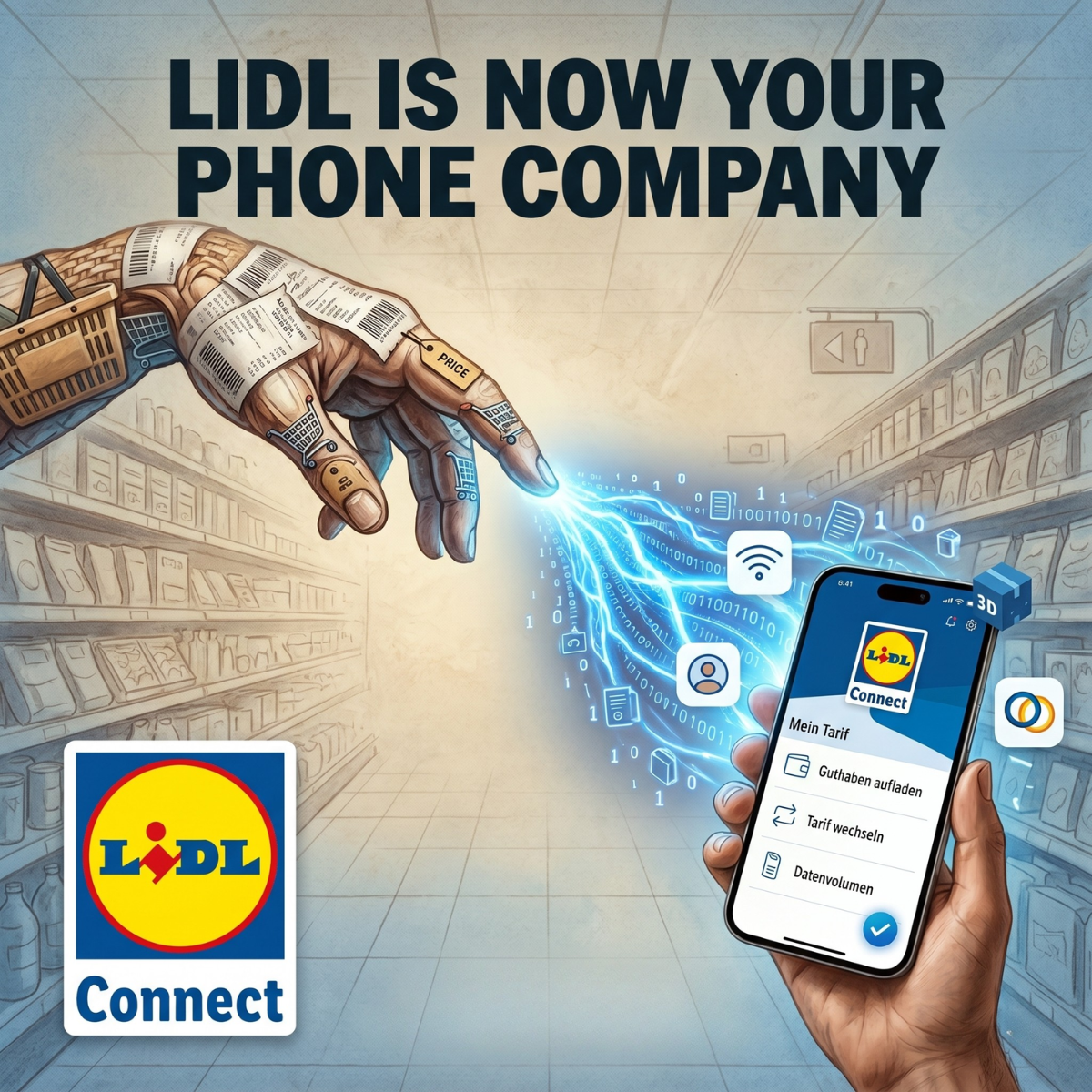
Lidl is taking advantage of this. They signed a big deal with a company called 1GLOBAL to sell mobile phone plans directly inside the Lidl Plus app in up to 30 countries. Customers can just buy a digital SIM card (eSIM) directly in the app without going to a phone store. This is very dangerous for traditional phone companies because Lidl already has 100 million users and doesn’t need to spend extra money to find new customers.
From Supermarket to Cloud Provider: Schwarz Digits
The most amazing change is the rise of Schwarz Digits. Originally, the Schwarz Group built its own computer servers and cybersecurity software just to run its grocery stores. Now, they are selling these computer services to other companies and governments.
Because European countries want computer systems that are kept safe inside Europe (called “digital sovereignty”), Schwarz Digits has become very successful. In 2026, they partnered with the German government to build a secure computer cloud for public offices. They are also working with defense companies to keep military data safe. In healthcare, they created a new company with the Charité hospital in Berlin to safely store patient data for medical research. They are even investing 11 billion euros in a new AI data center. A company that started by selling cheap groceries is now protecting national security and stopping cyberattacks.
The Healthcare Land Grab
In the United States, Amazon and Walmart are fighting over the healthcare market. They are using popular new weight-loss drugs (called GLP-1s) to get regular customers. Because patients have to take these drugs for a long time, the stores can build long-term relationships with them.
Amazon is putting new weight-loss pills in its physical health clinics and offering same-day delivery for medicine to thousands of cities. Walmart is using its thousands of physical pharmacies to offer a total health package. They connect patients with diet coaches and doctors on their computers, and even guide them to buy healthy food in their stores. By controlling the patient’s whole health journey, these stores can collect very valuable data and make a lot of money on other products.
Banks Becoming Stores: Revolut
While stores are adding digital services, digital banks are adding store services. Revolut is a huge digital bank that made 2.3 billion dollars in profit in 2025 and has over 65 million users. They recently opened a full bank in Mexico and plan to reach 100 million users soon.
But Revolut is much more than a bank now. Inside their app, you can book hotels, buy eSIM phone plans, and shop for products. They are also helping businesses easily hire and pay workers in other countries. Revolut is even using advanced Artificial Intelligence (AI). Their AI can talk to customers and automatically buy things for them online using a new Google payment system. This means the bank app becomes the main place where people shop, taking power away from regular store websites.
When Categories Clash: Shein in Paris
Even though the digital world is blending together easily, trying to force different physical businesses together can fail. In late 2025, the cheap online clothing brand Shein opened a permanent physical store inside the famous BHV Marais mall in Paris.
It was a total disaster. While many people came during the first week, they were shocked to find that the clothes were much more expensive in the physical store than they were online. Premium luxury brands didn’t want to be near Shein and pulled their products out of the mall. The mall also lost a major 300 million euro real estate deal because of the bad reputation. This event proves that you cannot just mix a cheap digital brand into a premium physical space without serious problems.
Advertising and Energy
Retailers are also becoming powerful in other areas like advertising and energy. Because stores know exactly what people buy, they sell advertising space on their websites and in their stores. This is called a Commerce Media Network (CMN), and it is growing extremely fast.
At the same time, energy companies are acting more like technology companies. They have to manage smart power grids, electric cars, and huge computer data centers. To do this, they are partnering with tech companies to upgrade the power grid using artificial intelligence.
What This Means for the Economy
Physical stores are still important, but their main job has changed. A store might actually lose money selling products, but the company keeps it open because it acts as a shipping center or a great place to show advertisements. Automation and AI are helping companies run these stores with fewer, higher-skilled workers.
The world is also dealing with higher prices. Tariffs (taxes on imported goods) have made many products more expensive, which makes it harder for consumers to afford things. Finally, technology is changing global politics. Companies like Schwarz Group are now important players in national defense because they control the computer systems that governments rely on.
Conclusion
The biggest business story of 2026 is that traditional business categories no longer exist. Companies can no longer survive by just doing one thing well. The company that owns the app you look at every day has the power to sell you anything – from groceries to phone plans to bank accounts. Companies must expand into new areas and become “super-apps,” or they will be swallowed up by their competitors.
Related posts:
 The Supermarket Grocerant Trend: Why Retailers Are Stealing Restaurant Profits
 Tesco and Football championship
 Retail Margin Protection: 4 Brutal Strategies to Survive Cheap Imports
 GLP-1 Retail Impact: How Weight-Loss Drugs Are Shrinking Supermarket Sales
 The Billion-Dollar Illusion: How a Fake Movie Parade Transformed Global Retail and Tourism
 Poland’s Growth Engine is a Margin Trap