
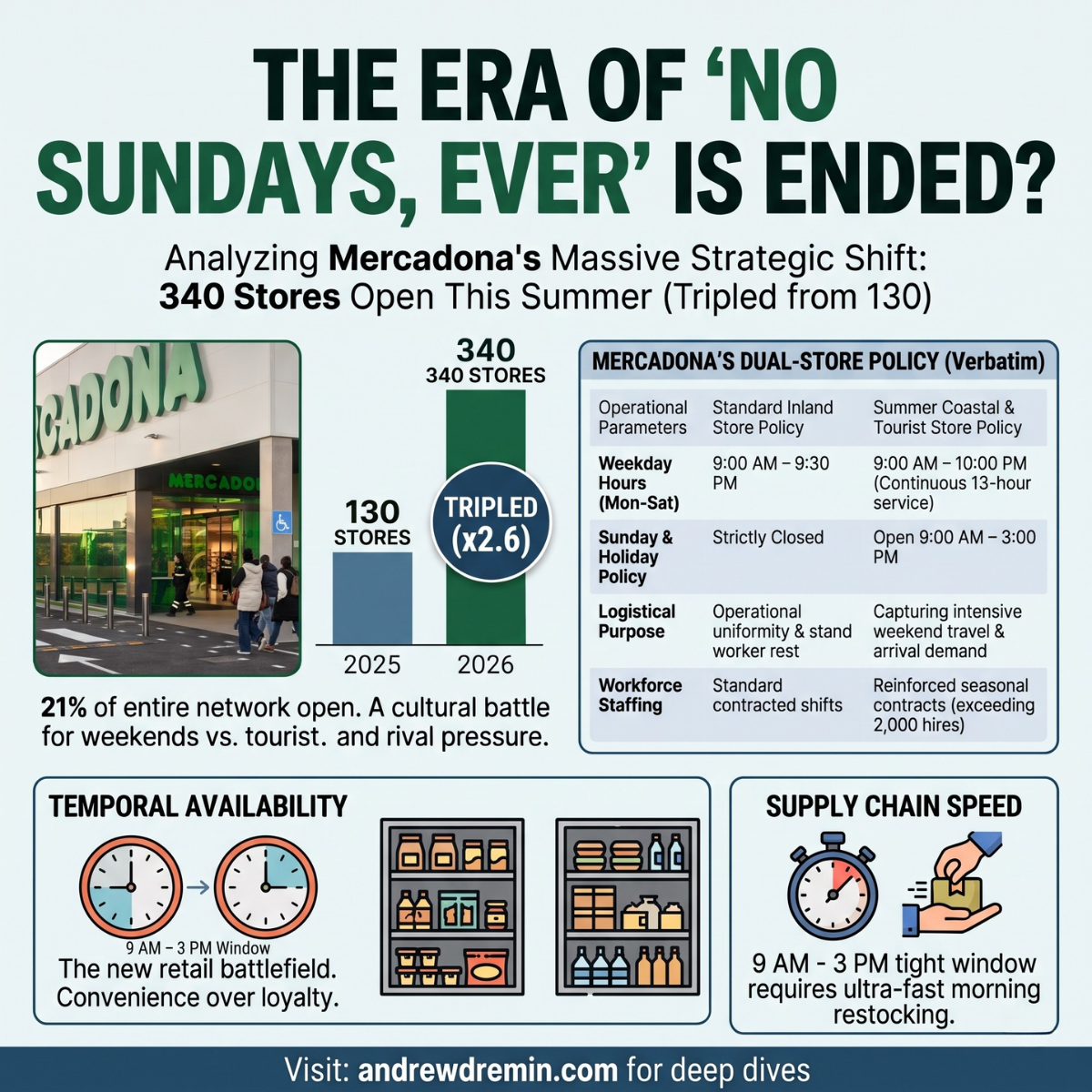
340. That is the exact number of stores Mercadona is opening on Sundays this summer. Last year, it was only 130. They basically tripled it. This is a radical shift for a company that used to treat its operational calendar like holy scripture, signaling a significant Spanish retail market shift.
But the economic reality is different. The growing tourist demand in coastal regions means tourists landing on late Saturday flights need to buy food immediately. They do not want to wait until Monday morning.
Opening from 9 AM to 3 PM is a very tight window. Six hours total. You cannot have store staff blocking the narrow aisles with big wooden pallets of stock while hundreds of tourists are rushing to buy food. This necessitates significant supply chain adaptation in retail, as the entire internal logistics system must adapt to this short shift.
And there is another reality. Every Sunday in coastal towns, I saw queues at Charter (the franchise stores of rival Consum ). Families waiting in the heat just to buy milk and bread. Mercadona was losing millions to them every single Sunday.
“Temporal availability” is the new retail battlefield.
Why the Rule Broke Now
Why did Mercadona abandon a corporate rule they defended for decades? It is pure economic math. When you are the market leader with over 25% market share in Spain, you cannot leave easy money on the table for your competitors. They are the default choice for millions of Spaniards, but defaults can be disrupted if you are not accessible.
In coastal regions, the summer season drives the revenue for the entire year. If you close your doors for 24 hours every single week during these peak months, you give your rivals a free pass.
I watched this happen myself in coastal villages. When Mercadona is closed, the local Charter or Carrefour Express stores are completely packed. Customers do not care about retail branding or corporate loyalty when they need cold water, fresh milk, or bread at 11 AM on a Sunday. Hunger and heat destroy brand alignment every single time. They just want a store that has an open door. By staying closed, Mercadona was not just losing that specific Sunday sale. They were actively training their loyal customers to try and trust their rivals. Habits change fast when friction appears.
The Internal Friction
We must also look at the internal conflict. This strategy creates serious tension inside the company. Spanish workers value their weekend rest highly, and unions are actively organizing protests outside some locations. For a brand that prides itself on having a stable, well-paid workforce, this is a major reputation risk. They spend years building an employer brand, and a sudden shift like this can damage it fast.
But market pressure beats internal comfort. Juan Roig had to choose between keeping a traditional corporate culture or adapting to the hard reality of global tourism. He chose the market reality. The lesson here is clear: your internal culture cannot survive if it ignores the external demands of your paying customers.
Takeaways for Retailers and FMCG
1. Convenience Beats Loyalty
Many retail executives believe their brand loyalty is an unbreakable shield. They think customers will wait until Monday morning because they prefer their specific store layouts. This is a dangerous illusion. If you are closed when the customer arrives, you do not exist to them.
Convenience is the ultimate currency in modern retail. A consumer with an immediate need has zero patience. If a competitor solves their problem while you are closed, you lose that wallet share instantly. Over time, that Sunday habit eventually bleeds into their weekday shopping routine.
2. Supply Chains Must Speed Up
Opening from 9 AM to 3 PM is a very tight window. Six hours total. You cannot have store staff blocking the narrow aisles with big wooden pallets of stock while hundreds of tourists are rushing to buy food. The entire internal logistics system must adapt to this short shift.
You need ultra-fast morning restocking to avoid empty shelves. The delivery trucks must arrive at the store in the middle of the night, and the shelf-replenishment must be completed with military precision before the doors open at 9 AM. If you run out of fresh items like meat or water at noon, your Sunday opening becomes a financial failure. Your fixed labor costs stay high, but you have nothing left to sell.
3. Surgical Scaling
Mercadona did not open all their stores across Spain. They did not implement a lazy, nationwide corporate policy. They targeted high-demand tourist zones on the coast while keeping inland stores completely closed. Your operational calendar must be local, not national. Every location needs its own P&L simulation.
Opening a supermarket in the center of Madrid or Valladolid on an August Sunday makes zero financial sense because the cities are empty. Everyone went to the beach. But opening in Benidorm, Torrevieja, or Marbella is highly profitable. You must use local data, foot traffic statistics, and seasonal population shifts to decide your schedule. Never use a copy-paste approach for your business hours.
4. The Labor Cost Penalty
Sunday labor in Spain is highly regulated and expensive. You must pay higher hourly premiums or give workers alternative rest days during the week. This means your operational cost per hour spikes significantly on the seventh day.
To make a Sunday profitable, your sales volume per hour must be double or triple that of a regular weekday. Mercadona ran the mathematical simulations and saw that the high volume in tourist zones covers this penalty. If the math does not work, staying closed is a competitive advantage. Calculate the exact tipping point where customer volume clears the labor cost hurdle before you change your schedule. Do not open just for vanity.
The Structural Impact on FMCG Brands
If you supply products to these retailers, this shift changes your business too. You cannot maintain a simple Monday-to-Friday production and shipping schedule if your biggest client is emptying their shelves on Sunday afternoon. You become part of the bottleneck if you sleep on weekends.
FMCG brands must adapt their delivery windows to match this new reality. If a supermarket sells out of your product on Sunday, you must be ready to restock them early Monday morning. If your own supply chain is slow, you will lose your premium shelf space to more agile competitors who can deliver on tight schedules. Temporal availability forces the whole chain to accelerate.
Conclusion
Mercadona was the last big defender of the traditional Spanish Sunday rest. Their pivot proves that modern retail cannot afford to ignore consumer friction. The market does not care about your historical dogmas or your old rules. If your customers change their lifestyle, your business model must change with them immediately.
Do you consider your business is opened on Sundays? Tell me your thoughts.
How to find Mercadona’s store which works on Sunday:
Use the official store locator to find which branches are open.
Steps via the Mercadona Website
Check the Opening Hours & Holidays section. Open stores will list specific Sunday operating hours (often marked with special holiday schedules or abierto tags for the upcoming Sunday). If a store is closed, the Sunday row will explicitly state “Closed”.
- Go to the official Mercadona supermarket locator: mercadona.es/en/supermarkets.
2. Enter your postal code, city, or allow browser geolocation.
3. Select the specific store from the list or map.
Mercadona is capturing market share from the restaurant sector by disguising in-store food courts as free “rest areas.” Barcelona restaurateurs are suing, accusing the retail giant of bypassing hospitality regulations and labor agreements. What wins out: municipal zoning laws or the consumer need for a €5 lunch? Read the full breakdown of the retailer’s operational strategy.


