
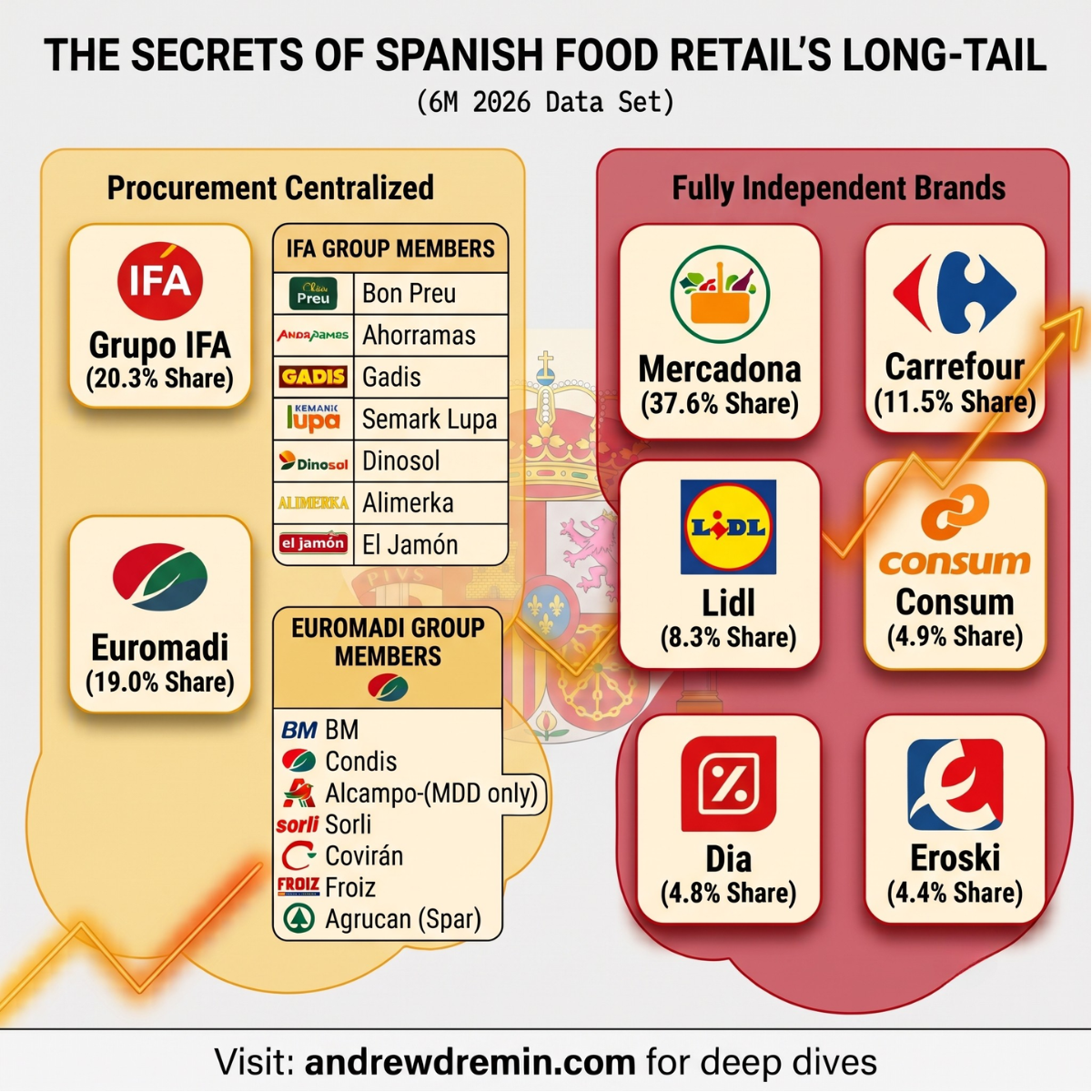
A few followers asked me recently why Spain still has such a massive long tail of small retailers Spain. They see the data, they look at the dominance of large chains across Europe, and they ask how these regional players actually survive against the national giants. Here is the detailed explanation.
For Analysts: Stop looking only at store counts and national market share. Track the backend. Track the procurement contracts. The real leverage shifts in European retail are happening in alliance movements, like Uvesco shifting to Euromadi. If you miss the backend, you misunderstand the retail market dynamics.
For FMCG brands: Stop defaulting your entire trade budget to Carrefour. It is lazy account management. You must map out the regional heavyweights inside IFA and Euromadi. Adjust your pack sizes, assortments, and promotions to fit the regional food cultures those specific stores serve. Do not push a flat national FMCG brand strategy. Negotiate the master terms with the alliance, but execute the category management locally.
The first baseline is culture. Spain is not a single unified food market. It is a collection of strong regional food cultures with highly localized consumer preferences. A customer in Catalonia buys different staples and expects a different assortment than a customer in Andalusia or the Basque Country. National chains struggle to adapt to this micro-level demand efficiently.
Look at Maria in Asturias. She goes to buy fresh fish and local meat at Alimerka every day. Alimerka stocks exactly what her specific region eats. They know the local suppliers. They know the exact cuts of meat the region prefers. On paper, Alimerka has only a 0.7% national retail share. You might think they are insignificant. But locally, in their core region, they hold a massive 31% share. They dominate Mercadona and Carrefour in that specific area because of this hyper-local fresh food focus and established trust.
But fresh food is only half the store. A retail client asked me recently: “Fresh food is fine, but how does a 0.7% shop get cheap prices from Coca-Cola or Procter & Gamble? They should be destroyed on price in the dry goods section.”
The secret is the split between retail share and purchase share.
If Alimerka goes to Coca-Cola alone, they get a bad price. They have no volume leverage. But in the negotiation room, they do not go alone. They use Grupo IFA.
Grupo IFA is a central buying alliance. They aggregate the purchasing power of dozens of these regional chains. IFA generates €45.5 billion in revenue. When IFA sits at the table with multinational FMCG brands, they control 20.3% of all manufacturer brand purchases in Spain. Because of this aggregated volume, Alimerka gets the exact same wholesale discount as Mercadona. The local shop on the corner operates with the purchasing power of a national giant.
It is the exact same structure for Euromadi. Euromadi is the other major alliance in the Spanish market. They manage €34 billion in turnover and control a 19% share of FMCG purchases. Furthermore, Euromadi does not stop at the Spanish border. They are backed by EMD, which is a €184 billion European buying alliance.
When you walk down the street in Spain and see tiny shops like Gadis, Lupa, Ahorramas, or Coviran, do not make the mistake of thinking they are weak. The storefronts look independent and small. But on the backend, they are backed by procurement monsters.
This creates a highly effective hybrid survival model. The regional retailer uses their local knowledge to win the perimeter of the store: the fresh fish, the bakery, the meat counter, the local vegetables. Then, they use the central buying alliance to neutralize their cost disadvantage on the center-store: the dry goods, the cleaning supplies, the global FMCG brands. It is a functional shield against international discounters like Lidl and Aldi.
But the chess board is currently shifting. These alliances are not static.
In May 2026, we saw a major move. Uvesco, a regional player with €1.2 billion in sales, left IFA. They decided to join Euromadi instead. Catalonian chains Condis and Sorli made the exact same move.
Why is this happening? Because retail margins are shrinking. Inflation pressure, labor costs, and intense price competition are forcing retailers to optimize every single cent. They negotiate hard not just with suppliers, but with the alliances themselves. They move to whoever offers better backend conditions, superior logistics integration, or better data sharing agreements. The backend is consolidating fast. Fewer buyers at the very top are controlling more volume, even if the shops on the street stay exactly the same.
If you work in FMCG, retail, or distribution, you need to adjust to this reality.
Takeaways:
- For FMCG brands: Stop defaulting your entire trade budget to Carrefour. It is lazy account management. You must map out the regional heavyweights inside IFA and Euromadi. Adjust your pack sizes, assortments, and promotions to fit the regional food cultures those specific stores serve. Do not push a flat national strategy. Negotiate the master terms with the alliance, but execute the category management locally.
- For Retailers: Do not try to copy Lidl. You cannot win a price war on dry goods without their international scale. If you try, you will destroy your margin. Defend the perimeter. Invest in your fresh meat, local fish, and regional produce. Build consumer trust there. Then, plug into a central buying alliance to protect your center-store pricing.
- For Analysts: Stop looking only at store counts and national market share. Track the backend. Track the procurement contracts. The real leverage shifts in European retail are happening in alliance movements, like Uvesco shifting to Euromadi. If you miss the backend, you misunderstand the market dynamics.
Are you adjusting your distribution strategy to account for these hidden regional monopolies, or are you still just fighting the national giants?
Related posts:
 The €3.90 Gourmet Threat: How Supermarket Meal Kits are Disrupting Fast Casual Dining
 A Strategic Portfolio Analysis of the 2026 FIFA World Cup Contenders
 The Supermarket Grocerant Trend: Why Retailers Are Stealing Restaurant Profits
 All posts
 The most reliable car brands in 2026 US
 Inditex Q1 2026 Performance