
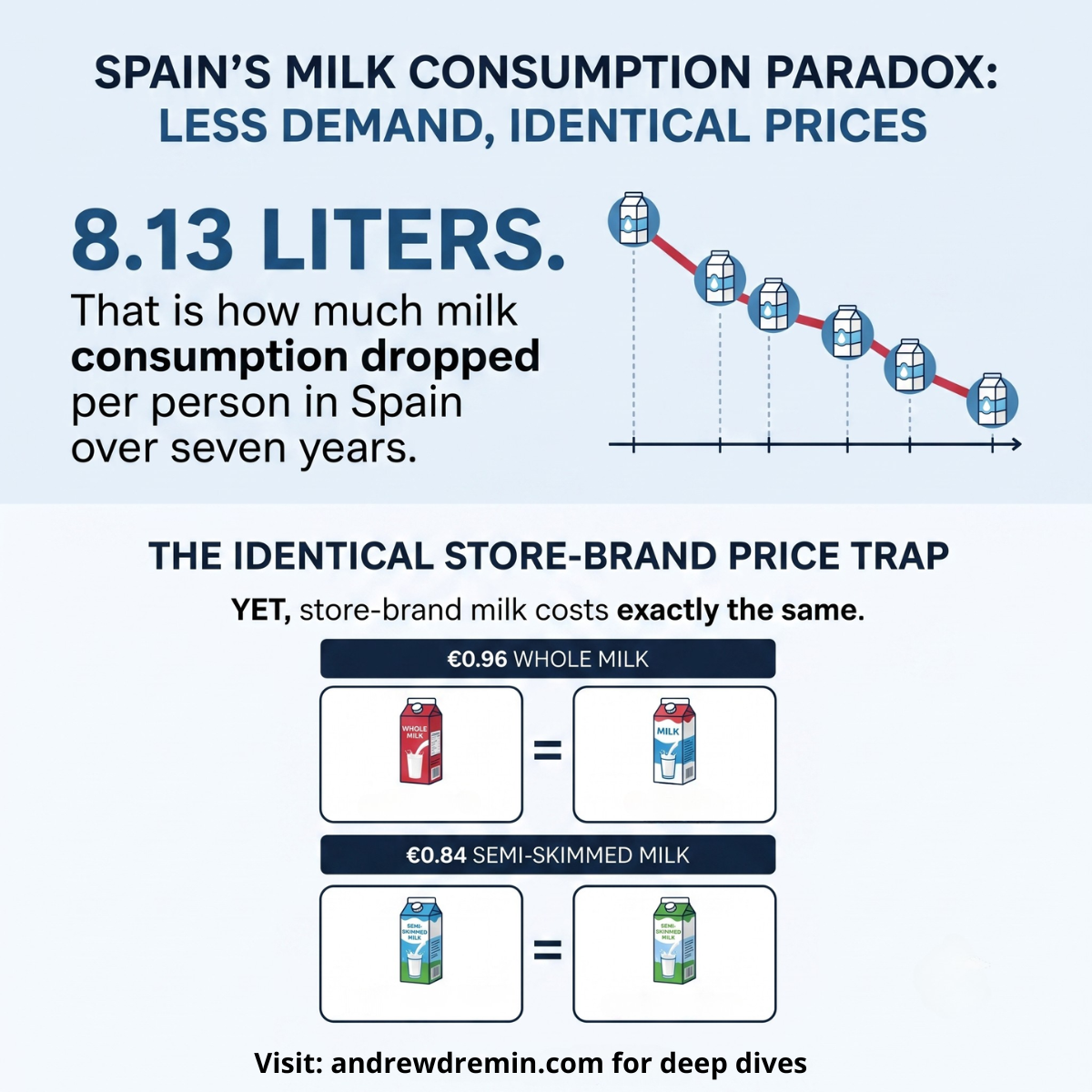
8.13 liters. That is how much milk consumption dropped per person in Spain over seven years.
The data from the Ministry of Agriculture is clear. People are drinking less dairy. They buy plant-based alternatives, they skip traditional breakfast, or they cut down on shopping expenses. Basic economic theory says that when demand drops this fast, sellers must compete. You would expect price wars, sudden discounts, and aggressive moves to win the remaining customers.
Yet, go to any major supermarket in Madrid or Barcelona today. Walk into a Mercadona store, Carrefour, Dia, or Lidl. The store-brand milk costs exactly the same across the board. €0.96 for a one-liter carton of whole milk. €0.84 for semi-skimmed.
It does not matter which logo is on the store door or which website you check. The price tag is frozen.
The Illusion of Collusion
Many shoppers and politicians see this absolute uniformity and think of a conspiracy. They assume retail executives meet secretly in hotel rooms to fix prices and exploit the public.
But the reality is different, and for the industry, it is worse. There are no secret meetings. Retailers do not need them anymore. Instead, they use automated web scrapers and dynamic pricing software.
These bots crawl competitor websites every few minutes. If Carrefour drops its price by one cent, Mercadona’s system detects it immediately and matches it. If Lidl shifts its price, Dia responds before the store manager even notices.
The Spanish antitrust regulator (CNMC) calls this “conscious parallelism”. It is completely legal. If you just follow the market leader using public data, you are not breaking the law.
However, this automation creates an operational trap:
- It eliminates human strategy: Decisions are outsourced to code.
- It creates a rigid price grid: No chain dares to move first because the others will match it instantly.
- It destroys profitability: The price locks at the lowest possible level, turning standard milk into a zero-margin product.
Strategy 1: Create Algorithmic Noise
If you want to protect your business, you must stop feeding the bots the exact data they want.
Dynamic pricing algorithms are built on strict matching rules. They look for direct equivalents to compare apples to apples. In the dairy sector, the universal benchmark is the 1-liter Tetra Brik. It is the perfect anchor point for comparison engines.
To beat the software, you must break the matching rule. You do this by changing your physical format.
Disrupt the 1:1 Matching Rule
Instead of packing your product in the traditional 1L carton, introduce 1.2-liter or 1.5-liter plastic bottles. When a competitor’s scraper scans your digital shelf, it cannot make an immediate comparison with their own 1L store-brand price. The algorithm gets confused. It flags your item as a different category or requires manual intervention from a human manager.
This delay breaks the automated race to the bottom. It gives you the operational room to set your own price based on actual costs, not on what your competitor’s bot decided five minutes ago.
Strategy 2: Shift to “Margin Shield” Products
Standard milk is dead money. It has become a commoditized utility, like tap water or electricity. Trying to extract a healthy margin from standard whole milk in the current Spanish market is a lost cause.
The solution is to change your shelf allocation. You must aggressively move your inventory toward premium, value-add segments. These act as your “Margin Shields.”
Product Category     | Price Variance Between Chains
---------------------|------------------------------
Standard White Milk  | 0% (Strictly Matched)
Specialty/Functional | 16% (Room for Margin)
Look at specialty milks: lactose-free, calcium-enriched, high-protein, or goat milk. While standard milk has zero price variance between chains, specialty products show up to a 16% price variance.
Why the Variance Exists
Consumers who buy lactose-free milk are solving a specific health need. They are not scanning the market for the cheapest survival product. They are less price-sensitive.
- The Action Plan: Reduce the space given to standard 1L bricks.
- The Target: Reallocate at least 30% of your total dairy shelf space to these high-margin, functional items.
Let your competitors destroy their margins fighting over the €0.96 standard carton. You win by capturing the premium margin on functional dairy where the bots have less influence.
Strategy 3: The Loss-Leader Hook
You must accept the market reality: basic milk is no longer a profit center. It is bait. It is a loss-leader designed for one single task – to get a human being inside the physical store or onto your e-commerce platform.
Stop trying to fix the margin on the milk itself. Instead, optimize the physical layout around it. There is a clear operational reason why milk fridges are always located at the very back of the supermarket. The retailer wants the consumer to walk past hundreds of other products before they reach the dairy aisle.
Practical Cross-Merchandising
Do not place cheap milk next to other cheap commodities. Use the high traffic of the milk section to sell high-margin items.
- Place premium coffee brands directly next to the milk display.
- Position artisanal bakery products or high-end breakfast cereals on the end-caps leading to the dairy fridges.
- Group organic syrups or premium cocoa powders on the same shelves.
If a consumer saves three cents on a carton of €0.84 semi-skimmed milk but picks up a €4.50 bag of premium ground coffee because it was placed right in front of them, the store wins. The cheap milk did its job.
The Cost to the Supply Chain
This algorithmic lockstep does not just hurt retail margins. It creates an unsustainable pressure that moves backward through the entire supply chain.
Spanish dairy farmers have faced rising costs for years – fuel, fertilizer, and animal feed. When supermarkets lock their retail prices via automated scrapers, they cannot absorb the shocks. The retailer squeezes the processor, and the processor squeezes the farmer.
By breaking the pricing algorithm through packaging innovation and strategic cross-merchandising, you do more than save your retail business. You create the financial room to pay sustainable prices to the producers at the base of the chain.
The future of retail cannot be run by passive software that copies competitors into bankruptcy. True competition requires differentiation, not automatic alignment.
How is your brand dealing with automated pricing? Are bots making real competition impossible in your sector, or have you found a way to outsmart the software?
Let’s talk in the comments.
Related posts:
 The €3.90 Gourmet Threat: How Supermarket Meal Kits are Disrupting Fast Casual Dining
 Inditex Q1 2026 Performance
 Retail Margin Protection: 4 Brutal Strategies to Survive Cheap Imports
 The Supermarket Grocerant Trend: Why Retailers Are Stealing Restaurant Profits
 Tesco and Football championship
 The Era of No Sundays, ever is ended?