
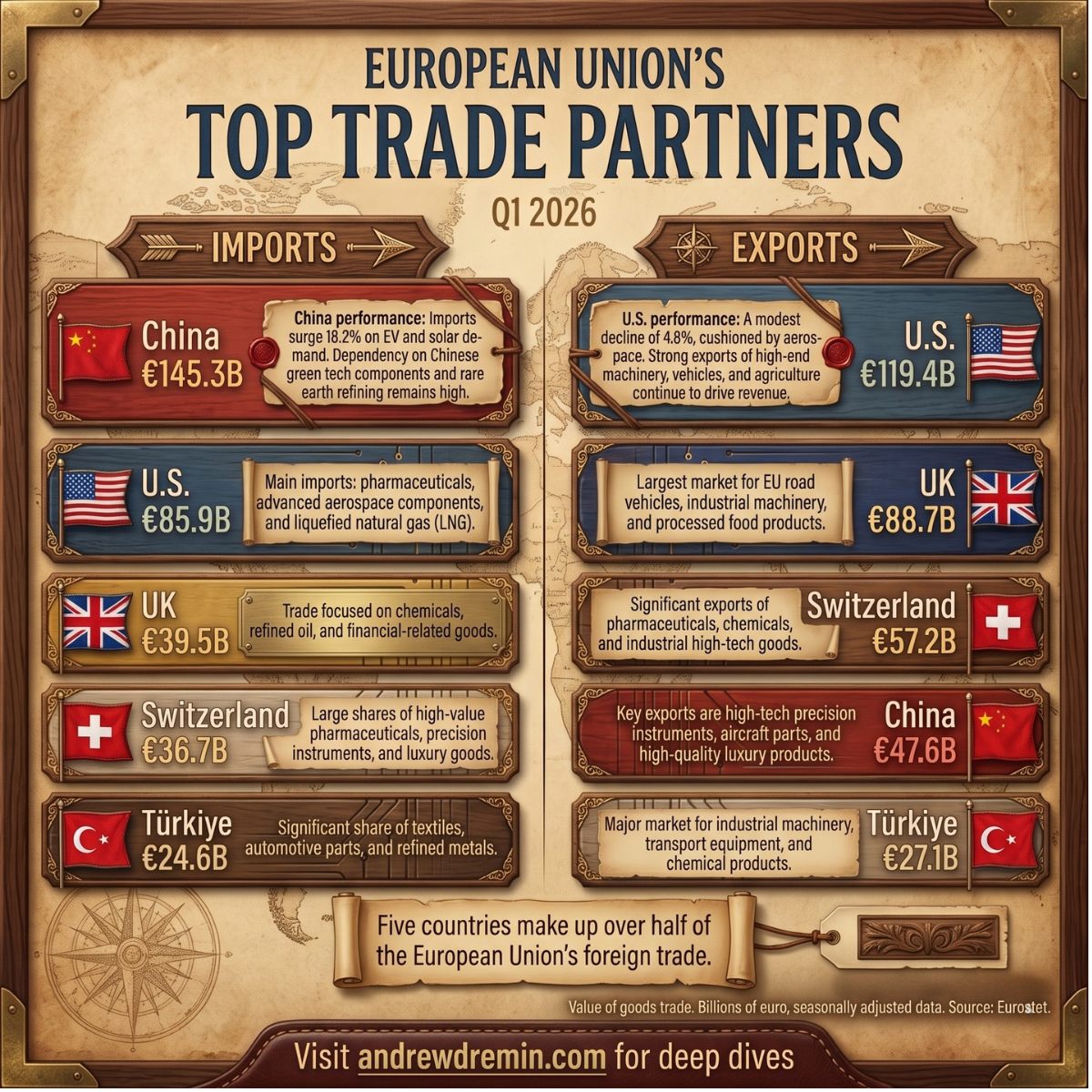
€145.3 billion. That is the exact amount of money the European Union spent on imports from China in the first quarter of 2026 alone. This massive figure highlights the importance of retail margin protection for businesses competing in global markets.
If you want to see how deep this dependency goes, look at the chart. It shows a massive 18.2% surge in imports. We are buying green tech, solar components, and cheap goods at an unmatchable scale.
Now, let us look at the controversy.
Walk into any European retail headquarters. Listen to the board meetings. Executives love to talk about sustainability. They talk about local sourcing. They print beautiful brochures about reducing the carbon footprint.
But it is mostly a corporate lie. The procurement data tells a completely different story. While we praise local farmers and regional factories in public, the retail industry relies on cheap foreign trade to keep its margins alive.
I see this reality gap every single week in my consulting work. I sit down with grocery buyers and category directors. Recently, a client of mine who runs a prominent supermarket chain showed me his regional brand data. He wanted to push local, organic choices.
But then we looked at the real human angle. We looked at a shopper named Juan. Juan is a regular family man. He wants to support local businesses. He wants to buy Spanish meat and European vegetables. But inflation has hit his household hard.
Now, Juan stands in the supermarket aisle for ten minutes. He looks at the local premium product. Then he looks at the private label item, which is 40% cheaper because the raw materials were imported. Juan cannot afford his morals anymore. His budget is broken. He takes the cheap private label.
The market is splitting into two extreme sides. The middle market is completely dead.
Look at Germany. Retail sales dropped by 2% recently. Look at the wider Eurozone, where retail sales fell 0.4% in April. High-income consumers do not care about small price jumps. They keep buying premium health items and luxury goods. But the low-income and middle-class consumers are forced to hunt for promotions.
If your retail business or FMCG brand is stuck in the middle, you are going to fail. Consumers will not save you out of loyalty.
I do not believe in marketing bluff. I believe in math. Here are four real, brutal, tactical steps that retailers and FMCG brands must take right now to survive this cheap import pressure.
1. Cut the SKU Fat Immediately Stop trying to please everyone. Retail shelves are crowded with slow-moving products that eat your capital. You need to run a zero-based assortment review. If a local brand does not hit its weekly velocity targets, drop it. Cut your total SKUs by 20% in the next two quarters. Fewer SKUs mean lower handling costs, less waste, and better warehouse efficiency.
2. Turn Private Labels Into a Shield You cannot compete with cheap international supply chains using secondary national brands. Move your store brand share toward 50% of your total shelf space. Do not make your private label look like a cheap copy. Make it the default choice for essentials. Focus on basic items where the customer refuses to pay a brand premium.
3. Run Ruthless Procurement Reviews Stop accepting automatic price increases from your mid-tier local suppliers. If your local suppliers cannot optimize their own operations, you cannot fund their inefficiencies. Tell them the truth. If they cannot match market realities, you will shift your sourcing to international markets that offer better economies of scale. It sounds harsh, but losing your margin is harsher.
4. Eliminate Flat Discounts Standard price promotions are destroying retail P&Ls. Stop throwing 20% discounts at the whole market. Use your loyalty data to give targeted discounts to price-sensitive shoppers like Juan. Let the high-income shoppers pay the full price. This protects your cash flow while keeping your core volume stable.
The times of easy growth are gone. The trade data proves that money is flowing out, and domestic retail volume is shrinking. You cannot fix a broken P&L with a new marketing campaign or a sustainability slogan. The consumer wants value they can feel in their wallet.
This is the exact restructuring work I do when I consult with retail clients. We stop the corporate talk, we look at the shelf math, and we make hard decisions about suppliers and products.
Is your current procurement strategy strong enough to survive this market squeeze? Or are you still hoping that consumers will pay more just to be nice?
Let me know your real thoughts in the comments. Let us have an honest conversation.
Traditional retail is celebrating the new EU parcel tax too soon. While European brands hoped customs fees would crush Shein and Temu, these giants already moved their logistics inside Europe to bypass the rules via bulk import. Why relying on regulators is a strategic trap, and how to survive the new domestic war for speed.

