
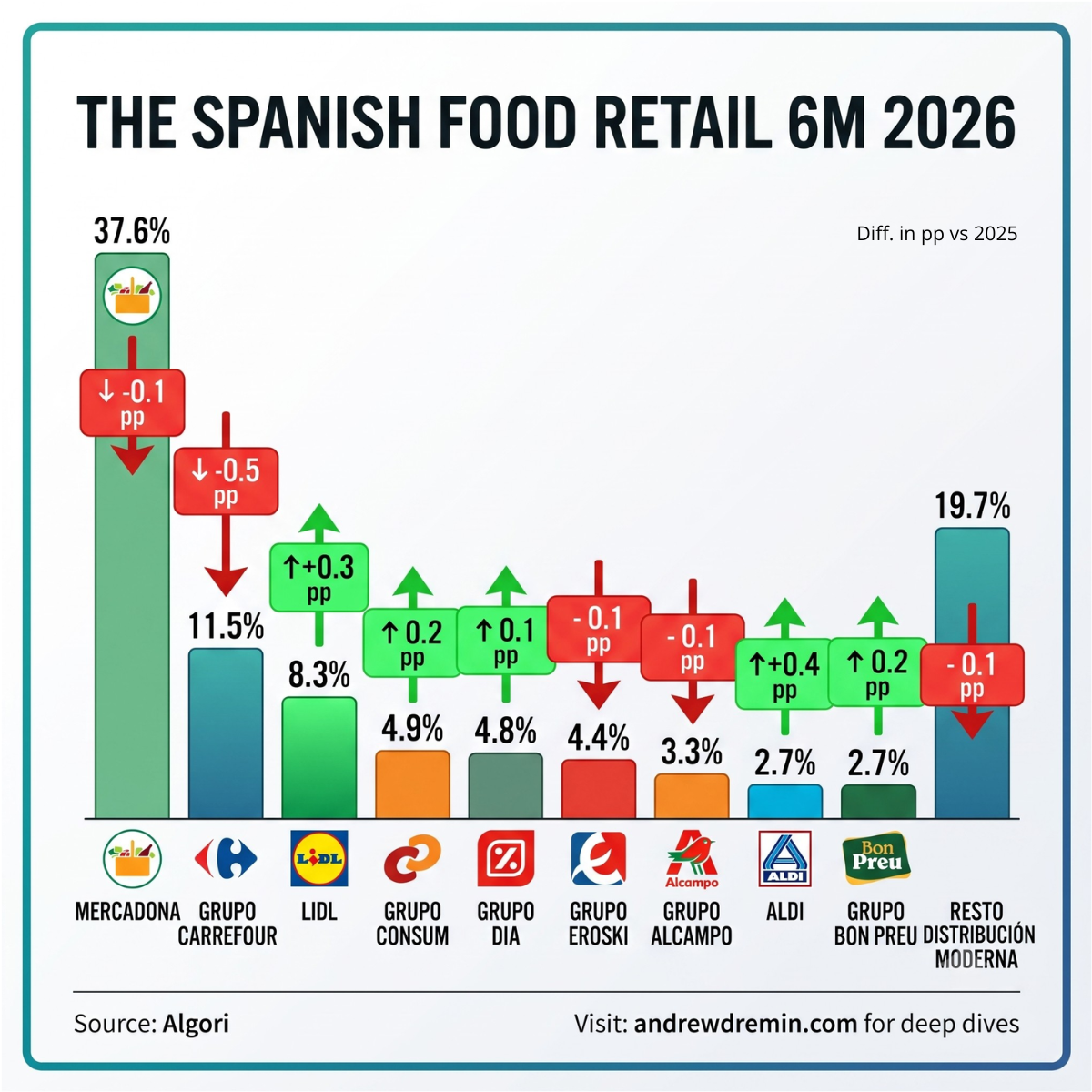
37.6%. That is Mercadona’s market share in the Spanish food retail market. But the king is slowing down. Meanwhile, Carrefour, the number two, is in a free fall, ceding share to end up at 11.5%.
The Spanish Food Retail 6M 2026
| Retailer | Market Share (6M 2026) | Diff. vs 2025 (pp) |
|---|---|---|
| Mercadona | 37.6% | -0.1 pp |
| Grupo Carrefour | 11.5% | -0.5 pp |
| Lidl | 8.3% | +0.3 pp |
| Grupo Consum | 4.9% | +0.2 pp |
| Grupo Dia | 4.8% | +0.1 pp |
| Grupo Eroski | 4.4% | -0.1 pp |
| Grupo Alcampo | 3.3% | -0.1 pp |
| Aldi | 2.7% | +0.4 pp |
| Grupo Bon Preu | 2.7% | +0.2 pp |
| Resto Distribución Moderna | 19.7% | -0.1 pp |
Juan does not want to waste fuel or food. Now, he walks. He makes quick, small trips. In Madrid, the average basket has dropped to just 10.5 units. Juan splits his money. He buys fresh food at Consum, grabs cheap chocolates at Lidl, and runs to Dia for daily bread. The big organized retailers are losing because of changing consumer habits, as Juan changed his life.
But while they rebuild, the door is open. Competitors are rushing in with aggressive retailer expansion strategies. Lidl has climbed to 8.3% share. They are opening 50 stores this year. They bought a massive 185,000 sqm plot in Constantí (Tarragona) and are opening Martorell. They also locked in a 15% wage increase until 2030 to keep their workers happy. Aldi is doing the same, adding 40 stores in 2026 to reach 536 supermarkets.
The Private Label Wall: Private label growth is evident, with value share now at 45.6%. If your brand is just “middle of the road,” you will get pushed off the shelves. You must either innovate on unique health/niche benefits or pivot to supply private label for these fast-growing discounters.
- Average tickets are 10% higher.
- Total sales grow by 3%.
- In their Murcia store, tickets are 6% above average.
- It saves 10% energy and 40% water.
FMCG Brands: Stop Using One National Plan. Spain is highly fragmented, demonstrating significant regional market differences. Catalonia spends €4,004/year on food; Madrid spends €3,488. Madrid shoppers buy tiny baskets of 10.5 units; Andalusians visit stores less but buy 12.5 units per trip. Customize your packaging and logistics to fit these regional habits.
But while they rebuild, the door is open. Competitors are rushing in, impacting overall supermarket market share. Lidl has climbed to 8.3% share. They are opening 50 stores this year. They bought a massive 185,000 sqm plot in Constantí (Tarragona) and are opening Martorell. They also locked in a 15% wage increase until 2030 to keep their workers happy. Aldi is doing the same, adding 40 stores in 2026 to reach 536 supermarkets.
Regional kings are also defending their turf. Take Catalonia. Households spend €4,004 a year on food – he highest in Spain. Bon Preu, led by Joan Font, holds a 14.2% regional share. They grew their sales by 7.9% to reach €2,611.5 million in 2025. How do they fight Mercadona? They adapt fast.
- They copied Mercadona’s pre-packaged fresh fish model. They prep it daily and package it so shoppers save time.
- They bought the old Danone factory in Parets del Vallès for €30 million to build an automated online hub by late 2027.
In Valencia, Consum is a beast. They reached a record €5,163.6 million in sales. They shared €128.7 million in profits and bonuses with their workers. In Galicia, northern families visit supermarkets 175 times a year—the highest frequency in the country. Froiz is winning there (+0.7%) because they kept traditional service counters. They hit €970 million in sales.
We also have Dia. After 7 years of losses, they turned it around with a €129 million net profit in 2025. Why? Proximity. They sold non-core brands and focused on their neighborhood franchise model. Meanwhile, regional giant Ahorramas in Madrid is facing a margin squeeze. Their sales reached €2,422 million, but profit fell 13.8% to €109 million. They spent €92 million on CAPEX and had to absorb huge wage increases. This is the real cost of growth.
In my consulting sessions, I tell my clients three things:
- Retailers: Cut the Queues. Kill service queues. Stop fighting for the “big basket”. Fight for the daily trip.
- FMCG Brands: Stop Using One National Plan. Spain is highly fragmented. Catalonia spends €4,004/year on food; Madrid spends €3,488. Madrid shoppers buy tiny baskets of 10.5 units; Andalusians visit stores less but buy 12.5 units per trip. Customize your packaging and logistics to fit these regional habits.
- The Private Label Wall: Private label value share is at 45.6%. If your brand is just “middle of the road,” you will get pushed off the shelves. You must either innovate on unique health/niche benefits or pivot to supply private label for these fast-growing discounters.
Size is no longer a shield. Speed, local execution, and capital efficiency are the only things that save you.
How is your company adapting to the death of the big weekly shop? If you need an audit of your regional distribution or commercial strategy, DM me. Let’s talk.
Source: Algori
Related posts:
 All posts
 The Supermarket Grocerant Trend: Why Retailers Are Stealing Restaurant Profits
 The Billion-Dollar Illusion: How a Fake Movie Parade Transformed Global Retail and Tourism
 European Retail Self Checkout Shrinkage 2026: 22% Loss
 Strategic alliance: Estée Lauder-Puig
 Poland’s Growth Engine is a Margin Trap