
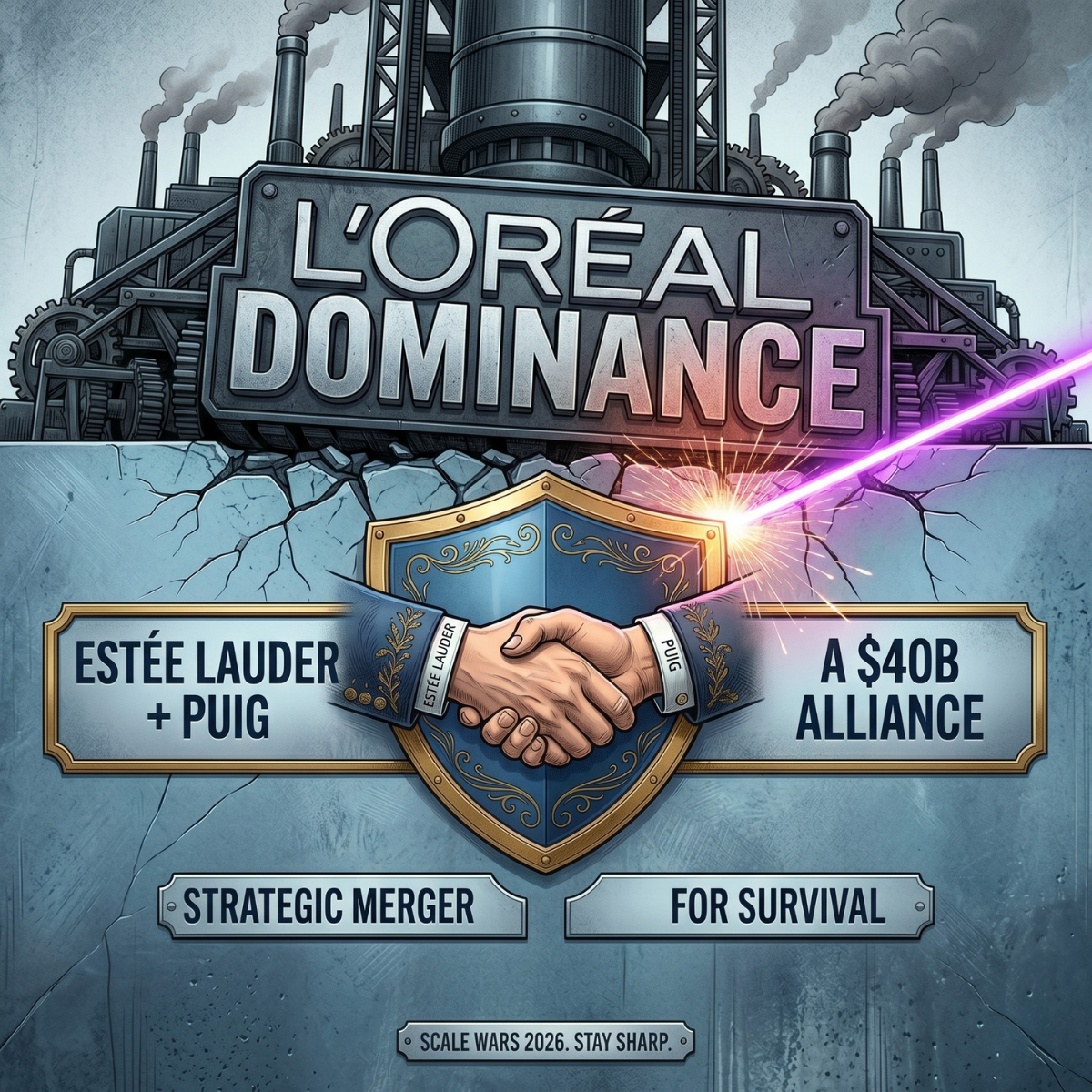
The beauty world is going through a massive earthquake in 2026. For decades, the industry was about big companies buying small, cool brands. But now, the game has changed. We are in the era of the “Scale Wars.” Two of the world’s most famous families- the Lauders in New York and the Puigs in Barcelona – are talking about joining their empires in a $40 billion deal, forming a significant strategic beauty alliance.
In 2026, being “big” is no longer an advantage; it is a requirement. The beauty industry consolidation is evident as the global beauty market is now worth over $677 billion, but the money is concentrating at the top. The five largest players now control nearly 60% of all premium sales.
1. The Global Landscape: Why Size is the Only Shield
This merger is, at its core, a “fragrance play.” In 2026, perfume is the fastest-growing part of the beauty industry, demonstrating significant fragrance market growth. Niche scents – expensive, artistic perfumes – are growing at 13.2% a year, while mass-market scents are only growing at 5%.
L’Oréal has been a “sales machine,” generating over €44 billion a year, solidifying its L’Oréal market dominance. They recently finished buying Kering Beauté for $4.7 billion, which gave them the legendary Creed fragrance and 50-year licenses for brands like Bottega Veneta and Balenciaga. This move left Estée Lauder (ELC) and Puig in a difficult spot. They realized that if they didn’t join forces, L’Oréal would simply be too powerful to compete with in department stores and airport shops.
Comparative Market Positioning (2025-2026 Estimates)
| Company / Entity | Est. Annual Revenue (USD Billions) | Primary Category Strength | Dominant Regional Exposure |
| L’Oréal Groupe | ~$47.0 | Mass & Prestige Mix | Global Balanced |
| ELC + Puig (Pro-forma) | ~$20.0 | Prestige Skincare & Fragrance | Americas / EMEA |
| Estée Lauder (Standalone) | ~$15.9 | Skincare & Makeup | Americas / China |
| Unilever (Beauty/Care) | ~$27.6 | Mass Personal Care | Global |
| Puig (Standalone) | ~$5.7 | Premium Fragrance | EMEA |
| LVMH (Perfumes/Cosmetics) | ~$9.0 | Ultra-Luxury | Europe / Asia |
The most interesting number here is the Operating Margin. Puig is run like a luxury house, with 16.1% margins, while ELC has dropped to 8.0%. ELC is hoping to learn from Puig’s lean and efficient management style, especially in managing luxury beauty brands.
2. The Financial Architecture: A $40 Billion Gamble
For Estée Lauder, this deal is an “escape hatch.” For years, ELC’s China market reliance was significant, accounting for half of its sales. But in late 2025 and 2026, China’s economy slowed down. ELC even tried to raise prices to cover costs – making a jar of La Mer cost 945 RMB – but this caused a huge backlash on social media apps like Xiaohongshu.
Why? Because Estée Lauder is struggling. When the news of the merger first leaked, ELC’s market value dropped by $30 billion. The company is already in the middle of a “Profit Recovery and Growth Plan” that involves cutting 3,000 jobs. They don’t have the spare cash for a $10 billion takeover.
Puig, however, is in a very strong position. After their 2024 IPO, they have very little debt – only 0.7 times their earnings – and they have over €664 million in cash. ELC has reportedly asked J.P. Morgan to put together a €5 billion ($5.89 billion) financing package to handle the cash part of the deal.
Key Financial Indicators (April 2026)
| Metric | Estée Lauder Companies (NYSE: EL) | Puig Brands SA (BME: PUIG) | Combined Entity Implication |
| Market Valuation | ~$28.16 Billion | ~$10.0 Billion | ~$40 Billion (incl. premium) |
| Operating Margin | ~8.0% | ~16.1% | Margin expansion via Puig’s efficiency |
| EBITDA Margin | ~14% | ~20.7% | Improved profit profile for ELC |
| P/E Ratio | ~50x | ~15x | Multiple arbitrage opportunities |
| Reliance on China | ~50% (of revenue) | ~2% (of revenue) | Massive geographic de-risking |
The most interesting number here is the Operating Margin. Puig is run like a luxury house, with 16.1% margins, while ELC has dropped to 8.0%. ELC is hoping to learn from Puig’s lean and efficient management style.
3. The Power of Perfume: The Strategic Heart of the Deal
This merger is, at its core, a “fragrance play.” In 2026, perfume is the fastest-growing part of the beauty industry. Niche scents – expensive, artistic perfumes – are growing at 13.2% a year, while mass-market scents are only growing at 5%.
Puig is an expert here. 72% of their money comes from perfume. They own some of the most successful “Love Brands” in the world, like Rabanne, Carolina Herrera, and the very trendy Byredo. ELC brings their own superstars like Tom Ford and Jo Malone.
The New Fragrance Hegemony
The merged portfolio will be virtually untouchable in the niche segment.
| Category | Estée Lauder Brands | Puig Brands | Combined Segment Influence |
| Niche Fragrance | Le Labo, Frédéric Malle, Aerin | Byredo, Penhaligon’s, L’Artisan Parfumeur | Dominance in storytelling |
| Designer Beauty | Tom Ford, Donna Karan | Rabanne, Carolina Herrera, Gaultier | Scale in high-volume luxury scents |
| Prestige Makeup | MAC, Bobbi Brown, Clinique | Charlotte Tilbury, Rabanne Makeup | Rejuvenation of “cool” factor |
| High-End Skincare | La Mer, Clinique, The Ordinary | Dr. Barbara Sturm, Charlotte Tilbury | Combined R&D for clinical beauty |
Together, they will own 15% of the global premium perfume market, putting them neck-and-neck with L’Oréal’s 16%.
4. Escaping the “China Trap”
For Estée Lauder, this deal is an “escape hatch.” For years, ELC relied on China for half of its sales. But in late 2025 and 2026, China’s economy slowed down. ELC even tried to raise prices to cover costs – making a jar of La Mer cost 945 RMB – but this caused a huge backlash on social media apps like Xiaohongshu.
Puig has the opposite situation. They are very strong in Europe and Latin America (where they get nearly 20% of their sales), but they are almost completely missing from China (only 2%).
The merger allows a massive exchange:
- ELC uses Puig’s strength in Europe and South America to balance its risks.
- Puig uses ELC’s massive infrastructure in Shanghai and their 1,600 stores to finally sell perfume to Chinese consumers.
Regional Revenue Forecasts (2026)
| Region | ELC Standalone | Puig Standalone | Pro-forma Combined |
| Americas | 26% | 12% | ~22% |
| EMEA | 38% | 55% | ~43% |
| Asia-Pacific / China | 36% | 11% | ~28% |
| Latin America | Negligible | 19% | ~7% |
5. Family Rules: Protecting the Legacy
One of the most unique things about this deal is that it is a “merger of dynasties.” Both companies are still controlled by the founding families.
At ELC, the Lauder family holds 84% of the voting power. The Puig family in Spain controls 93% of their group. In 2026, corporate “raiders” and activist investors are everywhere, looking to break up underperforming companies. By joining forces, the Lauders and Puigs are building a “defensive wall” of voting power.
Marc Puig, the current Executive Chairman of Puig, would likely join the board of the new giant. This ensures that the brands are run with a “family spirit” focused on the next 20 years, not just the next 3 months.
6. Technology and the Future: AI and “Clinical” Beauty
The merged entity is already planning for the future. Estée Lauder has appointed WPP as its global media partner to build a unified, AI-driven media system. The goal is to use data to target consumers more precisely for brands as different as The Ordinary and Tom Ford.
They are also pivoting toward “Biotech Beauty.” Both companies are moving away from traditional “anti-aging” marketing and toward “skin longevity.” Puig’s acquisition of Dr. Barbara Sturm and ELC’s focus on regenerative science show that they believe the future of luxury is clinical performance, not just pretty jars.
7. The Risks: Can Two Cultures Become One?
Investors are still nervous. While Puig’s shares went up because they get access to a global distribution network, ELC’s shares fell by 15%. There are three big risks:
- Integration Strain: ELC is already busy with a massive turnaround. Adding a $10 billion European group to the mix could be too much for management to handle.
- Brand Flattening: Puig’s brands are successful because they are creative and “indie” in spirit. If the Lauder corporate machine tries to standardize them too much, the “magic” will disappear.
- Regulatory Scrutiny: Governments in the US and Europe will watch this closely. If Jo Malone (ELC) and Carolina Herrera (Puig) control too much of the “perfume as a gift” market, they might be forced to sell some brands.
Valuation Multiples (April 2026)
| Company | P/E Ratio (2026 Est.) | EBITDA Multiple | Dividend Yield |
| Estée Lauder (NYSE: EL) | 50x | 14.5x | 2.1% (At risk) |
| L’Oréal (OR.PA) | 30x | 18.2x | 1.8% |
| Puig (BME: PUIG) | 15x | 9.8x | 1.2% |
| Coty Inc. (NYSE: COTY) | 12x | 7.5x | 0.0% |
My Point of View: The Conclusion for the Market
The ELC-Puig merger is the final signal that the era of the “independent family shop” is over. To survive against giants like L’Oréal and LVMH, you have to be a giant yourself.
For Retailers: You now have a massive new partner to negotiate with. They will have more power to demand the best shelf space for “Love Brands” like Charlotte Tilbury or Byredo.
For FMCG and SMEs: The “indie” wave is cooling down. In 2026, the winners are those who can combine artistic storytelling with corporate efficiency. If you are a small brand, your best strategy is to become so unique that one of these giants has to buy you.
In the next 5 years, I expect the new ELC-Puig entity to “prune” its portfolio – selling off older, slower brands to focus entirely on high-margin luxury and science-led skincare. This is the new blueprint for beauty. The Lauders and Puigs have made their move. Now, we wait to see how L’Oréal responds.
Related posts:
 PepsiCo’s Strategic Paradigm Shift
 Testing the Limits of Brand Power: Nivea in an Inflated Economy
 Lidl is now your phone operator
 GLP-1 Retail Impact: How Weight-Loss Drugs Are Shrinking Supermarket Sales
 European Retail Self Checkout Shrinkage 2026: 22% Loss
 EU Small Parcel Tax: Why the New Custom Rules Won’t Stop Shein & Temu