
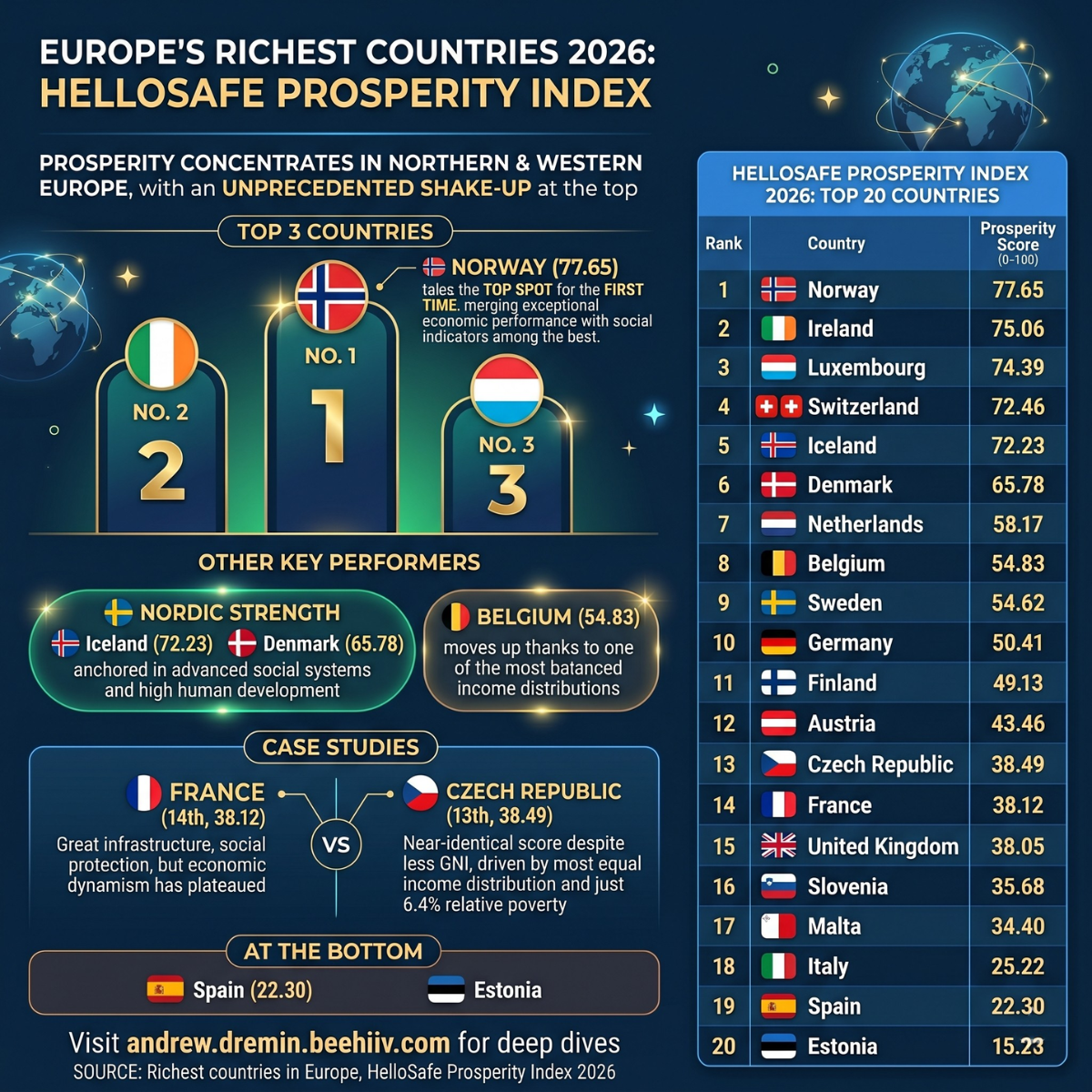
Spain scored 22.30 out of 100 on the 2026 HelloSafe Prosperity Index. That ranks us 19th in Europe out of 20 countries analyzed, placing us right near the bottom of the table. Only Estonia sits below us at 15.23, while Italy sits just one spot above us at 25.22.
If you listen to Spanish politicians, you hear a completely different economic story. They highlight a 2.6% GDP growth rate this year. They claim Spain is leading the Eurozone economy and outperforming regional peers. But there is a massive gap between macroeconomic statistics and what people experience daily on the street.
HelloSafe Prosperity Index 2026 (Top 20 Countries)
| Rank | Country | Prosperity Score (0-100) |
|---|---|---|
| 1 | Norway | 77.65 |
| 2 | Ireland | 75.06 |
| 3 | Luxembourg | 74.39 |
| 4 | Switzerland | 72.46 |
| 5 | Iceland | 72.23 |
| 6 | Denmark | 65.78 |
| 7 | Netherlands | 58.17 |
| 8 | Belgium | 54.83 |
| 9 | Sweden | 54.62 |
| 10 | Germany | 50.41 |
| 11 | Finland | 49.13 |
| 12 | Austria | 43.46 |
| 13 | Czech Republic | 38.49 |
| 14 | France | 38.12 |
| 15 | United Kingdom | 38.05 |
| 16 | Slovenia | 35.68 |
| 17 | Malta | 34.40 |
| 18 | Italy | 25.22 |
| 19 | Spain | 22.30 |
| 20 | Estonia | 15.23 |
Raw GDP growth does not reach the average person. GDP measures total national output, including government expenditure, corporate balance sheets, and industrial production. It tells you nothing about how that money is distributed among regular households.
The HelloSafe Prosperity Index measures structural reality: relative poverty rates, income inequality, and real purchasing power. That is where Spain fails.
Look at how other European countries perform on this index. The Czech Republic scored 38.49, ranking 13th and beating France, which scored 38.12 at 14th place. The Czech Republic has a lower Gross National Income than France, but they held relative poverty down to 6.4% through better income equality. Belgium ranks 8th with a score of 54.83 due to a balanced income distribution structure.
Top-ranking nations show where true purchasing power sits:
- Norway leads the index at 77.65
- Ireland sits at 75.06
- Luxembourg scores 74.39
- Switzerland hits 72.46
- Iceland holds 72.23
- Denmark reaches 65.78
These economies combine economic output with strong distribution, keeping median household budgets intact.
In Spain, macro growth is offset by stagnant middle-class wages, high structural unemployment, and stubborn basic costs. A family does not feel a 2.6% GDP growth rate when housing, utilities, and daily food items eat up almost their entire paycheck.
I see this practical reality every week in retail performance. Store foot traffic is up, but average basket sizes are shrinking. People visit stores more often, but they buy fewer items per trip.
This shopping behavior is a direct reaction to financial pressure. When budgets are tight, consumers avoid large weekly supermarket trips. Doing one large €180 or €200 shop creates financial stress and increases the risk of food waste. Instead, shoppers visit store locations four or five times a week, buying only five or six items they need for the next two days.
An average consumer in Reus, Valencia, or Madrid does not track GDP forecasts or Eurozone stats. They care about basic grocery shelf prices: the cost of 1 liter of olive oil, milk, bread, and eggs. When essential staples remain expensive relative to monthly earnings, consumers cut spending everywhere else.
Look at who wins in this environment.
Mercadona’s dominance in Spanish retail now controls 38.1% of the Spanish FMCG market. They achieved this by aggressively freezing prices on essentials and expanding their private label inventory. Consumers trust Mercadona because their total checkout bill stays predictable.
Hard discounters like Lidl España and ALDI ESPAÑA are expanding rapidly across the country. Extreme discount chains like Primaprix are popping up in every major neighborhood. Primaprix builds its entire model on selling overstock, closeouts, and discounted international inventory to budget-conscious shoppers.
Meanwhile, traditional retailers and hypermarket formats like Carrefour are losing market share. Large hypermarkets require long drives, fuel costs, and impulse purchases. When family budgets contract, consumers stop visiting large hypermarkets and shift to neighborhood discounters.
For FMCG brands and retail executives operating in Spain, the strategy must change.
First, stop chasing premium margins in Spain. The Spanish market is a street fight for absolute value. If your brand relies on premiumization strategies to grow revenue, you will face strong headwinds here.
Second, build strong private label operations. If consumers are moving away from branded goods due to price pressure, manufacturer survival relies on white-label production and store-brand partnerships. Volume in Spain is concentrated in private label.
Third, reconfigure packaging and logistics for high-frequency purchasing. Smaller package sizes with lower absolute shelf prices perform better than large bulk packs. When consumers operate on tight daily cash flow, a €2.50 smaller item sells faster than a €6.00 value pack, even if the value pack offers a lower cost per gram.
Fourth, adjust your European sales distribution. If you want high margins and premium pricing, export to Northern and Western Europe. Markets like Norway, Ireland, Luxembourg, Switzerland, and the Netherlands have the disposable income needed to support premium price points.
If you operate in Spain, accept the squeeze. Focus on tight operations, lean distribution, low price points, and high volume. You cannot sell premium promises to a market that is managing daily survival.
Related posts:
 PepsiCo 15 Percent Price Cut: Why Revenue Dropped 2%
 The $255,000 Aldi’s Blind Box Fiasco
 Proximity retail shift Spanish FMCG: 2026 data analysis
 A Strategic Portfolio Analysis of the 2026 FIFA World Cup Contenders
 Why the Ferrari EV Launch Failure Cost $4 Billion in 48 Hours
 The Real Estate Mechanics Behind the $195.1 Billion Valuation