
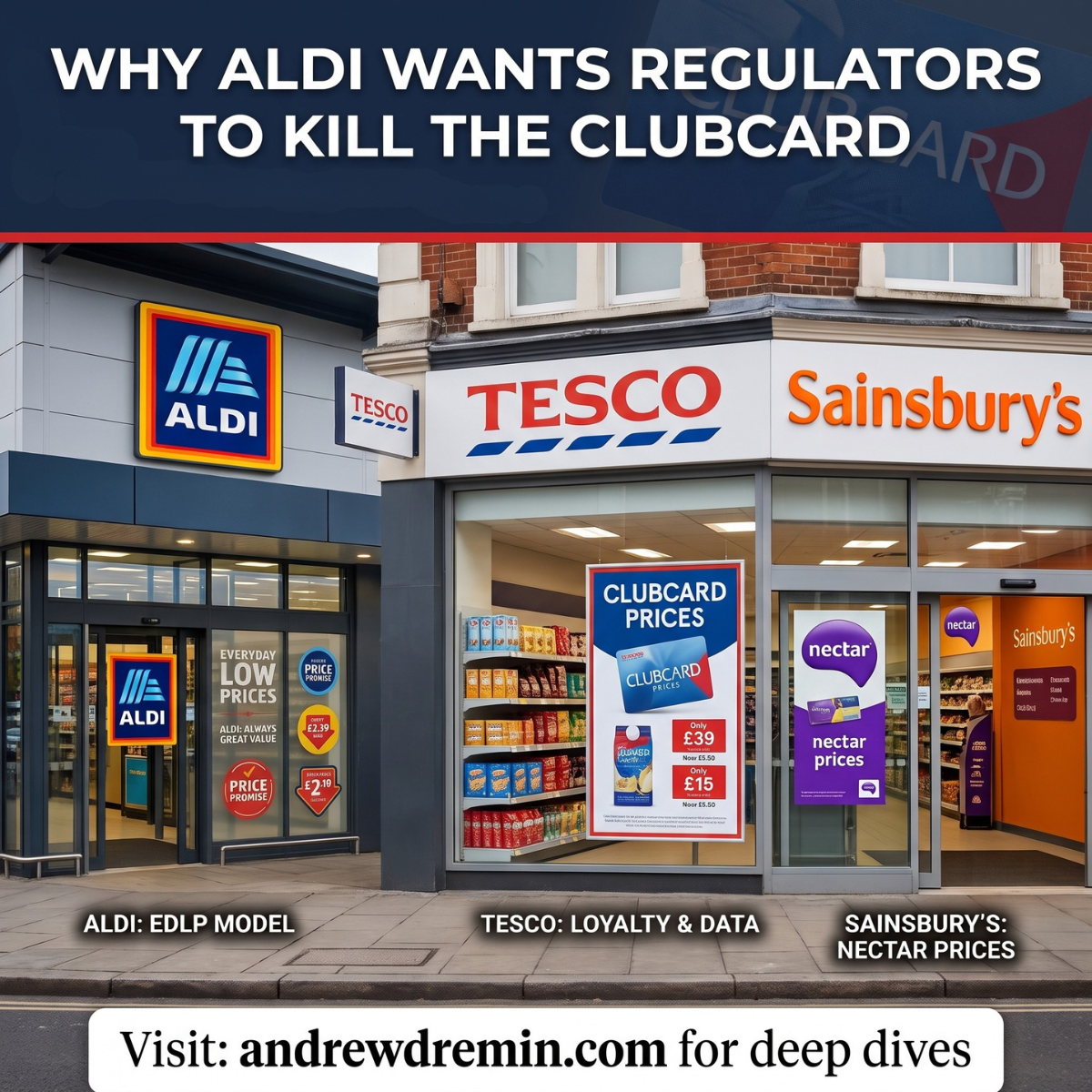
55% of UK grocery shoppers believe supermarket loyalty discounts are fake. Yet, when the UK Competition and Markets Authority (CMA) investigated the matter, they found that 92% of those promotional prices were mathematically genuine compared to historical shelf prices.
This creates an obvious question: why do shoppers still feel cheated?
On August 16, Aldi UK chief executive Giles Hurley targeted Tesco Clubcard and Sainsbury’s Nectar pricing directly with a blunt statement: “Taking £2 off a £6 product doesn’t make it good value if you can buy it for £3 somewhere else.”
Hurley pointed out a fundamental truth in modern grocery retail. A price can be legally compliant inside one store while remaining bad value compared to the market across the street. But Aldi is not making this point out of pure kindness. It is a calculated commercial move.
Supermarket Loyalty Pricing: The Psychology Behind Two-Tier Schemes
Two-tier loyalty pricing is basic price discrimination disguised as customer appreciation. The retailer creates two prices for the exact same item on the exact same shelf:
- The Regular Price: An inflated sticker price paid by casual shoppers, tourists, or people who refuse to register an account.
- The Member Price: The actual target price of the item, available only to shoppers who scan a barcode or tap an app at checkout.
This setup works through psychological anchoring. When a customer sees an item marked down from £6.00 to £4.00, the brain registers a £2.00 win. In reality, the product was often worth £4.00 all along.
The retailer simply raised the base price to create the illusion of a bargain. If you scan your card, you pay the normal market rate. If you do not scan your card, you pay a penalty tax.
The system does not reward loyalty. It punishes non-compliance.
Retail Media Networks: The 70% Margin Machine Inside Supermarkets
Selling food is a difficult, low-margin business. Traditional supermarket chains typically operate on thin net margins between 1.5% and 3.5%.
To find new revenue streams, major grocers transformed into advertising platforms known as Retail Media Networks (RMNs).
- High logistics costs
- Perishable stock risk
- Pure digital revenue
- First-party data monetized
When a retailer forces you to scan an app to get normal prices, they are collecting granular first-party data:
- Exact purchase frequency: What day and time you buy your essentials.
- Brand switching habits: Whether you buy branded butter or private label spreads.
- Dietary profiles: Whether your basket indicates a vegan, gluten-free, or pet-owning household.
- Price elasticity: How high a price can go before you stop buying.
This data is packaged and sold back to consumer goods manufacturers. Retail Media Networks carry profit margins between 50% and 70%.
Dual pricing is not about selling cheaper groceries; it is the intake funnel for high-margin data harvesting.
Aldi EDLP Model vs Dual Pricing: Why Discounters Want Regulators to Step In
Aldi operates on an Everyday Low Price (EDLP) model.
How Aldi’s Business Differs from Traditional Grocers
- Limited Assortment: Aldi stores carry roughly 1,500 to 2,000 core items, while a standard Tesco or Sainsbury’s superstore carries over 30,000 items.
- Private Label Focus: Over 90% of Aldi products are exclusive store brands, eliminating trade promotion negotiations.
- Lean Operational Structure: No loyalty point databases, no physical card management, and no retail media ad network to maintain.
Aldi gains nothing from two-tier loyalty apps. Calling for a regulatory ban on dual pricing costs Aldi zero pounds, makes them look like consumer champions, and directly attacks the most profitable growth engine of their main rivals.
The Discounter Defense Strategy
Discounters have their own corporate vulnerabilities. The UK CMA previously investigated major supermarket chains – including discounters like Aldi and Lidl – for using restrictive land covenants.
These legal agreements in property contracts were designed to stop rival grocery stores from opening on nearby plots for years.
Both sides use specific commercial tactics to protect their territory:
- Legacy Grocers: Use digital lock-in and app-based loyalty walls to protect margins and collect shopper data.
- Hard Discounters: Use real estate restrictions and copycat packaging to protect market share and drive volume.
The FMCG Supplier Trap: Trade Budgets, Margin Erosion, and Shelf Space
Fast-Moving Consumer Goods (FMCG) brand managers face heavy pressure in this environment. In many categories, loyalty promotions have become mandatory to maintain physical distribution.
The Three Ways Dual Pricing Damages FMCG Brands
- Trade Spend Cannibalization: Brands are forced to allocate larger shares of their commercial budgets to fund loyalty discounts. Instead of investing in product quality or independent marketing, money goes directly into the retailer’s loyalty mechanics.
- Baseline Price Destruction: When a branded product is constantly discounted behind a loyalty tag, consumers refuse to pay the standard retail price. The perceived value of the brand permanently drops to the promotional price.
- The Double Charge: Retailers ask FMCG suppliers to fund the price discount at the shelf, and then demand that the same brand buy advertising space inside their Retail Media Network to let shoppers know the discount exists.
What Retailers and Consumer Brands Must Do Next
The market will eventually correct as shopper fatigue increases. Navigating this shift requires clear adjustments from both sides of the supply chain.
For FMCG Brand Leaders
- Audit Promotional Dependency: If more than 60% of your sales volume happens exclusively on loyalty promotions, your base pricing strategy is broken.
- Evaluate True Net Margins: Calculate the full cost of retail media ad spend combined with mandatory promotional funding. If the partnership is unprofitable, reallocate volume to discounters or alternative retail channels.
- Build Direct-to-Consumer Channels: Maintain alternative sales channels to preserve pricing power and keep access to customer data without paying a supermarket gatekeeper.
For Grocery Retail Executives
- Reduce Digital Checkout Friction: Forcing shoppers to download apps, remember passwords, and manage bad mobile connections inside stores creates frustration.
- Balance Data Collection with Price Transparency: As regulatory scrutiny from organizations like the CMA intensifies, retailers relying on artificially inflated regular prices face significant reputational risk.
- Maintain Honest Price Baselines: Dual pricing generates cash flow today, but simple, direct shelf pricing builds long-term customer retention.
Frequently Asked Questions About UK Supermarket Loyalty Schemes
Are supermarket loyalty discounts genuine savings?
Mathematically, yes. The CMA found that 92% of loyalty promotions are cheaper than the store’s previous regular price. However, the regular non-member price is often set higher than the wider market average, meaning the “saving” is frequently calculated against an artificially inflated base price.
Why are supermarkets replacing paper coupons with loyalty apps?
Apps allow retailers to track individual customer behavior in real time. This first-party data is used to build Retail Media Networks, which sell targeted digital ad space to FMCG brands at operating margins between 50% and 70%.
How does Aldi keep prices low without a loyalty card scheme?
Aldi uses an Everyday Low Price (EDLP) model. By selling roughly 90% private-label goods across a streamlined inventory of 1,500 to 2,000 products, they eliminate the administrative, software, and marketing costs required to run a two-tier loyalty program.
Why do FMCG suppliers complain about two-tier loyalty pricing?
Suppliers usually pay for the price cuts out of their own trade promotion budgets. Additionally, constant steep discounting erodes their brand value, training customers never to buy their products at full retail price.


Leave a Reply