
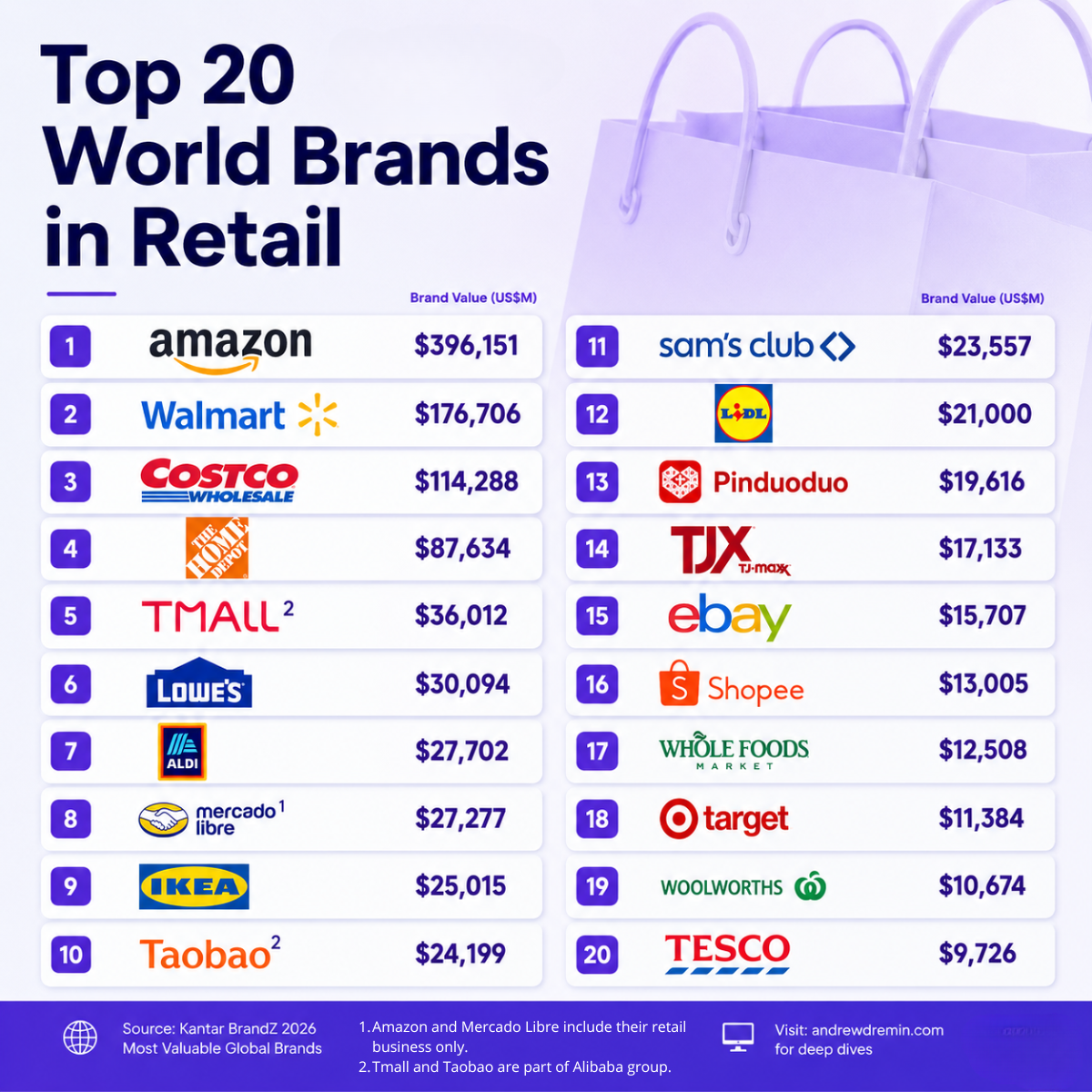
According to the global retail brand value ranking 2026, Amazon’s retail brand is now worth $396 billion. Amazon is bigger than Walmart ($176 billion) and Costco ($114 billion) combined.
But look further down the list. This is where the real story is.
Aldi sits at $27.7 billion. Lidl is at $21.0 billion.
Now look at legacy retail giants. Target is $11.4 billion. Tesco is $9.7 billion.
| Rank | Brand | Brand Value (US$M) |
|---|---|---|
| 1 | Amazon | $396,151 |
| 2 | Walmart | $176,706 |
| 3 | Costco | $114,288 |
| 4 | Home Depot | $87,634 |
| 5 | Tmall | $36,012 |
| 6 | Lowe’s | $30,094 |
| 7 | ALDI | $27,702 |
| 8 | Mercado Libre | $27,277 |
| 9 | IKEA | $25,015 |
| 10 | Taobao | $24,199 |
| 11 | Sam’s Club | $23,557 |
| 12 | Lidl | $21,000 |
| 13 | Pinduoduo | $19,616 |
| 14 | TJX | $17,133 |
| 15 | eBay | $15,707 |
| 16 | Shopee | $13,005 |
| 17 | Whole Foods Market | $12,508 |
| 18 | Target | $11,384 |
| 19 | Woolworths | $10,674 |
| 20 | Tesco | $9,726 |
Two German discounters have twice the brand value of famous traditional supermarkets. People see this and say legacy supermarkets are dying.
They are wrong. We need to separate facts from assumptions.
Retail Brand Equity vs. Total Revenue
We must look at the data critically. Kantar measures brand equity. This is the financial value driven by consumer perception. It does not measure total revenue.
Tesco generates over $80 billion in annual revenue. It dominates the UK market. But it is a regional business. Aldi and Lidl operate in over 30 countries. Global brand rankings favor multi-national scale.
High brand value does not mean better cash flow. Lower brand value does not equal a failing business model. We cannot confuse a brand popularity contest with a balance sheet.
Still, the ranking shows a real shift in consumer minds. People value what Aldi and Lidl do.
The Hard Discounter Strategy in Grocery Retail
Why do shoppers value hard discounters so much? Simplicity.
When you walk into a traditional supermarket, you see 40,000 items. This causes range overload. Business leaders often think more choice means more sales. It does not. A famous study from the Kellogg School of Management showed that huge variety can lower shopper satisfaction. People get tired of choosing.
Aldi offers a limited range. They stock around 2,000 items. They keep it simple. Shoppers save time and money.
Consumers today want one of two things. They want absolute convenience, like Amazon. Or they want extreme efficiency, like Aldi and Lidl.
The discounter model works because it cuts operating costs. Smaller stores need fewer staff. Limited items mean faster turnover.
The Supermarket Price Wars and Quality Controversies
Legacy supermarkets are panicking. They see discounters taking their customers.
Look at the UK market. Big chains like Tesco and Sainsbury’s try to match Aldi’s prices. They put “Aldi Price Match” labels on their shelves.
But here is the controversial part. Consumer investigations showed some of these price-matched products were not the same. Traditional supermarkets reduced the main ingredients to cut costs. A chicken pie had less chicken. Aldi responded directly. They told shoppers that true Aldi value only exists at Aldi.
You cannot fake a discount model. If your operating costs are high, you cannot sell at discount prices without cutting product quality. Shoppers notice this.
The Rise of Membership-Locked Bulk Savings
Look at the top of the list again. Costco is number three at $114.2 billion. Sam’s Club is number eleven at $23.5 billion.
These companies use a different model. They charge a membership fee. This fee covers their profit margin. They sell products at near-cost prices.
Consumers accept this deal. They pay upfront for the right to buy in bulk. This model creates extreme loyalty. Shoppers feel they must spend money there to justify the membership fee.
Costco also limits choices. A typical Costco warehouse stocks about 4,000 items. A normal supermarket stocks ten times that amount. This proves again that massive variety is not necessary for high brand value.
FMCG Strategies for Global Markets
What does this mean for FMCG suppliers?
My professional background involves the historical organization of manufacturing and sourcing for brands. I know how FMCG margins are built. Suppliers used to rely entirely on big legacy grocers for shelf space. That strategy is shrinking.
Hard discounters are growing. They now sell more A-brands to attract middle-class shoppers. FMCG companies must find a clear route into these discount and club formats.
But they cannot just lower prices everywhere. Product pricing varies heavily by country due to local import factors. Tariffs, transport costs, and local regulations change the final price on the shelf. A food item or an electronic device costs a different amount to import into Spain than into the US. FMCG brands need a market-by-market strategy. A single global pricing model will fail.
Private Label is Now a Real Competitor
In the past, store brands were just cheap alternatives. They had ugly packaging. Now, retailers invest heavily in them.
A strong private label program gives a retailer power. It forces FMCG brands to negotiate better terms. If an A-brand asks for a price increase, the retailer can simply promote their own private label instead.
Your brand must offer something the store brand cannot. If it does not, you will lose shelf space.
Is the Middle Market in Retail Dead?
Many analysts say the middle market is dead. They claim consumers only want premium or discount.
This is a cognitive bias. The undifferentiated middle is struggling, yes. But a traditional supermarket can still win if it executes well.
Take Mercadona here in Spain. It is a traditional supermarket format. But it holds nearly 37% market share. How? Operational perfection. They have a massive, high-quality private label program. They do not do heavy promotions. They offer fair prices every day.
The middle survives when it is efficient. If a retail chain sits in the middle with high costs and bad inventory, it will lose market share.
Key Takeaways for Retailers and FMCG Brands
Here are the hard facts you need to know.
For Retailers:
- Cut slow-moving inventory. Broad assortments are a liability.
- Fix operating costs. You cannot compete on price if your overhead is too high.
- Treat private label as a real brand. It is not cheap filler. It builds loyalty.
For FMCG Suppliers:
- Do not rely solely on traditional supermarkets. Look at discounters and club formats.
- Build regional pricing strategies. Remember that import factors change costs.
- Justify your price premium. If your brand does not have real strength, private labels will replace you.
Brand value is perception. Profit comes from simple operations.
What do you think is the biggest threat to big box retail today? Let’s discuss in the comments.
Frequently Asked Questions (FAQ) About Retail Brand Value
What is retail brand equity? Brand equity is the financial value of a brand based on consumer perception. It is how much extra money a company makes simply because of its brand name and reputation.
Why is Amazon ranked number one in retail? Amazon offers absolute convenience and speed. Their brand value reflects their massive global scale and consumer reliance. The Kantar data shows their retail business alone is worth $396 billion.
Are traditional supermarkets going out of business? No. Companies like Tesco have massive annual revenues. But they must improve their operations to fight off hard discounters. The middle market survives if it is efficient.
How do Aldi and Lidl keep prices so low? They run a hard discount model. They have smaller stores, fewer staff, and a limited number of items. This lowers their operating costs, allowing them to pass savings to the shopper.
What is range overload in grocery retail? It happens when a store offers too many choices. This confuses shoppers and can lower sales. Limited assortments often perform better and reduce inventory costs.
Infographic source: Kantar BrandZ 2026 Most Valuable Global Brands
Related posts:
 Global Food Beverage Brand Value 2026
 Global Airline Market Cap 2026
 Global Outbound Travel Statistics by Country: Why FMCG Brands Fail
 UK Grocery Discounter Trends 2026: What the CMA Ruling Means for Aldi and Lidl
 The Supermarket Grocerant Trend: Why Retailers Are Stealing Restaurant Profits
 UK Grocery Loyalty Trends 2026: Why the Lidl Plus Points Backlash Matters
Leave a Reply