
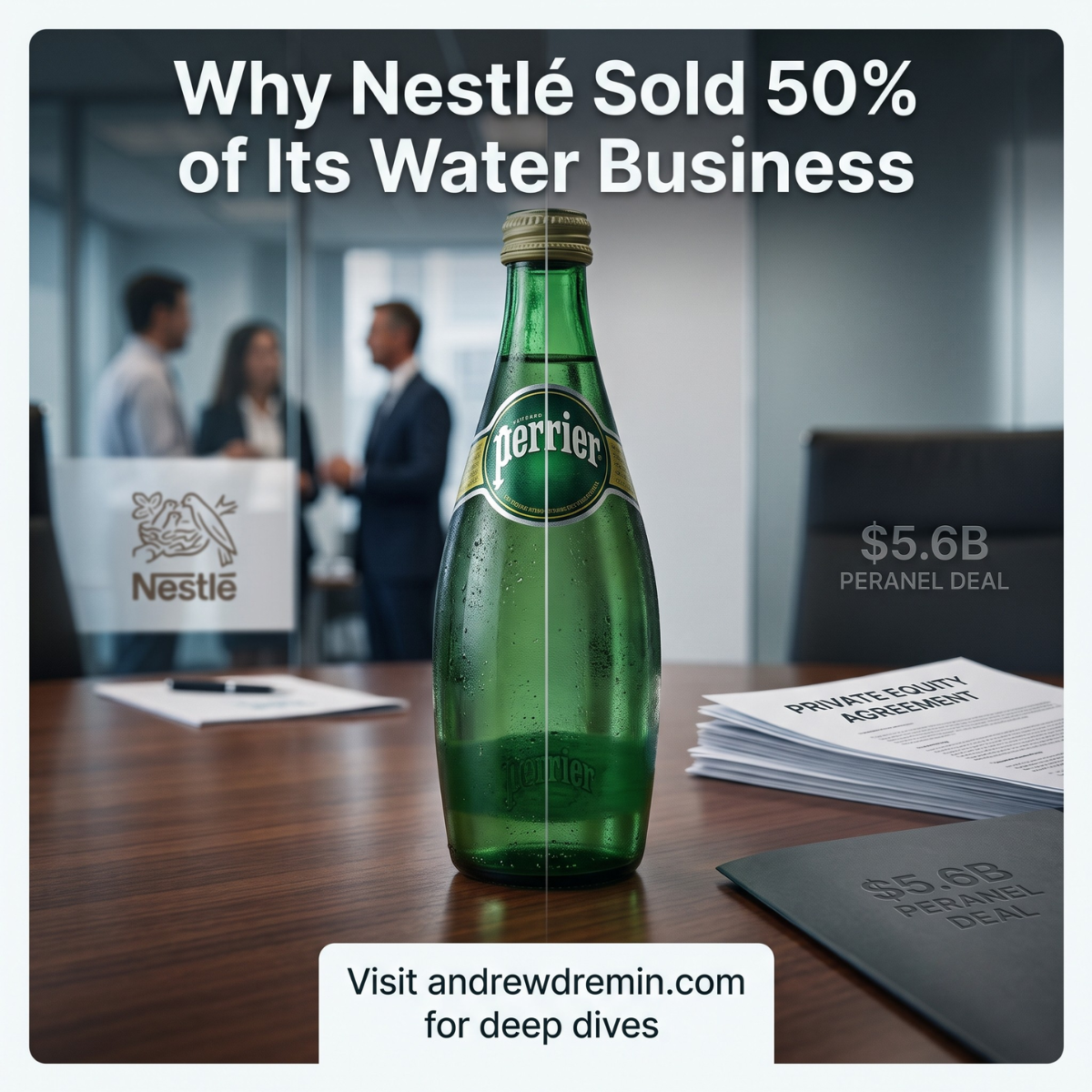
Nestlé reported a massive 31.4% drop in H1 2026 net profit. On the exact same day, they announced a 50/50 joint venture with private equity giant Platinum Equity. They carved out their $5.6 billion global water empire into a new standalone company called Peranel.
Big food conglomerates are broken. Corporate giants can no longer manage old heritage brands efficiently.
Look at the regular consumer. Imagine a customer standing in a grocery store aisle in London or New York. They pick up a bottle of Perrier or S.Pellegrino. They do not care about Nestlé’s corporate debt or Swiss accounting rules. They just want clean water and reliable quality. But when corporate executives get stuck in legal battles and big bureaucracies, product quality and supply chains take a hit.
The Real Story Behind the 31.4% Profit Crash
Many news headlines say Nestlé is collapsing. That is wrong.
As a retail consultant, my job is to look behind the numbers. This profit crash was a planned accounting cleanup.
Here is what really happened in H1 2026:
- Nestlé took a CHF 1.3 billion non-cash write-down on assets reclassified as “held for sale.”
- They spent CHF 800 million on transformation and restructuring costs.
- Their underlying organic sales actually grew by 3.6%.
- Their free cash flow jumped by 46.3% to CHF 3.375 billion.
So why did Nestlé dump half of its water empire? Because the European mineral water business became a huge legal headache. Nestlé faced severe legal and regulatory troubles in France over water filtering practices. Consumer groups like Foodwatch launched legal complaints. Police investigators even searched facilities in Paris and Vergèze.
CEO Philipp Navratil decided to isolate these legal risks. He moved the water assets off Nestlé’s main corporate balance sheet.
The $5.6 Billion Peranel Deal Mechanics
Nestlé did not do a simple sale. Instead, they built a new independent business called Peranel, headquartered in Paris.
Here are the main facts of the transaction:
- Structure: 50% owned by Nestlé and 50% owned by Platinum Equity.
- Asset scope: Over 30 water and beverage brands sold in 120 countries, including Perrier, Acqua Panna, S.Pellegrino, and Nestlé Pure Life.
- Cash proceeds: Nestlé gets about €3.0 billion (CHF 2.8 billion) in net cash when the deal closes in H1 2027.
- Strategic goal: Nestlé will use this cash to pay off debt and invest in core high-margin categories.
Nestlé wants to focus on four main powerhouse pillars: Coffee (Nescafé, Nespresso), Petcare (Purina), Food & Snacks (KitKat, Maggi), and Nutrition. Water was slow, capital-heavy, and legally risky.
Corporate Ownership vs. Private Equity Playbook
Is private equity better at running old food and drink brands than traditional consumer goods giants?
Here is my evaluation framework comparing corporate giants like Nestlé, Danone, or Unilever against PE firms like Platinum Equity or KKR:
- Operational Speed
- Corporate: Slow. Every decision goes through layers of corporate approval in Vevey or Paris.
- Private Equity: Fast. PE managers cut unnecessary corporate overhead and fix supply chains quickly.
- Product Trust & Quality
- Corporate: High focus on long-term brand heritage, but corporate bureaucracy hides local quality problems.
- Private Equity: PE pushes hard for short-term profit margins. If cost cuts are too aggressive, product quality can suffer.
- Capital Allocation
- Corporate: Water had to compete for budget against fast-growing categories like Petcare. Water always lost.
- Private Equity: Peranel has its own budget. Platinum Equity can buy smaller regional hydration brands without asking Nestlé for permission.
The Human Angle: Factory Workers and Supermarket Buyers
Big corporate restructurings sound clean on balance sheets. But they impact real people on the ground.
Think about the factory worker in Vergèze, France, where Perrier is bottled. For decades, they worked for a Swiss food giant with stable corporate benefits. Now, their workplace is half-owned by an American private equity firm known for cost-cutting.
And look at supermarket buyers. Store managers want reliable delivery dates and stable wholesale prices. Under private equity control, Peranel will likely raise prices on premium glass bottles while cutting slow-moving products. Retailers must prepare for tough commercial negotiations in 2027.
How to Choose Your Portfolio Strategy in 2026
If you are an executive or owner running an FMCG brand in 2026, use this decision framework:
- Is your brand in a high-growth, high-margin category? Keep it in-house. Invest heavy marketing dollars to gain market share.
- Is your brand capital-heavy, slow-growing, or facing legal risks? Carve it out. Partner with private equity to cut cost structures and free up capital.
- Are non-core assets pulling down your corporate focus? Take the accounting write-down early. Clean up your balance sheet and reinvest in core products.
What Do You Think?
Would you trust a private equity firm to protect a 150-year-old heritage brand like Perrier, or will aggressive margin cuts end up hurting product quality?
Drop your thoughts in the comments below. Let’s start a discussion.
I help retail executives and FMCG brands fix commercial strategy, streamline portfolio operations, and navigate market shifts. Send me a direct message if you need consulting for your business.
Related posts:
 UK Grocery Market Share August 2026: Why Lidl Is Outpacing Aldi
 The Supermarket Grocerant Trend: Why Retailers Are Stealing Restaurant Profits
 Strategic alliance: Estée Lauder-Puig
 The Billion-Dollar Illusion: How a Fake Movie Parade Transformed Global Retail and Tourism
 The €3.90 Gourmet Threat: How Supermarket Meal Kits are Disrupting Fast Casual Dining
 PepsiCo’s Strategic Paradigm Shift