
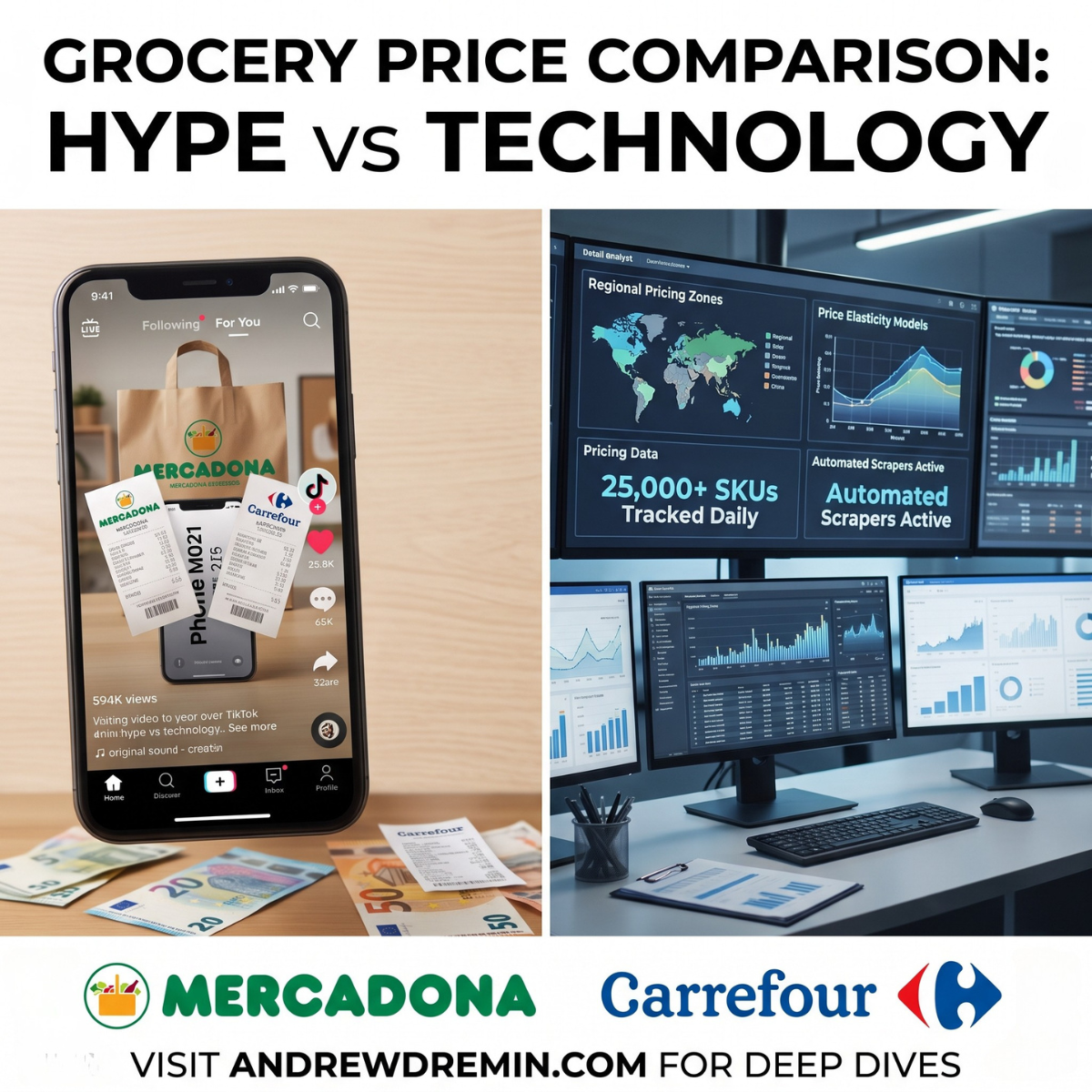
A TikTok creator goes to Mercadona and Carrefour in Spain, buys 20 basic grocery items, spends roughly €80, and finds a €3.24 total price difference. The video gets 500,000 views, thousands of shares, and hundreds of comments debating which supermarket is ripping off working families.
To a professional retail pricing analyst, a single 20-item receipt on a Tuesday afternoon is useless data. It has zero statistical significance.
To a regular shopper, that receipt is absolute proof.
This creates a serious problem for commercial directors and category managers. Should retail teams care about a 60-second video with flawed methodology?
Mathematically: no.
Commercially: absolutely.
Why Viral TikTok Grocery Receipts Beat Retail Pricing Algorithms
Supermarket chains invest millions of euros into advanced price intelligence software, web scrapers, and dynamic pricing engines. Large pricing teams track 20,000 to 50,000 SKUs every single night against direct competitors. Their dashboards might show an overall price index of 100.2 against a key rival—meaning their entire store assortment is almost identical in average price.
The problem is simple: customers do not buy algorithms. Customers buy groceries.
When a half-million consumers watch a creator show two physical receipts side-by-side on camera, all your backend index math disappears. The consumer sees a clear narrative: Store A cost €78.50, and Store B cost €81.74 for the exact same dinner.
Once that price perception takes root, it stays.
Mercadona vs Carrefour Price Perception on Social Media
In the Spanish grocery sector, the battle between Mercadona and Carrefour is a classic case study in price perception.
Mercadona holds roughly 26% of the Spanish grocery market share, while Carrefour sits in second place with around 9% to 10%. A big reason for Mercadona’s long-term dominance is its deep-seated image of price consistency.
When a viral video shows Carrefour coming out slightly more expensive on a standard basket, it reinforces the existing public belief that Carrefour is the pricier option. Even if Carrefour runs massive promotional campaigns to change that image, one unboxing video on social media can wipe out that advertising budget in 24 hours.
The Core Conflict: EDLP vs Hi-Lo Retail Pricing Models
The real reason these social media comparisons happen comes down to a clash between two fundamentally different retail pricing strategies: Everyday Low Price (EDLP) and Hi-Lo Promotional Pricing.
Cash at the Register Beats Deferred Loyalty Points
Carrefour’s commercial model depends heavily on its loyalty ecosystem. When you shop at Carrefour, you might pay €81.74 at the cash register, but you accumulate €5.00 in your ChequeAhorro digital wallet to spend next month. Mathematically, your net cost was only €76.74—making Carrefour cheaper than Mercadona’s €78.50.
Here is the problem: the TikTok creator does not calculate deferred loyalty value. The creator reads the final number printed at the bottom of the paper receipt.
For the average consumer dealing with inflation:
- Immediate cash savings right now carry high psychological value.
- Deferred store credit carries friction, conditions, and future effort.
If a shopper has to wait 30 days to get their discount via an app voucher, they do not feel like they saved money at the checkout counter.
The Power of Known Value Items (KVIs)
Most shoppers do not know the price of 95% of the items in a supermarket. They have no idea what a jar of capers or a bottle of floor wax costs down to the cent.
Instead, shoppers evaluate a store’s price level using a small group of Known Value Items (KVIs):
- 1 liter of semi-skimmed milk
- 1 kilogram of white rice
- 1 liter of olive oil
- 12 fresh eggs (Size L)
- 1 loaf of sliced sandwich bread
- 1 kilogram of fresh chicken breast
- 6-pack of 1.5L mineral water
If a supermarket is 15 cents cheaper on these specific items, the customer automatically assumes the entire store is 15% cheaper. Viral content creators naturally pick these exact everyday items for their comparison videos. When your competitor beats you on KVIs, you lose the perception war.
Flaws in Social Media Basket Comparisons
While retail executives must respect the commercial impact of viral videos, they must also understand why these receipts are statistically flawed.
The Single-Basket Trap and Methodological Errors
A creator’s receipt comparison is an uncontrolled experiment. It ignores several basic retail variables:
- Regional Price Zones: Mercadona uses mostly unified pricing across mainland Spain. Carrefour uses different pricing tiers depending on store formats (Hypermarket vs. Carrefour Market vs. Carrefour Express). A video recorded in a city-center convenience format will show inflated prices compared to an out-of-town hypermarket.
- Timing and Day of Week: Hi-Lo retailers run specific promotional cycles that start on Thursdays. A test basket bought on a Tuesday misses the primary discount windows.
- Pack Size and Shrinkflation: Comparing a 400g package of chicken breast against a 500g package without calculating the price per kilogram creates false conclusions for viewers.
National Brand vs Private Label Equivalence
Mercadona built its brand on strong private labels (Hacendado, Bosque Verde, Deliplus). Carrefour balances its own private label with a heavy mix of national manufacturer brands (Coca-Cola, Danone, Nestlé).
When creators make comparison videos, they often mix private label and branded products inconsistently:
- If they compare Mercadona private label against Carrefour private label, the price gap is usually narrow.
- If they accidentally substitute a national brand at Carrefour because the private label was out of stock, Carrefour looks significantly more expensive.
- The viewer does not notice the product substitution; they only notice the final bill.
What Commercial Teams Must Do to Protect Price Image
Commercial teams cannot simply issue press releases calling viral videos inaccurate. No consumer reads corporate press statements. Instead, retail leaders must actively manage their price perception.
Practical Rules for Category and Pricing Managers
- Lock Down Your Top 50 KVIs: Your pricing engine should never allow top staple items to drift above your direct EDLP competitor on raw shelf price. Use higher-margin long-tail SKUs to balance gross margin targets.
- Simplify the Value Message at the Shelf: If you use a Hi-Lo or loyalty model, make the net discounted price visible directly on the shelf tag. Do not make the shopper calculate discounts in their head.
- Audit Private Label Equivalency: Ensure your entry-level private label products directly match the pack sizes and entry-level price points of market leaders like Mercadona or Lidl.
- Engage with Direct Transparency: When public price comparisons circulate, use social channels to explain how your loyalty mechanisms, multi-buys, and quality tiers actually work in practical terms.
Retailers invest heavily in pricing analytics, but perception is what drives foot traffic. If you lose the perception battle on social media, your backend mathematical accuracy will not save your sales volume.
If you want the market share breakdown for Mercadona vs. Carrefour in Spain, tap the “Visit my website” button under my profile name.
Frequently Asked Questions (FAQ)
What is the difference between EDLP and Hi-Lo retail pricing?
Everyday Low Price (EDLP) keeps shelf prices stable and low every day without relying on coupons or temporary sales. Mercadona is a classic EDLP retailer. Hi-Lo pricing uses higher standard shelf prices mixed with frequent, aggressive promotions, multi-buy deals, and loyalty points. Carrefour commonly uses the Hi-Lo model.
Why do consumers trust viral receipts over official price indexes?
Consumers trust real-world social proof more than corporate advertising. A physical receipt shown on camera feels objective, authentic, and relatable, whereas a statistical pricing index is abstract and invisible to the average buyer.
What are Known Value Items (KVIs) in grocery retail?
Known Value Items (KVIs) are everyday grocery staples – such as milk, eggs, bread, oil, and chicken – whose prices consumers remember accurately. Supermarkets price KVIs aggressively because they dictate how cheap or expensive the entire store is perceived to be.
Can a supermarket be cheaper overall even if a 20-item receipt shows it is more expensive?
Yes. A 20-item basket is a tiny fraction of a store’s 20,000+ products. A supermarket might be slightly more expensive on basic staples but significantly cheaper on meat, fresh fish, specialty goods, household electronics, or bulk promotional packs.
Related posts:
 Cost to Retire 2026: Retail Impact of $478k Migration
 UK Grocery Loyalty Trends 2026: Why the Lidl Plus Points Backlash Matters
 Spain Eclipse 2026 Retail Demand Insights Revealed
 The €3.90 Gourmet Threat: How Supermarket Meal Kits are Disrupting Fast Casual Dining
 Global Airline Market Cap 2026
 Global Food Beverage Brand Value 2026
Leave a Reply