
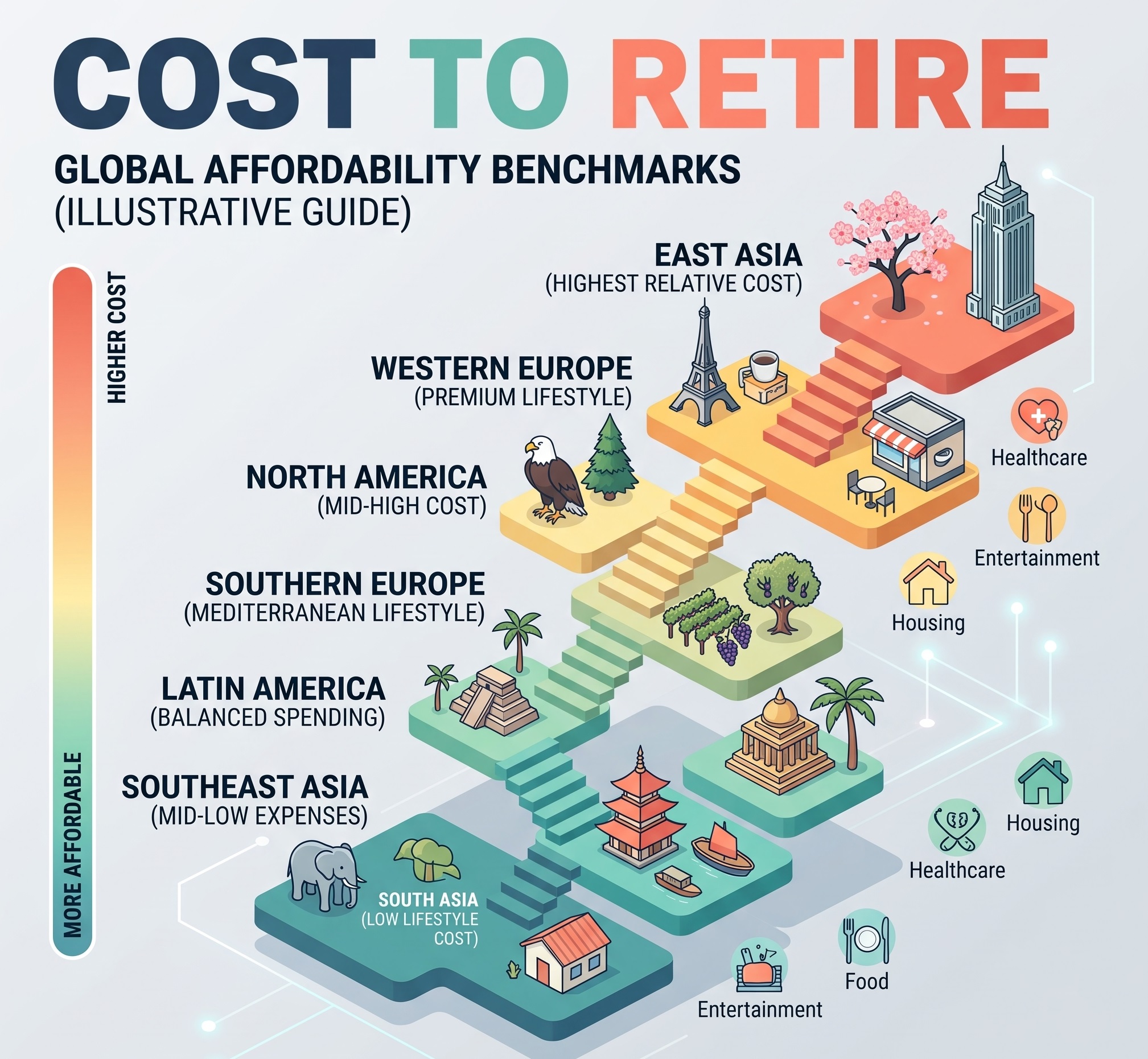
$738,000 is the estimated capital an American needs to retire comfortably at home. In Spain or Portugal, that number drops to $478,000. In Mexico, it falls to $356,000.
Many retail analysts look at these macro migration maps and predict an automatic boom for supermarkets across southern Europe and Latin America. They assume that when older people move abroad with money, grocery turnover rises across the entire market.
I do not buy this broad hype.
When you manage retail categories or advise grocery chains, you learn that macro migration numbers rarely match shelf reality. If you misread demographic headlines, you end up with dead inventory, annoyed local shoppers, and weaker operating margins.

Source: Visual capitalist
Cost to Retire Comfortably
| Country | Estimated Cost |
|---|---|
| Singapore | $1.1M |
| Iceland | $893K |
| CHE (Switzerland) | $859K |
| U.S. | $738K |
| Ireland | $702K |
| UK | $627K |
| Norway | $623K |
| Australia | $620K |
| Canada | $598K |
| Costa Rica | $556K |
| NZL (New Zealand) | $527K |
| FIN (Finland) | $520K |
| Sweden | $508K |
| FRA (France) | $496K |
| PRT (Portugal) | $478K |
| Spain | $478K |
| Uruguay | $451K |
| Japan | $398K |
| Mexico | $356K |
| Taiwan | $354K |
| Argentina | $347K |
| DOM (Dominican Republic) | $339K |
| Chile | $338K |
| Ghana | $324K |
| Nigeria | $324K |
| South Africa | $313K |
| Philippines | $301K |
| Morocco | $284K |
| Russia | $281K |
| China | $279K |
| Brazil | $268K |
| India | $189K |
| Pakistan | $187K |
Macro Migration Data vs Supermarket Shelf Economics
The data circulating online relies on cost-of-living estimators like Numbeo. It takes a theoretical basket of goods, calculates average prices, and adds a 20% cushion.
This approach hides two operational realities:
- Healthcare and tax friction: The data excludes healthcare costs and tax liabilities. When an American moves abroad, they often lose domestic Medicare coverage. Private international health insurance quickly erodes the living-cost gap.
- Low absolute volume: While retirement migration gets huge media attention, the absolute number of people moving permanently across borders is relatively small.
Because of this, retiring foreigners never create nationwide retail demand. They create hyper-localized pockets of demand.
If a supermarket chain with 400 stores changes its national assortment to chase foreign retirees, 380 of those stores will see their category margins drop. The target shoppers simply do not live there.
Why Expat Shoppers Break Standard Retail Planograms
A 65-year-old expat moving from Chicago or London to a sunny coastal town does not shop like a domestic family.
- Household structure: They cook for one or two people, not four or five.
- Brand equity: They have zero emotional attachment to local heritage brands that domestic shoppers have bought for decades.
- Basket composition: They spend money on fresh items, ready meals, dietary products, and wine, but they buy in strictly limited volumes.
- Price philosophy: They have stable pension income, but they hate throwing food away.
When a category manager forces a standard, family-focused planogram into an expat-dense store, space productivity collapses. The 1kg family meat packs sit on the shelf until they require markdowns. Meanwhile, the single-serve salads and imported breakfast items sell out by midday.
Store Clustering Strategy for Expat and Retirement Hubs
To capture real profit from cross-border retirees, retailers must stop managing assortments at the national or broad regional level. The solution is store clustering.
How to Build an Expat Store Cluster
Retailers must isolate specific postal codes where foreign resident density exceeds 15% to 20% of the store catchment area. Common examples include the Costa Blanca and Costa del Sol in Spain, the Algarve in Portugal, or towns like San Miguel de Allende in Mexico.
Once these specific stores are grouped:
- Tag the cluster inside your inventory and space planning software.
- Disconnect these stores from the standard national planogram.
- Give store managers the flexibility to adjust local shelf facings based on weekly velocity data.
The “World Food” Aisle Trap
Most supermarkets respond to foreign demand by creating a separate “international foods” aisle in the back corner. This is usually a waste of valuable floor space.
That aisle ends up filled with overpriced, slow-moving novelty items like dusty snack boxes and specialty sauces. It turns into dead inventory.
Instead, take the top 3 to 5 high-velocity foreign staples and integrate them directly into core categories:
- Put foreign tea and cereal brands right next to the local category leaders.
- Place expat-preferred bacon cuts or breakfast sausages inside the main fresh meat section.
- Shelve plant-based and lactose-free dairy alternatives directly alongside standard milk.
4 Real-Life Category Adjustments for High-Margin Retailing
If your supermarket operates inside a proven expat cluster, here are four concrete adjustments to make on the shop floor:
- Downsize fresh protein packaging: Family-sized 800g and 1kg meat trays fail with two-person households. Introduce 200g to 300g fresh packs containing single steaks, two chicken breasts, or clean fish fillets. Packaging costs per unit rise slightly, but shoppers gladly pay a 15% to 20% higher price per kilo to avoid food waste.
- Replace multi-buys with simple unit pricing: Domestic chains love “Buy 2, Get 1 Free” or “50% off the second unit.” Older shoppers in smaller homes do not want three large detergent bottles taking up storage space. Move to Everyday Low Price (EDLP) or straight single-unit discounts. Clear shelf-edge prices build loyalty faster than complex loyalty apps.
- Optimize category navigation and dietary callouts: Older foreign consumers actively search for functional foods: low-sodium, gluten-free, organic, and high-protein. Add clear bilingual shelf talkers (such as English alongside the local language). Ensure private label dietary icons are bold and placed on the front of the pack.
- Protect supplier promotional funding: Do not eliminate volume-driving supplier promotions across the entire chain. Keep standard supplier-funded multi-buys in your core 90% domestic family stores. Re-negotiate trade terms specifically for your expat cluster stores, trading volume rebates for margin support on single-pack formats.
Operational FMCG Checklist for Supermarket Category Managers
Category buyers and store operations teams can use this step-by-step review process:
- Audit catchment demographics: Review municipal registration data and credit card origin metrics for each store.
- Identify top 10 expat SKUs: Run velocity and margin reports on international lines across all coastal or hub stores.
- Reallocate fresh category shelf space: Reduce 1kg meat and fish trays by 30% in cluster stores, giving that space to 250g portions.
- Audit in-store language: Verify that aisle signs, category headers, and dietary icons are readable for non-native speakers without violating local language regulations.
- Track fresh shrink weekly: Measure whether downsized packs reduce markdown waste and increase category margin per square meter.
Frequently Asked Questions (FAQ) on Retail Store Clustering
What is store clustering in retail category management?
Store clustering is the practice of grouping retail stores based on specific customer demographics, shopping behaviors, and sales patterns rather than simple geographic regions. It allows category managers to tailor product assortments, pack sizes, and shelf space to specific customer profiles.
Why do international food aisles underperform in expat areas?
International aisles treat foreign residents as novelty shoppers instead of regular grocery consumers. Isolating foreign products in a separate aisle reduces foot traffic and lowers sales velocity. Placing high-demand foreign items directly into core aisles drives higher daily turnover.
How does pack size impact retail margins with older shoppers?
Older shoppers living in 1- or 2-person households prioritize zero food waste over bulk volume discounts. Retailers can earn higher margins per kilogram by offering smaller, single-portion packs at a higher unit price.
Should retailers translate all product packaging for foreign retirees?
No. Translating all packaging is expensive and often violates national labeling laws. Retailers should instead use clear bilingual shelf-edge labels and standard universal dietary icons on the shelf edge.
Related posts:
 The battle for US grocery market.
 Inditex Q1 2026 Performance
 The Billion-Dollar Illusion: How a Fake Movie Parade Transformed Global Retail and Tourism
 US Brand Equity Harvesting Trends: Why Heritage Products Are Failing
 Scaloni Garmin Watch: The True Story of the Viral 180 BPM Ad
 European Retail Self Checkout Shrinkage 2026: 22% Loss
Leave a Reply