
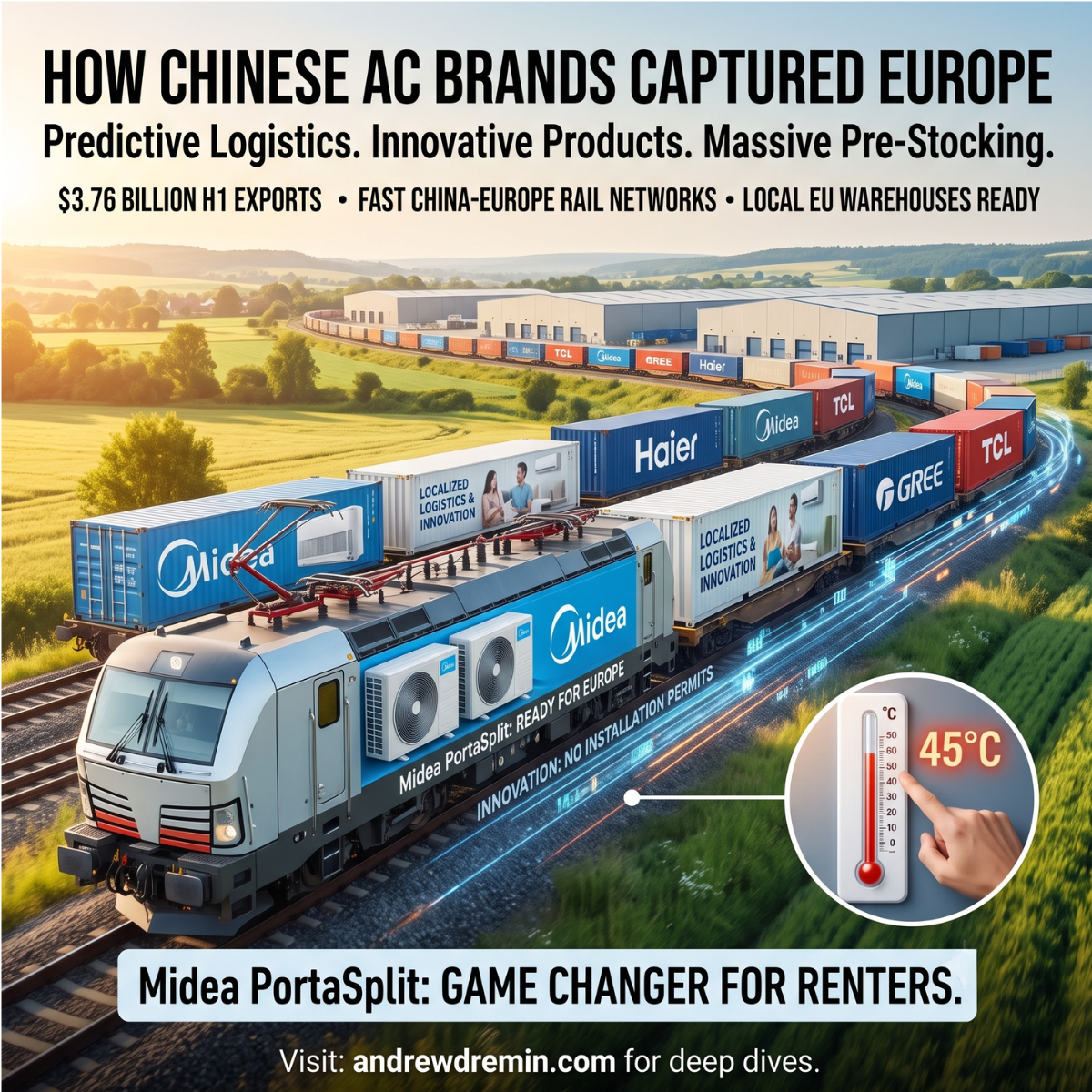
$3.76 billion in six months. That is the exact value of Chinese air conditioners exported to the EU in the first half of this year.
Let us look at what happened on the ground. When temperatures hit 45°C, European citizens were literally fighting in supermarket aisles. The desperation was real. An Austrian buyer used three AI bots just to track store inventory. He drove 200 kilometers for a single Midea unit. At a Lidl near Paris, local police had to break up crowds fighting over €179 AC units. People abandoned normal buying behavior. Scalpers took advantage of this panic. They flipped €800 portable units for up to €5,000 on secondhand online platforms. This is not normal retail. This is survival buying.
I speak with retail clients often. Many of them try to blame the sudden weather for empty shelves. They say nobody could predict this exact demand spike. I disagree completely. The heatwave did not create the problem. It just exposed a broken retail model.
European retail has a supply chain problem. Traditional purchasing relies on rigid, long cycles. You order in Asia, wait for manufacturing, consolidate at the port, and ship by ocean. Ocean transit from China to Europe takes 30 to 45 days. Add order processing and inland distribution, and you easily get a 90-day delay.
Blaming the ocean journey is a weak excuse. You cannot fix a sudden climate emergency with a three-month delay. Traditional retailers plan inventory using historical weather data. They order what sold last year. When climate changes bring overnight demand spikes, this old model fails hard. If your supply chain needs 90 days to react, you lose the market entirely. By the time the ship arrives, the heatwave is over. You are stuck with inventory you must discount next year.
There is a popular narrative right now in the industry. People say Chinese brands like Midea, Haier, Gree, and TCL won because they used the 15-day China-Europe rail network to react to the weather instantly.
As a critical analyst, I have to state: this is a myth. The math does not work.
First, look at the timing. A severe heatwave lasts maybe ten days. If you wait for the demand spike to trigger a shipment from China, a 15-day train ride means the product arrives just as the weather cools down. You miss the sales window. Second, look at the economics. Rail freight costs significantly more than ocean freight. It also has a fraction of the capacity. Moving thousands of bulky air conditioners by train destroys retail margins. You lose money on every unit you sell.
The Chinese brands did not win because they put units on trains in response to the heat.
They won through predictive positioning. They took a calculated risk. Brands moved massive inventory into localized European warehouses months ahead of the summer season. They committed the capital to hold stock inside the EU. When the demand spiked overnight, they were already there. They did not need to cross a border. They only needed a local truck. The rail network was likely used for secondary replenishment later, not as the frontline response.
This is the exact difference between a reactive supply chain and a proactive one. If you want to capture sudden demand, your product must already be inside the local market border. You cannot outrun a 10-day heatwave with a 15-day train from China.
Logistics is only half the story. The real victory was in product innovation. They understood local market constraints better than local companies.
Traditional split air conditioners have a massive bottleneck: installation. In the EU, strict F-gas regulations mean you need a certified technician to handle the refrigerant. Building codes are very strict. Renters cannot drill holes in walls without explicit landlord permission. During a heatwave, waiting three weeks for a technician is not an option. People need cold air today.
Chinese brands saw this gap. They removed the friction. Look at the Midea PortaSplit. They designed a product with a factory-sealed refrigeration circuit. This engineering choice entirely bypasses the strict EU F-gas regulations. It requires no professional installation. It requires no permanent drilling. You hang it over the window.
Renters could buy it, take it home, plug it in, and cool down immediately. The product design bypassed the regulatory and physical barriers of the European market. They sold convenience, not just cold air.
Here is the hard takeaway for retail and FMCG leaders.
Stop planning your inventory using old weather data. Climate volatility is the new baseline. Demand spikes will happen overnight.
Stop relying on long-haul transit to react to weather anomalies. If you wait for a demand spike to trigger a shipment, you fail. The lesson here is not about finding a faster shipping route.
It is about two things. First, remove usage friction from your products. If the customer cannot use it the same day they buy it, they will buy something else. Second, hold localized inventory ahead of the curve. Accept the cost of holding stock locally as the price of capturing high-margin panic buying.
You must build systems that are already in place before the crisis hits. Anything else is just making excuses.
Related posts:
 Эспрессо против энергетика: почему регуляторы убивают алюминиевые банки и что делать FMCG
 GLP-1 Retail Impact: How Weight-Loss Drugs Are Shrinking Supermarket Sales
 The Supermarket Grocerant Trend: Why Retailers Are Stealing Restaurant Profits
 European Retail Self Checkout Shrinkage 2026: 22% Loss
 The €100 Billion Milestone: Inside the Rise of Europe’s Silent Retail Giant
 74% Leakage: Why Offline Trust is Dying Online