
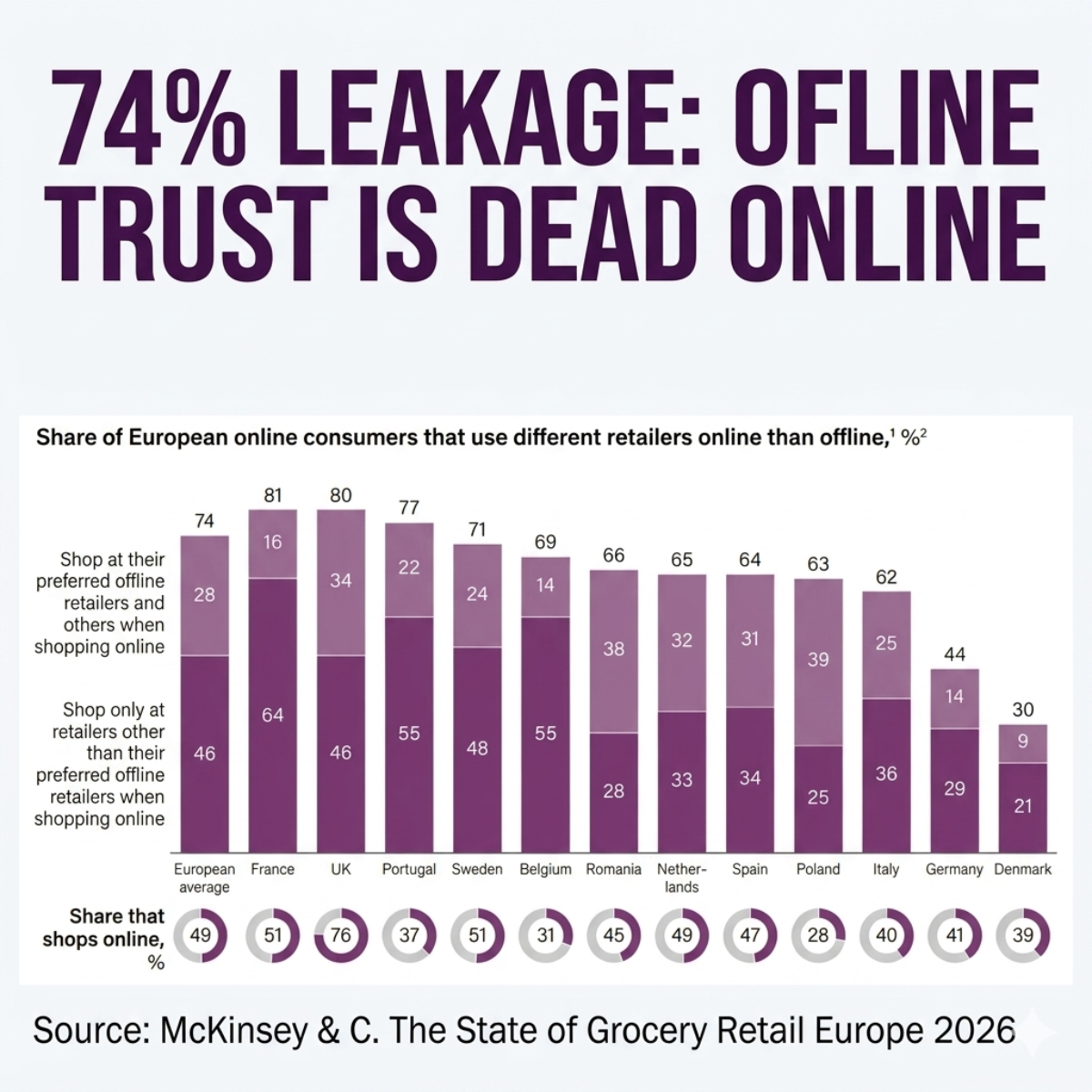
Why is this happening? Many retail executives believe their offline brand name will protect them online. They are wrong. The research shows that what makes a customer happy in a store is completely different from what makes them happy on an app, underscoring the difficulty of maintaining offline trust digital.
When a person shops online, they aren’t looking for a “brand experience.” They are looking for a tool. If your app is the best tool for the job, they use it. If a competitor’s app is better, they switch. In fact, 30 out of 40 retailers analyzed actually received higher satisfaction scores for their online channels than their physical stores. This tells us that consumers often prefer the digital experience, provided it works perfectly, emphasizing the critical role of digital shopping convenience.
Retailers are “bleeding cash” because they treated their apps like a side project. To survive, they must rethink their retail app strategy and offer “friction-free” journeys: one-tap reordering, auto-filled addresses, and biometric checkouts.
The Anatomy of a Financial Leak
But the “eye-level” of the internet is the top search result. If a brand owns 40 percent of the physical shelf but ranks on page two of an app’s search results, it is effectively invisible to the digital shopper, highlighting the critical challenge of achieving strong FMCG digital visibility.
This means that for almost half of your customers, your brand does not exist in their digital world. Another 28 percent use a “hybrid” approach, shopping at their favorite store but also frequently checking other apps. Together, this creates a 74 percent “hole in the pocket” for traditional grocers.
Market by Market: The Loyalty Gap
The “leakage” is not the same in every country. In France, the situation is even more critical, with an 80 percent leakage rate. This means that for every five loyal customers who walk through a physical door, four will choose a competitor when they open an app.
Below is the detailed breakdown of how consumers across Europe are switching banners when they move from the street to the screen:
| Country | Shop ONLY at competitors online | Shop at preferred + others online | Total Digital Leakage | Share that shops online (%) |
| France | 64% | 16% | 80% | 51% |
| UK | 46% | 34% | 80% | 76% |
| Portugal | 55% | 22% | 77% | 37% |
| Sweden | 48% | 24% | 72% | 51% |
| Belgium | 55% | 14% | 69% | 31% |
| European Average | 46% | 28% | 74% | 49% |
| Romania | 28% | 38% | 66% | 45% |
| Netherlands | 33% | 32% | 65% | 49% |
| Spain | 34% | 31% | 65% | 47% |
| Poland | 25% | 39% | 64% | 28% |
| Italy | 36% | 25% | 61% | 40% |
| Germany | 29% | 14% | 43% | 41% |
| Denmark | 21% | 9% | 30% | 39% |
Data source: McKinsey & Co. The State of Grocery Retail Europe 2026.
The difference between France (80% leakage) and Denmark (30% leakage) is eye-opening. In markets with high online penetration, like the UK (76%) and France (51%), the competition from tech-native delivery platforms is so strong that it is overwhelming the loyalty people feel for their local hypermarkets.
Why Trust Does Not Survive the Digital Transition
Why is this happening? Many retail executives believe their offline brand name will protect them online. They are wrong. The research shows that what makes a customer happy in a store is completely different from what makes them happy on an app.
In a physical store, people care about location, low prices, and promotions. Trust is built because the store is nearby and familiar. However, online shopping satisfaction is driven by value for money, product quality, and ease of use.
When a person shops online, they aren’t looking for a “brand experience.” They are looking for a tool. If your app is the best tool for the job, they use it. If a competitor’s app is better, they switch. In fact, 30 out of 40 retailers analyzed actually received higher satisfaction scores for their online channels than their physical stores. This tells us that consumers often prefer the digital experience, provided it works perfectly.
The One-Second Rule: Tech as a Survival Strategy
For a retailer in 2026, technology is not a “bonus” – it is your primary defense. The relationship between speed and money is simple and brutal: every one-second delay in page load time reduces your sales by 7 percent.
If your app takes longer than three seconds to load, 53 percent of users will simply close it and go somewhere else. In the world of Sunday night grocery shopping, a slow app is a direct invitation for your customer to leave forever.
The big winners are moving toward “Native” apps (built specifically for iOS or Android) rather than “Mobile Websites.” Here is why the tech choice matters:
| Metric | Native Mobile App | Progressive Web App (PWA) | Mobile Website |
| Avg. Load Speed | < 1.0 Seconds | 1.5 – 2.5 Seconds | 3.0 – 5.0 Seconds |
| Conversion Rate | 3.0x (Baseline) | 1.5x | 1.0x |
| Abandonment Rate | < 10% | 20% – 30% | > 50% |
| Offline Power | Full | Limited | None |
Retailers are “bleeding cash” because they treated their apps like a side project. To survive, they must offer “friction-free” journeys: one-tap reordering, auto-filled addresses, and biometric checkouts.
The FMCG Crisis: The Digital Shelf Trap
It isn’t just the stores that are in trouble; the brands that sell products (FMCG) are also facing a crisis. For fifty years, these brands won by owning the “eye-level” shelf in physical stores. If you had the most space in the pasta aisle, you sold the most pasta.
But the “eye-level” of the internet is the top search result. If a brand owns 40 percent of the physical shelf but ranks on page two of an app’s search results, it is effectively invisible to the digital shopper.
The Strategy Shift for Brands
| Physical Store Lever | Digital Counterpart | Why it Matters |
| Eye-Level Shelf | Top 3 Search Results | 90% of clicks happen here |
| End-Cap Display | Sponsored Ads / Media | Immediate visibility in a crowded app |
| Shelf Talkers | High-Quality Video / A+ Content | Builds trust without physical touch |
| In-Store Sampling | Data-Driven Personalization | Replaces “tasting” with “recommending” |
FMCG brands must move from “Retail Analytics” (looking at what happened last month) to “Retail Intelligence” (monitoring search rankings and out-of-stock signals in real-time). Digital data shows that a product being out-of-stock online can “bleed” sales for days before a human manager even notices.
The SME Advantage: Small, Fast, and Local
While the giants struggle with their massive apps, Small and Medium Enterprises (SMEs) are finding a different way to win. They are focusing on hyper-local delivery – serving a specific neighborhood in 15 to 30 minutes.
SMEs do not need “heavy tech.” They need “agile tech.” By using neighborhood stores as small fulfillment centers, they can deliver niche products that big retailers ignore: artisanal bread, local organic meat, or specialty produce.
These small players are seeing 30% better customer retention because they offer a personal connection that a massive, cold app cannot provide. They are winning by digitizing the “trust of the neighborhood”.
The Next Wave: Agentic Commerce
As we look toward the end of 2026, a new technology is arriving: Agentic Commerce. This is the use of AI “agents” that shop for the consumer.
Imagine an AI that knows your budget, your health goals, and your pantry levels. It builds your basket automatically and compares prices across five different stores in milliseconds to find the best deal. For retailers, this is a nightmare: the AI agent doesn’t care about your brand history or your store’s atmosphere. It only cares about price, availability, and speed.
Grocery CEOs have noticed. AI and automation are now the second-highest priority on the CEO agenda for 2026, rising four places since last year.
The Final Bill: €600 Billion to Stay in the Game
Survival is not cheap. To fix the 74 percent leakage and modernize for the AI era, the European retail sector needs to invest between €315 billion and €600 billion by 2030.
This money must go into:
- IT Modernization: Replacing old systems with fast, cloud-based tech.
- Advanced Analytics: Using data to predict what people will buy before they buy it.
- Automation: Turning warehouses and stores into high-speed fulfillment hubs.
For an industry with very low profit margins (typically 3-4%), this is a massive burden. SMEs alone will need to find about €35 billion to €60 billion to keep up.
Conclusion: Reversing the Leak
The 74 percent leakage is a wake-up call. The “omnichannel” dream of the past – where a store and an app just existed together – is dead. It has been replaced by a reality where the digital interface is the primary guardian of the customer relationship.
To stop the bleeding, retailers and brands must follow three rules:
- Win on Speed: If your app isn’t under 1.0 second, you are losing money every minute.
- Win on Search: If you aren’t in the top three results, your brand is invisible.
- Win on Local: Use hyper-local delivery to provide a service that global giants can’t match.
In 2026, the grocery market is not slowing down; it is resetting. The winners will be those who realize that while offline trust is a great start, digital convenience is the finish line.
Related posts:
 Electronic shelf labels wars
 Retail Margin Protection: 4 Brutal Strategies to Survive Cheap Imports
 Strategic alliance: Estée Lauder-Puig
 EU Small Parcel Tax: Why the New Custom Rules Won’t Stop Shein & Temu
 Tesco and Football championship
 The Billion-Dollar Illusion: How a Fake Movie Parade Transformed Global Retail and Tourism