
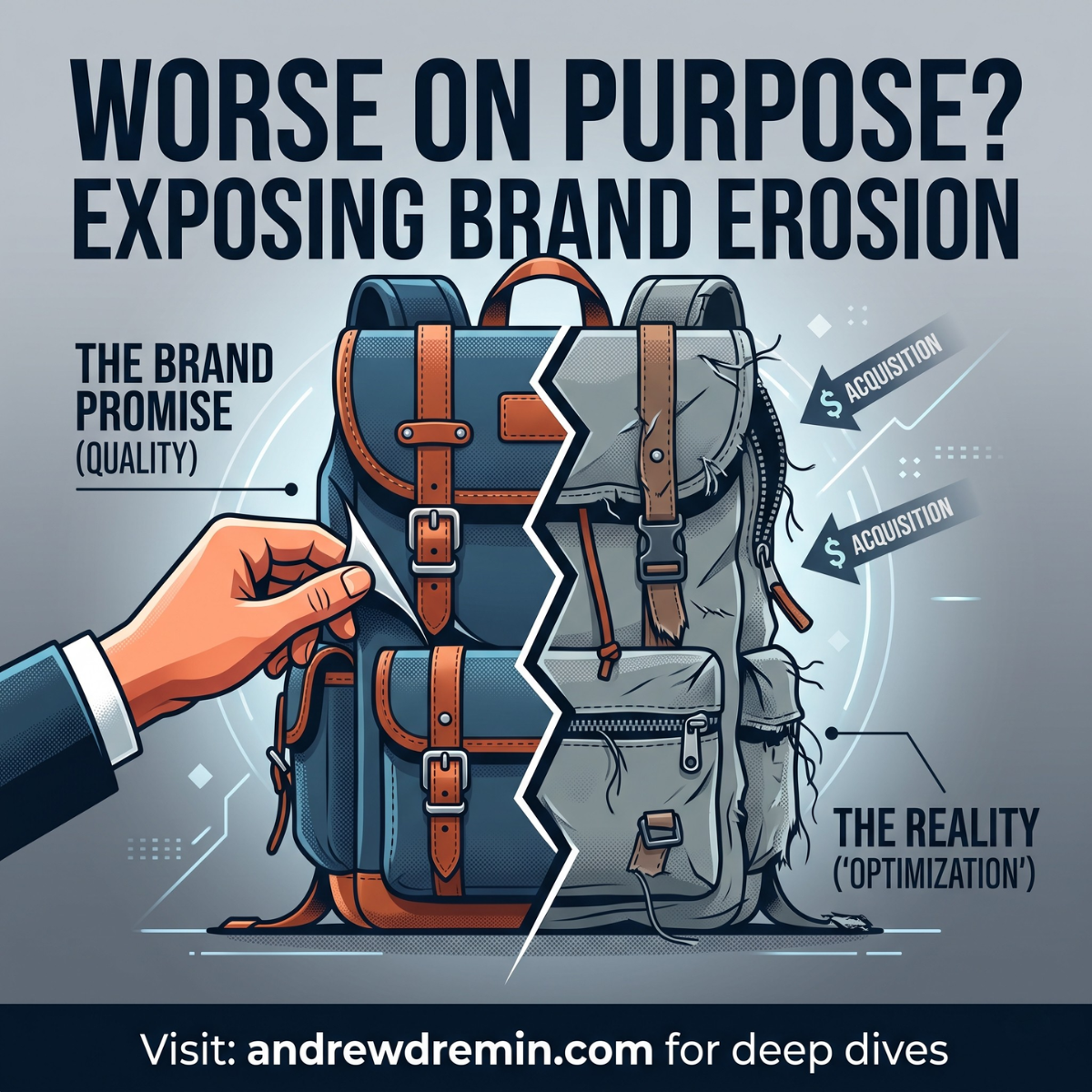
75% of consumers faced a product failure or bad customer service last year. That is double the rate recorded in 1976. Recent US brand equity harvesting trends may help explain this sharp increase and its impact on customer experience.
At the same time, US corporate profits hit a record $3.9 trillion.
A investigation by The Guardian showed this is not an accident. It is a calculated strategy called “brand equity harvesting”.
Tracking “Worse on Purpose” Products
Here is the human angle.
Keyana Sapp bought a backpack. He expected it to last. When zippers jammed and seams split, he checked who actually owned the company.
He discovered JanSport, The North Face, and Eastpak – once fierce competitors – are now all owned by the same corporate group, VF Corporation.
So he created “The Brand Ledger” and the “Worse on Purpose” project. He tracks 345 heritage brands to show how parent companies downgrade materials, stitching, and hardware post-acquisition to hit short-term profit targets.
We see this everywhere. A casserole dish cracks on its third use. A new coat zipper breaks in week two. Unilever changes Talenti gelato ingredients after acquiring it.
The Private Equity Playbook
In my years analyzing retail and FMCG strategy, I have watched this private equity playbook repeat:
- Buy a trusted brand with high customer loyalty.
- Strip out manufacturing costs step by step.
- Ride the reputation until the product becomes a shell of itself.
Executives assume consumers will not notice small quality drops.
As Ben & Jerry’s co-founder Ben Cohen told The Guardian: You take a sliver off the loaf of baloney, and you think nobody realizes. You keep doing it year after year. Then suddenly, you have no baloney left.
Why Corporate Opacity Is Dead
Here is the real problem for retail leaders:
- Corporate opacity is dead.
- Today, shoppers stand in store aisles and scan barcodes with apps like Buy’r. They check community databases before spending money. They switch to independent brands in seconds.
Strategic Takeaways for FMCG Executives
My conclusions for FMCG executives:
- Quality reduction is not cost optimization. It is slow-motion brand liquidation.
- Short-term gains, long-term loss. Cost cuts look great on a quarterly slide, but they destroy customer lifetime value.
- The risk of disruption. Independent brands that refuse to cheapen their products will take your market share.
When you treat customer trust as a depreciable asset, you destroy the terminal value of the enterprise.
How often do you notice heritage brands getting worse post-acquisition? Do you check who owns a brand before buying?
Source: Guardian


Leave a Reply