
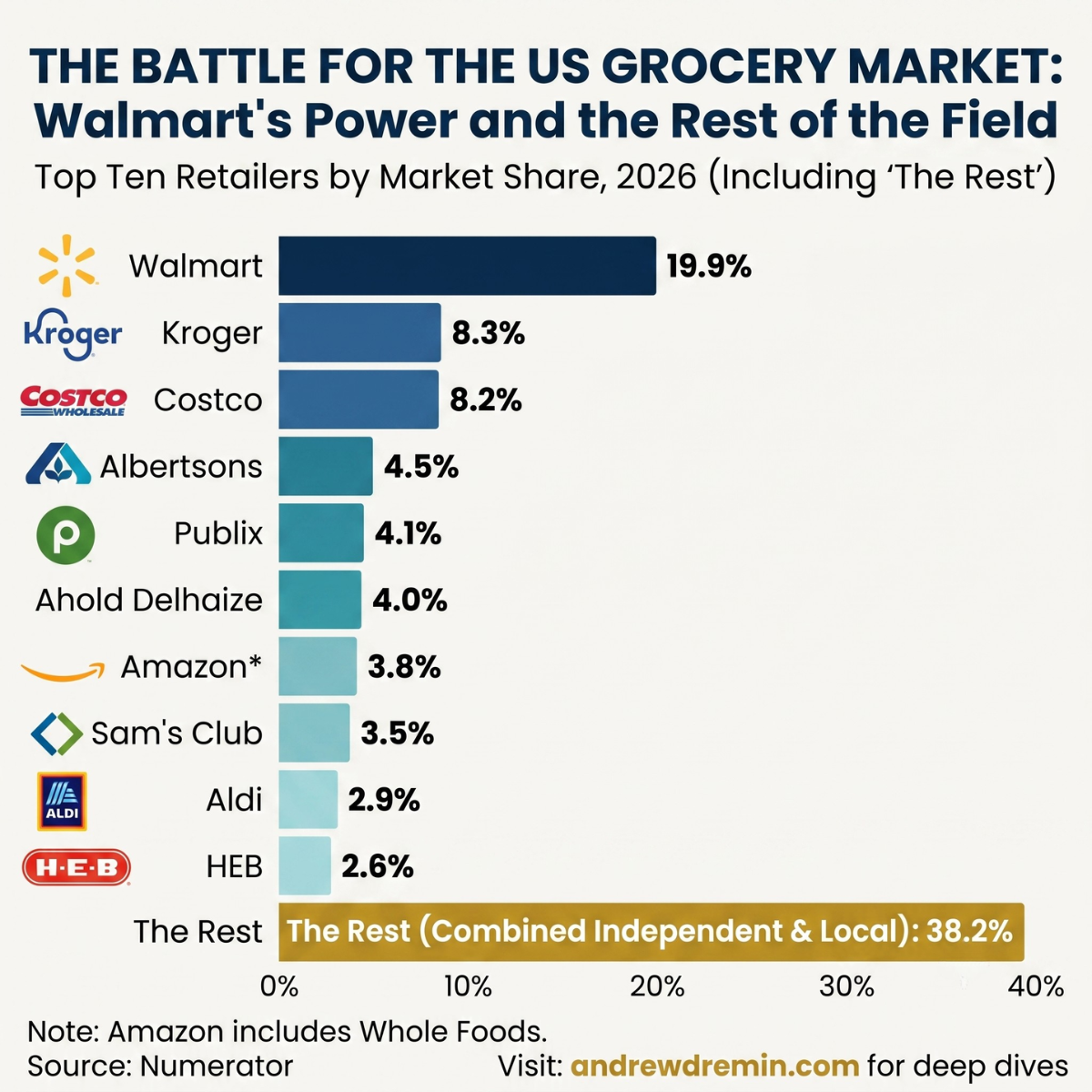
$353.5 billion.
That is the direct annual sales of independent and regional grocers in the US, according to the latest 2026 data from the National Grocers Association (NGA).
This is not a small niche. It represents 38.4% of the entire US food retail market.
The Battle for the US Grocery Market (2026)
| Retailer | Market Share (2026) |
|---|---|
| Walmart | 19.9% |
| Kroger | 8.3% |
| Costco | 8.2% |
| Albertsons | 4.5% |
| Publix | 4.1% |
| Ahold Delhaize | 4.0% |
| Amazon* | 3.8% |
| Sam’s Club | 3.5% |
| Aldi | 2.9% |
| HEB | 2.6% |
| The Rest (Combined Independent & Local) | 38.2% |
To put that in perspective, “The Rest” is larger than Walmart’s 19.9% and Kroger’s 8.3% combined.
Yet, if you read corporate slides, you would think Walmart and Amazon run the entire world. Every FMCG brand I talk to is obsessed with getting into the biggest chains. They spend millions on listing fees. They wait six months for a single corporate meeting. They fight over tiny margins.
Meanwhile, they completely ignore the 38.4%.
This is a massive strategic mistake. The real growth, fast implementation, and product innovation are happening in “The Rest.”
Let us look at why.
The Reality of Regional Needs
Meet John. He is a real store manager in Ohio. John does not work in a shiny corporate tower. He is on the shop floor every day, talking to customers.
John knows his community. He knows that families in his town do not want the exact same generic bread or flour that people buy in New York or Los Angeles. They want basic, local goods. They want sausage from the regional farm. They want local honey.
For basic goods, regional tastes are incredibly strong.
But giant national chains cannot handle this level of detail. Their supply chains are too rigid. They need every store from coast to coast to look exactly the same.
This is where John wins. Because his store is independent, he can adapt to local needs instantly. He does not need a corporate committee to approve a local supplier.
Niche is the Real Innovation Lab
There is a common myth that independent grocers are old-fashioned and slow.
It is the opposite. Major distributors like KeHE point out that independent grocers are the direct pipeline for product innovation. They are the real market laboratory.
When a new food trend starts – like a new plant-based ingredient or a localized basic snack – it does not start at Walmart. It starts on the shelves of a local, independent grocer who took a chance on a local entrepreneur.
By the time a product gets to a massive national chain, the trend is already old news. The big chains are just the end of the journey. They copy what already worked in the independent market.
If you want to build a resilient FMCG brand, you must treat independent retailers as your primary launchpad.
Cooperatives Give Scale to “The Rest”
How can small stores compete with giant supply chains?
They do it through cooperatives. Organizations like Associated Wholesale Grocers (AWG) represent thousands of local stores. They negotiate together. They buy in bulk.
This means a local store has the buying power of a giant, but keeps the speed and local knowledge of an independent.
They are also modernizing fast. They are implementing new unified tech platforms to manage their inventories and stock basic goods more efficiently. They do not need billion-dollar tech budgets to be smart. They just use what works.
In fact, every dollar spent in these independent supermarkets generates an additional 58 cents in economic benefits for their local communities. It supports local truck drivers, food producers, and farmers.
Takeaways for FMCG and Retail Leaders
If you are running an FMCG brand or managing retail operations, you need to change your view of the market. Here is how:
- Stop treating “The Rest” as leftovers. A 38.4% market share is a massive, profitable territory. If you only focus on the top three chains, you are missing more than one-third of your potential customers.
- Focus on basic goods and local tastes. Do not try to sell a uniform product nationwide. Customize your basic goods portfolio to match regional tastes and traditions.
- Use speed to your advantage. Use regional grocers to test your new products. They can get your item on the shelf in days. Use them as your test lab, refine your product, and then scale.
- Build strong relationships with local distributors. Companies like KeHE and AWG are your gateway to thousands of highly profitable shelves.
Are you still wasting your budget waiting in line at corporate headquarters? Or are you winning the 38.4%?
Let me know your thoughts in the comments.
Related posts:
 The Tapas Wars: Mercadona vs Restaurants
 Tesco and Football championship
 The Ghost Wall: Why Mercadona is Killing the Fish Counter
 The €3.90 Gourmet Threat: How Supermarket Meal Kits are Disrupting Fast Casual Dining
 GLP-1 Retail Impact: How Weight-Loss Drugs Are Shrinking Supermarket Sales
 Proximity retail shift Spanish FMCG: 2026 data analysis