
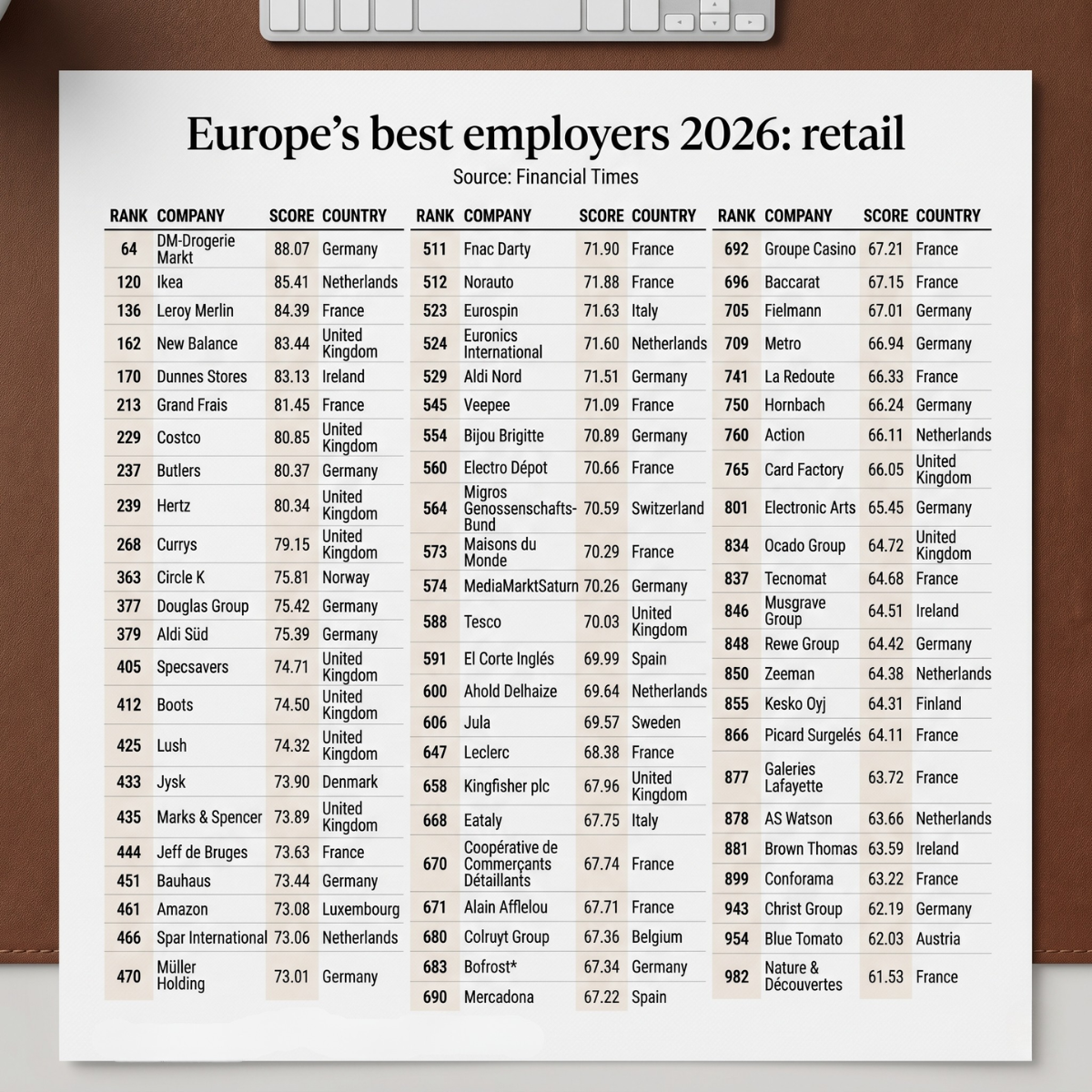
Zero out of the top 50 employers in Europe in the 2026 Financial Times ranking are traditional retailers. This observation highlights the ongoing challenges for the retail sector, especially when measured against titles like Europe Retail Best Employer 2026.
Look at Fast-Moving Consumer Goods (FMCG) companies like L’Oréal. They sit near the top. The reason comes down to basic math and margins: FMCG brands operate on gross margins that often exceed 60% to 70%. High margins allow these companies to offer strong compensation, comfortable corporate offices, career growth pipelines, and stability.
Traditional retail operates in a different reality. Supermarket chains and general retailers work with thin net profit margins, often between 2% and 4%. When margins are low, labor is treated as the primary controllable expense. Management cuts staffing levels to lower overhead, increasing the physical workload on remaining staff.
Because of this, major European grocery giants like Tesco and Carrefour land deep in the lower half of employer rankings. Their operating model is built for inventory volume and speed, not employee retention.
The Hidden Cost of Staff Turnover
A 75% annual employee turnover rate is common across grocery and mass retail. Many executives view this turnover as an acceptable cost of doing business. They treat entry-level staff as replaceable inputs.
Replacing a single store worker costs roughly $12,000. When a store with 200 employees replaces 75% of its staff every year, it loses 150 workers annually. That equals $1.8 million in direct turnover losses per store every year.
Where the $12,000 Cost Goes:
- Recruitment and Screening: Money spent on job ads, background checks, and HR processing time.
- Onboarding and Training: Paid hours for trainers and new hires before full productivity is reached.
- Productivity Loss: A new employee works at roughly 50% capacity during their first month compared to a experienced worker.
- Inventory and Process Errors: Mistakes in stocking, checkout errors, and product damage caused by inexperienced staff.
- Overtime Pay: Extra hours paid to current staff to cover open shifts.
Why Technology Made Retail Work Worse
Executives assumed that store automation, digital scheduling tools, and automated fulfillment centers would fix retail jobs. The data shows the opposite outcome. Pure e-commerce and logistics companies like Amazon and Ocado continue to receive low scores for employee satisfaction.
In modern fulfillment hubs, algorithms act as line managers:
- Continuous Tracking: Scanners and cameras track worker movement second by second.
- Time-Off-Task (TOT) Enforcement: Systems flag short pauses or bathroom breaks as efficiency drops.
- Algorithmic Scheduling: Software shifts work schedules day-by-day based on real-time customer orders, removing predictability for workers.
Technology in retail was implemented to track inventory and maximize throughput. Instead of making work easier, it created a high-surveillance environment for warehouse and store staff.
Framework: Two Models for Retail Survival
Not every retail company fails at employee retention. Two different strategies show how retailers can build a stable workforce.
1. High-Skill Sales Leverage (The Ikea Example)
- Mechanism: Ikea ranks higher on employer lists than department stores or grocery chains.
- Why it works: Planning a custom kitchen or complete living room requires product training and design skills. The total sales value per transaction is high.
- Impact: If an experienced worker leaves, the store loses high-ticket sales and risks customer errors. The employee holds leverage, so management invests in better schedules, higher pay, and better working conditions.
2. Decentralized Autonomy (The dm-drogerie markt Example)
- Mechanism: German drugstore chain dm-drogerie markt achieved rank 64 out of 1,000 European employers—the top result in retail.
- Why it works: They sell low-margin everyday goods, but give store teams control over their work.
- Impact: Local teams manage their own shift schedules, select product displays, and make stocking decisions based on local demand. Giving staff control over their environment reduces burnout without increasing wage bills.
The Demographic Reality in Europe
European retail relied on a steady supply of low-cost, flexible labor for decades. That labor pool is shrinking due to demographic shifts across the continent.
- Aging Population: In major markets like Germany, Italy, and Spain, the total number of working-age adults decreases every year.
- Increased Competition: Retail stores must compete for workers with logistics hubs, last-mile delivery services, and entry-level desk jobs.
- Higher Expectations: Younger workers reject unpredictable shift patterns and physical strain for low wages.
A business model built on replacing 75% of your staff every year fails when replacement workers are no longer available.
Action Items for Retail Operations
Fixing retail work requires fundamental operational shifts rather than minor office perks.
- Provide Shift Predictability: Publish schedules three to four weeks in advance. Stop using real-time, just-in-time shift adjustments.
- Delegate Store Authority: Allow store staff to adjust floor displays, process returns, and manage stock issues without needing central manager approval.
- Track Turnover as a Core Metric: Evaluate store managers on employee retention and shift stability, not just scanning speed and labor-cost reduction.
- Focus on Time Control: Give staff simple ways to swap shifts and request time off without penalty. Giving people agency over their schedule is the main factor in reducing turnover.
Related posts:
 FMCG skincare market trends 2026: NIVEA drops 6.8% vs Derma
 Tesco and Football championship
 The €3.90 Gourmet Threat: How Supermarket Meal Kits are Disrupting Fast Casual Dining
 Home – English
 The Ghost Wall: Why Mercadona is Killing the Fish Counter
 The 48% Price Increase: How Milka Changed the Bar
Leave a Reply