
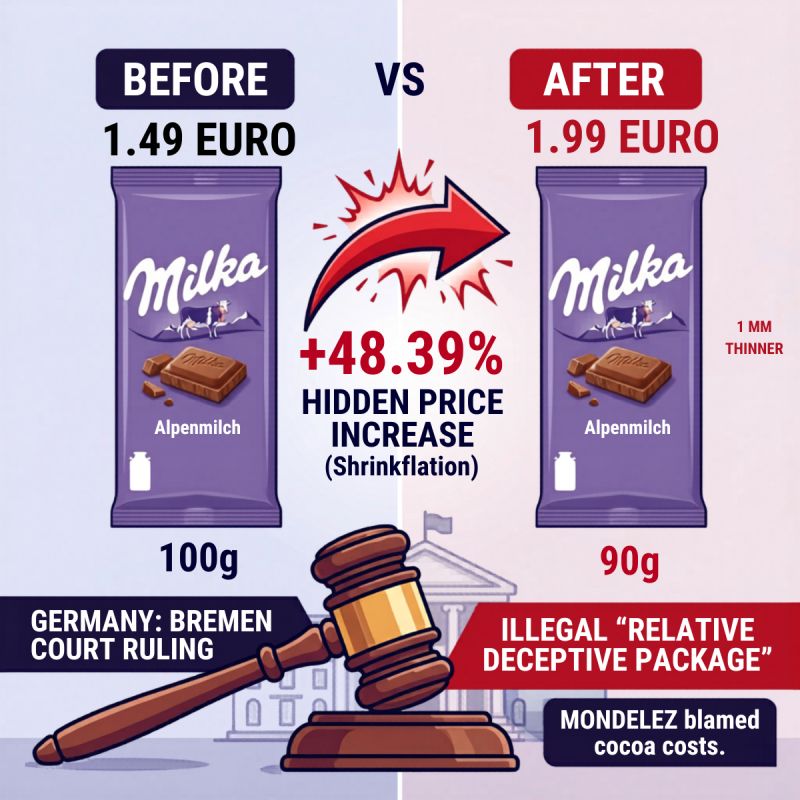
Mondelez reduced the standard Milka chocolate bar in Germany from 100 grams to 90 grams. At the same time, they raised the retail price. When you calculate the price per 100 grams, the final price for consumers increased by 48.39%.
To conceal this change, Mondelez made the chocolate bar 1 millimeter thinner. The outer wrapper kept the exact same length and width. To a customer grabbing chocolate off the shelf in a rush, the package looked identical to the old 100-gram version.
This is standard shrinkflation. Companies know that consumers check shelf prices much faster than they read the small weight numbers on the back of a wrapper. Shrinking the product thickness while keeping the package dimensions allowed Mondelez to lower manufacturing costs while charging more money per gram.
The Bremen Court Decision: Why It Is Illegal
The German consumer protection group Verbraucherzentrale Bremen took Mondelez to court over this packaging design. The Regional Court of Bremen ruled against Mondelez and declared the practice illegal.
The court called the package a “relative deceptive package” (relativ Mogelpackung). The judges explained that keeping the same outer dimensions while reducing the content misleads the average buyer. If the wrapper stays the same size, the shopper assumes the amount of chocolate inside remains unchanged.
Mondelez defended its decision by pointing to rising cocoa costs. Global cocoa prices reached historic highs due to bad weather and plant disease in West Africa. While raw material costs did increase, the court made a clear distinction: rising ingredient costs give a brand the right to change prices, but not the right to deceive buyers with misleading packaging.
Europe Is Cracking Down on Shrinkflation
The court ruling in Bremen is not an isolated event. Governments and regulatory bodies across Europe are taking direct action against hidden price increases.
- Austria: Passed rules requiring large supermarkets to place clear warning signs on store shelves when a product’s content shrinks but the retail price stays the same or goes up.
- France: Implemented regulations forcing retailers to notify shoppers about shrinkflation directly on shelf tags for two months after any size reduction.
- Germany: Consumer watchdogs systematically track shrinkflation and publish regular lists of deceptive products, putting public pressure on consumer goods companies.
Even heritage brands face backlash. Ritter Sport received heavy public criticism when they introduced 75-gram bars alongside their classic 100-gram square bars. For decades, European consumers viewed 100 grams as the fixed standard for chocolate. Disrupting that baseline creates immediate consumer friction and legal scrutiny.
The Strategic Risks of Shrinkflation
Damage to Brand Trust
Shrinkflation looks good on a corporate spreadsheet. Finance managers like it because it protects profit margins without triggering the immediate shock of a higher shelf price. As consumers become more aware of US shrinkflation trends in consumer goods, they may start to question the value of products they purchase. This scrutiny can lead to a shift in buying habits and preferences, as shoppers seek out better deals or alternative options. Companies will need to adapt their strategies to maintain customer loyalty in this evolving market landscape.
However, the long-term risk to brand equity is high. When buyers realize a brand quietly reduced product size, they feel cheated. Brand trust takes years to build, but a single public lawsuit or viral social post can destroy it quickly. Disillusioned buyers often switch to store brands or cheaper competitors.
Conflict Between Retailers and Brands
Retailers stand on the front lines with consumers. Store employees deal directly with angry shoppers who notice the smaller weight after buying. Shoppers often blame the supermarket instead of the manufacturer.
Because of this, supermarket chains are pushing back hard. European retailers like Edeka and Carrefour have pulled products off shelves during price disputes with major suppliers like Mondelez, PepsiCo’s pricing conflicts, and Mars. Retailers want to protect customer loyalty and avoid taking the blame for manufacturer margin tricks.
Advice for Brands and Retailers
Match Packaging Size to Product Weight
If you cut product weight by 10%, shrink the physical size of the packaging by 10%. Leaving empty air or excess wrapper space is now a direct legal risk in Europe. Identical packaging dimensions with lower net weight is now categorized as legal deception.
Practice Clear Transparency
Be direct on the front display. If product weight drops, print a clear notice on the front wrapper: “New 90g size.” Being open about changes lowers consumer anger and preserves long-term brand authority.
Retailer Governance and Unit Pricing
Retailers must protect their shoppers by setting clear rules for suppliers. Require manufacturers to give a 90-day notice before any product weight changes occur. Display unit prices – such as price per 100 grams or price per kilogram – in large, bold text on store shelf tags so consumers can compare value instantly.
Related posts:
 Spain reached 19th place on the 2026 HelloSafe Prosperity Index
 The Billion-Dollar Illusion: How a Fake Movie Parade Transformed Global Retail and Tourism
 The most reliable car brands in 2026 US
 Lidl is now your phone operator
 Inditex Q1 2026 Performance
 The Supermarket Grocerant Trend: Why Retailers Are Stealing Restaurant Profits