
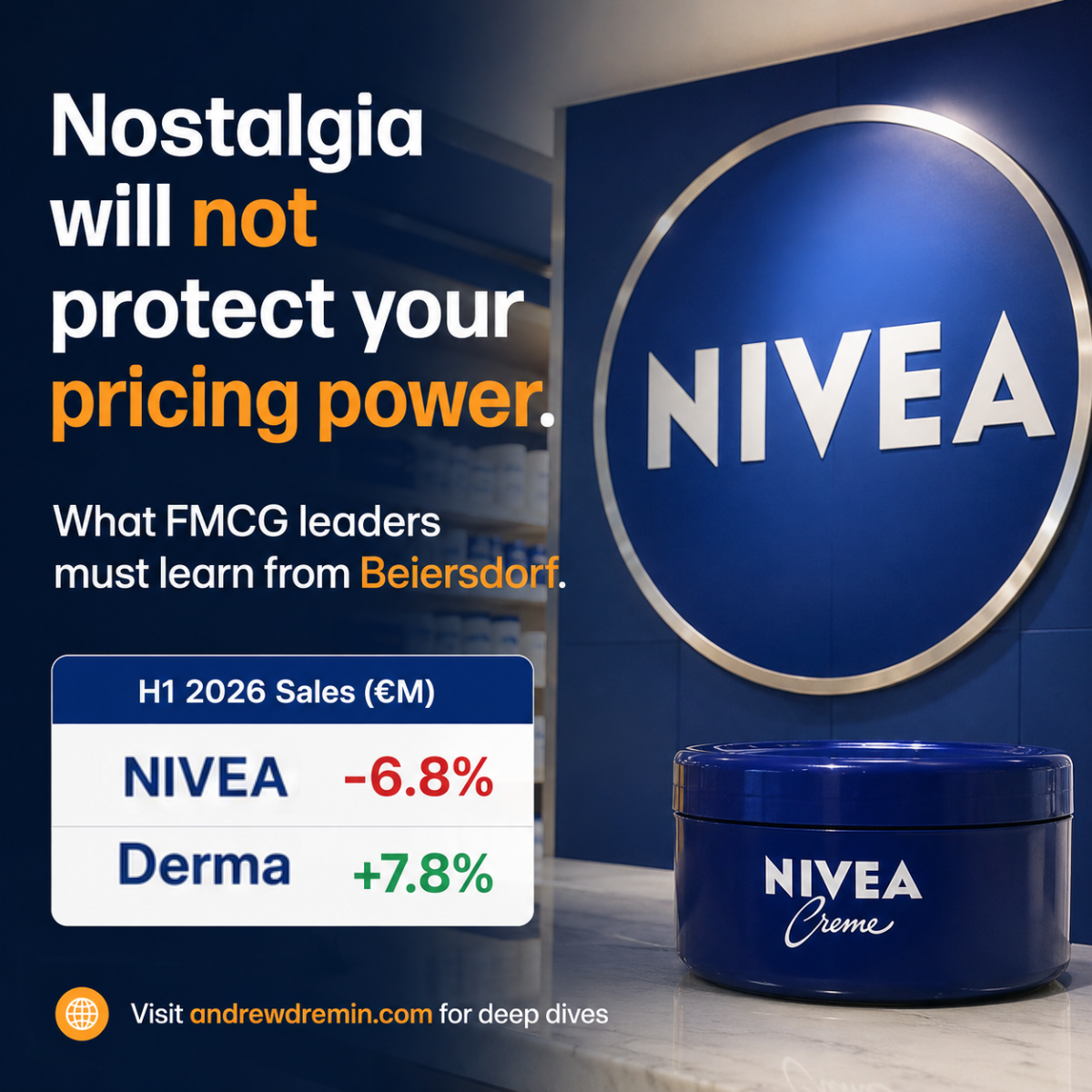
NIVEA sales dropped 6.8% in the first half of 2026. These results can be better understood when looking at FMCG skincare market trends 2026. In the second quarter alone, sales fell 6.7%. Because of this drag, parent company Beiersdorf was forced to cut its corporate financial guidance for the year.
To stop the top-line decline, executive management announced an emergency 18-month turnaround plan. They are dumping an extra €100 million into media spend and consumer activation during the second half of the year.
As a retail advisor, my opinion is simple: throwing cash at marketing will not save a brand that allowed its core strategy to get complacent.
The Commercial Reality: Sell-In vs. Sell-Out
To understand this situation properly, we have to separate factory shipments (sell-in) from store register sales to consumers (sell-out).
NIVEA’s factory shipments dropped sharply due to three commercial friction points:
- European supermarket chains fought aggressively against brand price increases, leading to contract disputes and listing suspensions.
- Retailers aggressively reduced their store inventory levels to cut working capital.
- Unusually cold and wet spring weather across Western Europe delayed the summer sun care buying season.
Register sales to actual shoppers (sell-out) performed slightly better than factory shipments. But the underlying retail trend is clear: consumer buying habits are changing, and traditional mass skincare brands are losing ground.
The Market Is Splitting: Basic Hydration vs. Clinical Efficacy
The mass skincare category is no longer operating as a single market. It has split into two opposite directions:
- Trading Down for Everyday Basics: For general body hydration, inflation-weary consumers are trading down to private-label store brands that cost significantly less.
- Trading Up for Visible Results: For facial care, consumers are trading up to clinical, science-backed products with proven active ingredients like Thiamidol® or Niacinamide.
Look at the clear performance gap within Beiersdorf’s own portfolio:
- NIVEA (Mass Portfolio): Declined 6.8% globally in H1 2026.
- Derma Division (Eucerin & Aquaphor): Grew 7.8% globally in H1 2026.
- Derma Growth Drivers: Surged 71% in Brazil, 62% in China, and 40% in US facial care.
While NIVEA struggled with European grocery negotiations, Beiersdorf expanded its Aquaphor dermo brand into body care. In July 2026, they launched daily hydration lotions enriched with ceramides and hyaluronic acid straight into mass giants like Walmart, Target, and Amazon.
Clinical dermo-skincare is winning because modern shoppers want active ingredients and visible skin benefits, not generic moisturizing claims.
TikTok Shop Won’t Save an Outdated Formula
To reach younger shoppers, NIVEA is expanding its presence on TikTok Shop across Germany, France, and Italy. They are building creator livestream studios and enabling direct in-app shopping.
Expanding channel distribution is a reasonable tactical step. But opening new digital sales channels does not fix underlying product fatigue.
In my advisory work with consumer goods leaders, I see the same strategic mistakes repeatedly:
- Executives confuse historical brand awareness with current pricing power.
- They assume a blue tin from 1911 guarantees shelf dominance forever.
- They focus on marketing channels instead of product formulations.
If your core product offers basic hydration without strong functional benefits, running live social commerce feeds will only help consumers realize faster that your formula hasn’t evolved.
5 Strategic Lessons for FMCG Leaders and Retailers
Here is my direct advice for brand managers, FMCG directors, and retail category buyers:
1. Nostalgia does not protect shelf space
Shoppers will not buy a product simply because their parents used it. Private label store brands have improved their quality, and price-sensitive consumers know it.
2. Fix the formulation before the media budget
Dumping €100 million extra into ads for basic product lines is poor capital allocation. Upgrade the active ingredients first, then scale the marketing spend.
3. Differentiate with clear active ingredients
Every mass skincare brand needs a transparent ingredient narrative. If you cannot clearly explain the science behind your product, you will lose sales to clinical alternatives.
4. Stop pushing price hikes without value upgrades
Demanding higher wholesale prices from retailers without upgrading product benefits leads directly to contract fights, listing cuts, and empty shelves.
5. Align digital channel expansion with product innovation
Launching direct selling on platforms like TikTok Shop works only if the product delivers fast, visible benefits that creators can demonstrate on video.
The Verdict for Retail Executives
Beiersdorf is taking a pragmatic operational step by using cash generated from Eucerin and Aquaphor to fund NIVEA’s turnaround. However, extra marketing budgets alone will not resolve structural brand complacency.
If mass heritage brands want to defend their market share against store brands and clinical dermo products, they must modernize their product formulas and offer genuine value.
Here is my question for FMCG directors and retail buyers:
If you were sitting in the CEO chair, would you approve €100M in extra media spend before upgrading the core formulas? Or would you direct that capital straight into product R&D?
Let’s discuss in the comments below.
Related posts:
 PepsiCo’s Strategic Paradigm Shift
 Testing the Limits of Brand Power: Nivea in an Inflated Economy
 74% Leakage: Why Offline Trust is Dying Online
 The Billion-Dollar Illusion: How a Fake Movie Parade Transformed Global Retail and Tourism
 Why Mercadona’s 27.4% Market Share Is Misleading
 Spain Grocery Market Share 2026: Why Giants Flatline
Leave a Reply