
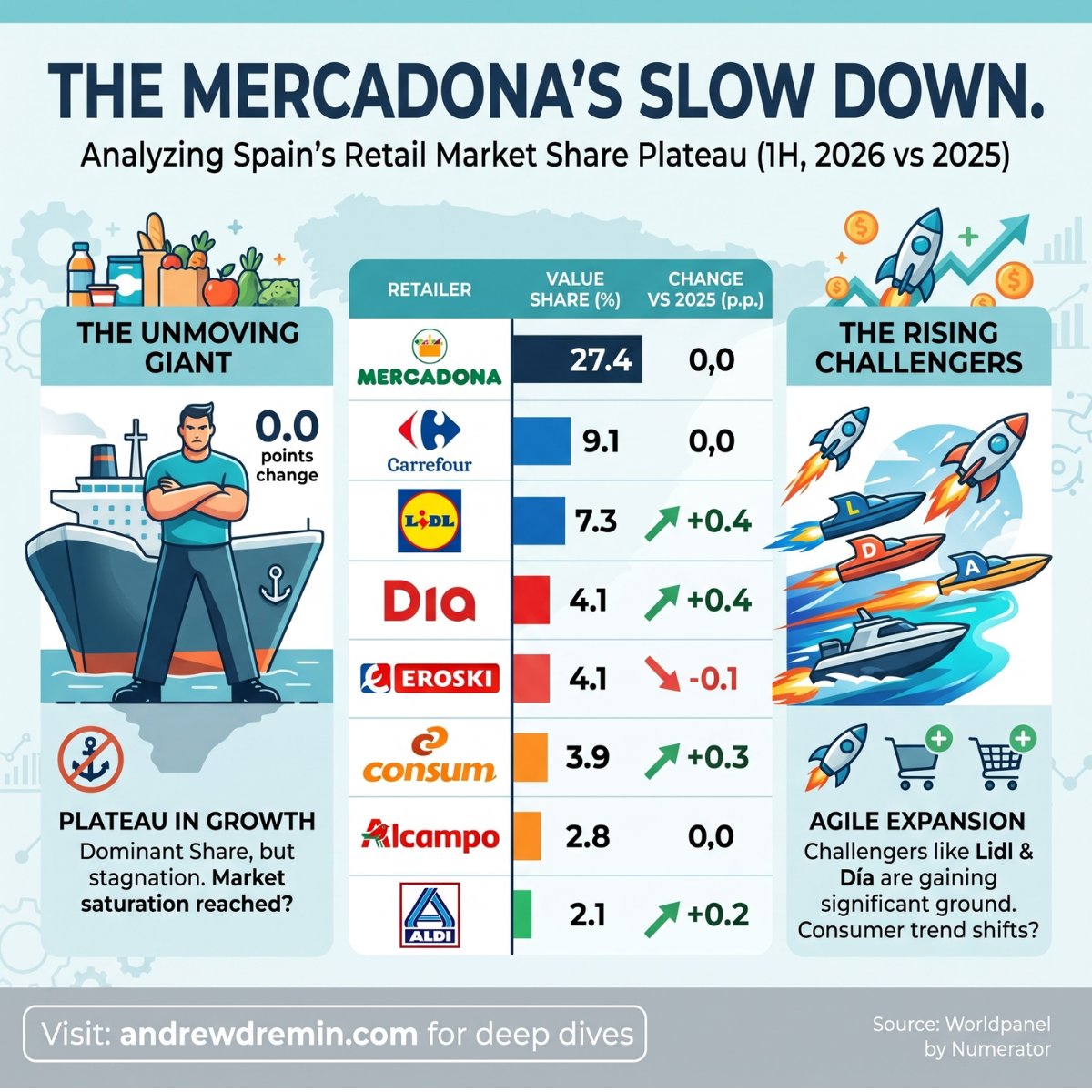
June 2026: 27.4% of Spanish grocery sales belong to one giant, but its growth just flatlined. Traditional retail loyalty is a complete illusion today.
People do not buy out of habit anymore. They buy math.
Mercadona and Carrefour hit exactly 0.0 points of market share growth in the first half of 2026. They stopped growing. Meanwhile, the discounters are winning. Lidl took +0.4 points. Dia also took +0.4 points. Consum took +0.3. Aldi is moving up with +0.2 points. The numbers tell a very clear story. The market is shifting fast. Shoppers are walking away from the middle ground.
Why did Mercadona’s private label growth pause? Is their strategy failing? My answer is no. The slowdown is temporary. They are heavily remodeling their stores right now. In my 15 years in retail procurement and operations, I see this pattern often. A structural overhaul disrupts short-term sales. You close aisles. You move categories around. You change the cold chain layouts. Shoppers get confused and walk out. Sales drop for a few months. But Mercadona is making the right.
| Retailer | Value Share (%) | Change vs 2025 (p.p.) |
|---|---|---|
| Mercadona | 27.4 | 0.0 |
| Carrefour | 9.1 | 0.0 |
| Lidl | 7.3 | +0.4 |
| Dia | 4.1 | +0.4 |
| Eroski | 4.1 | -0.1 |
| Consum | 3.9 | +0.3 |
| Alcampo | 2.8 | 0.0 |
| ALDI | 2.1 | +0.2 |
Look at the winners in the chart. Lidl and Dia. They operate very differently, but both solve the exact same problem for the consumer. Money and time. Dia wins on extreme proximity. They are on your street corner. You do not need a car. You walk there, you buy what you need for the next two days, and you leave fast. It is pure convenience. Lidl wins on aggressive pricing and strong private labels. They keep their assortment small. A regular supermarket might have 15 types of ketchup. Lidl has two. Less choice means faster decisions, lower warehouse costs, and massive volume discounts from suppliers. Aldi is doing the exact same thing globally.
Take Maria as an example. She lives near me in Barcelona. Two years ago, she used to buy everything at one large hypermarket on Saturday morning. She pushed a big cart and filled it up for the whole week. But today? That behavior is dead. She checks her phone for digital coupons. She buys fresh fruit at a small local shop. She buys heavy staples like milk and cleaning supplies at Consum or Dia. Her salary stayed exactly the same this year. But her rent went up. Her electricity bill went up. She does not care about brand logos anymore. She is forced to optimize every single euro. This is the human reality for millions of people. You cannot fight this trend with standard marketing.
Evaluation Framework: Where Growth Happens Today
Compare retail models right now. You can see what works and what fails across different countries.
- Scale and Data Power: Look at the UK market. Tesco holds a massive 27.3% share. They win because they weaponize their Clubcard discounts. They force loyalty through absolute value. If you do not scan the card, you pay a penalty price. They squeeze mid-tier legacy chains like Asda. They use the data to negotiate harder with FMCG brands.
- Aggressive Private Label Pricing: Aldi and Lidl steal market share everywhere. They pull customers away from legacy retailers by pushing their own brands. They control the supply chain. They dictate the cost. They do not rely on big FMCG marketing budgets.
- Extreme Proximity and Convenience: Dia grows in Spain because it is close. Convenience is a currency. If you save a shopper 20 minutes of driving, they will pay a few cents more for the product.
- FMCG Squeeze: Big brands are losing leverage fast. In the past, a major soda or snack brand dictated shelf space. Today, retailers like Mercadona and Lidl say no. If the brand does not offer a deep discount, the retailer simply expands its private label facings. The power shifted entirely to the retailer.
How to Choose Your Path
Retailers and FMCG brands must adapt quickly. The generic middle ground is dangerous. If you are neither the cheapest nor the most convenient, you will die. Here is a quick decision guide for your commercial strategy:
- Check Your Margins First: Can you win on raw price like Aldi? Look at your P&L statement. If you cannot fight a price war, do not start one. Instead, build a real digital loyalty program. Give actual cash value back to the shopper immediately.
- Review Your Assortment Ruthlessly: Cut weak middle-tier products. If a brand does not bring traffic or high margin, delete it from the shelf. Replace it with a strong private label. FMCG brands must prove their financial worth to the category manager every single day.
- Invest in Physical Infrastructure: Look at Mercadona. Do not be afraid to sacrifice short-term growth. Remodel your stores. Upgrade your supply chain tech. You need to win later, not just this quarter. Build better warehouses.
- Demand Hard Data from Suppliers: FMCG suppliers must stop pushing generic promotions. Bring targeted data. Help the retailer win in their specific format. A bulk promotion for a hypermarket will fail completely in a small proximity store. Tailor the offer.
- Stop Fighting Discounters on Volume: If you are a premium retailer, sell premium. Do not try to match Lidl on basic pasta or toilet paper. You will lose margin and fail. Win on fresh produce, meat, and in-store experience.
The rules of retail changed completely. Brand loyalty is earned with math, not television ads. You either adapt your commercial operations or you lose market share to a discounter. In my consulting work, I help companies navigate this exact shift. We audit category management and fix broken commercial strategies. We look at the raw data and make the hard choices. Do you need help adjusting your category strategy for 2027? Send me a direct message. Let’s get to work.
Related posts:
 The Real Estate Mechanics Behind the $195.1 Billion Valuation
 The Supermarket Grocerant Trend: Why Retailers Are Stealing Restaurant Profits
 European Retail Self Checkout Shrinkage 2026: 22% Loss
 The Billion-Dollar Illusion: How a Fake Movie Parade Transformed Global Retail and Tourism
 The battle for US grocery market.
 Poland’s Growth Engine is a Margin Trap