
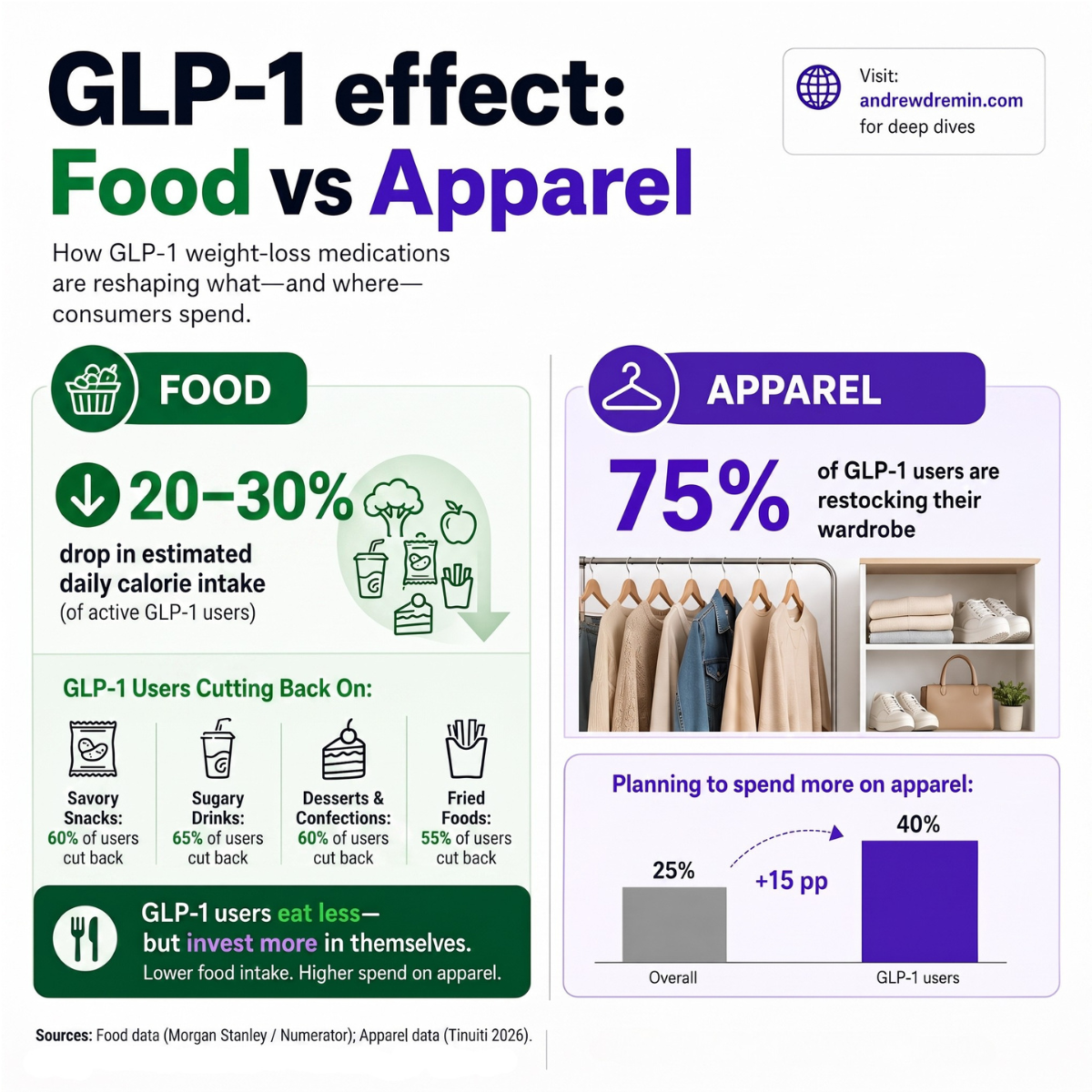
75% of GLP-1 users say they are buying a new wardrobe. At the same time, their daily calorie intake drops by 20% to 30%. Financial analysts and media headlines claim grocery budgets are permanently shifting straight into fashion retail.
Before rewriting multi-year category plans, look at the actual math.
But retail operations do not run on simplified headlines. When you break down transaction data, GLP-1 consumer spending habits, and prescription economics, the reality is far more complex.
4 Financial Realities Behind the GLP-1 Consumer Basket
1. One-Time Wardrobe Replacement vs Recurring Grocery Spend (Capex vs Opex)
Buying new clothes after losing 15 kg is a one-time capital expense for a household. A consumer buys three pairs of pants, two shirts, and a belt in their new size. Once their closet fits their new body, that extra apparel spending stops.
Grocery spend is an operating expense. A household buys food 52 weeks a year, year after year.
- A consumer who saves $35 a week by skipping chips, soda, and frozen pizza saves roughly $1,800 across a full year.
- Replacing a basic wardrobe costs between $600 and $1,200 one single time.
- Once the wardrobe is rebuilt in month four or five, that retail budget does not keep flowing into fashion. It either disappears into general inflation, pays for other household bills, or gets absorbed by the medication itself.
Apparel brands that treat this sudden spike in smaller sizes as permanent baseline growth will over-purchase inventory and face severe markdowns later.
2. High Treatment Discontinuation and the Weight Rebound Trap
The biggest blind spot in GLP-1 market models is patient adherence. Clinical trials show sustained weight loss, but real-world pharmacy data tells a different story.
- 50% drop-off within 12 months: Real-world prescription data across major healthcare registries shows that roughly half of all patients stop taking GLP-1 medications within the first year.
- Key quit drivers: Persistent gastrointestinal side effects, insurance coverage denials, out-of-pocket costs, and localized pharmacy stock shortages.
- The biological rebound: When patients stop the drug, appetite hormones return quickly. Most users regain a significant portion of their lost weight within 6 to 18 months.
For fashion retailers, this creates an inventory trap. If you aggressively cut procurement of larger sizes (L, XL, XXL) to chase a temporary surge in size S and M, you risk stockouts when former patients need their previous sizes back.
GLP-1
Sizes
(One-Off Spike)
Month 8
Rebounds
(Replacement Cycle)
3. Real Market Penetration: US Hype vs European Grocery Reality
Market commentary often generalizes US numbers to the entire global retail sector. Even in the United States, actual active penetration is far narrower than headlines suggest:
- United States: About 10% to 12% of adults have tried a GLP-1 drug, but consistent, long-term active users represent a smaller fraction.
- Europe: Penetration remains strictly under 3% in most markets (including the UK, Germany, Spain, and France) because public healthcare systems restrict reimbursement strictly to severe type 2 diabetes or extreme medical obesity.
For a supermarket chain with 500 stores, the portfolio-level math is straightforward:
- If 6% of your shoppers use GLP-1s, and those users cut their food intake by 25%, the total volume drag on your total grocery chain is only 1.5% ($0.06 \times 0.25 = 0.015$).
- A 1.5% volume drop is manageable through normal category adjustments, promotional shifts, and private-label mix management. It is not an overnight collapse of the supermarket business model.
4. The Out-of-Pocket Prescription Cost Trap
The theory that consumers take their grocery savings and spend them on discretionary lifestyle goods ignores the high price of the medication.
In markets where insurance does not cover the full cost for weight loss, out-of-pocket expenses range from $250 to over $900 per month. Even with manufacturer copay cards or subsidized plans, a patient frequently spends an extra $50 to $150 every month. That medical cost directly absorbs any money saved by walking past the snack and confectionary aisles. The consumer does not have extra disposable income; their monthly budget is actually tighter.
GLP-1 Retail Impact: Real POS Data vs Market Speculation
| Category | Theoretical Market Fear / Hype | Practical POS Data Reality | Strategic Category Action |
|---|---|---|---|
| Salty Snacks & Chips | Category collapses by 20%+ permanently. | Volume dips 3% to 5% mainly in large multi-packs; single-serve premium holds steady. | Downsize pack sizes; introduce baked and high-fiber variants. |
| Bakery & Confectionery | Massive drop in sweet treats and impulse buys. | Impulse units drop slightly; demand shifts toward higher-quality, smaller portions. | Reduce pack size; focus on premium, single-portion indulgence. |
| High-Protein & Dairy | Zero impact or passive growth. | Immediate 15% to 30% volume spike in ready-to-drink shakes, Greek yogurt, and cottage cheese. | Expand linear shelf space for 20g+ protein items; add functional claims. |
| Apparel & Fashion | Permanent multi-year boom in smaller sizes. | Short-term spike in mid-size basics (M/L) followed by plateau; high return rates. | Use open-to-buy flexibility; avoid multi-season commitments to small sizes. |
Category Management Playbook: FMCG, Apparel, and Supermarkets
FMCG Manufacturers: Protect Margins with Functional Formulation
Do not kill your legacy product lines. Instead, adapt your portfolio to capture the specific nutritional needs of GLP-1 patients:
- Prioritize muscle retention: GLP-1 users lose lean muscle mass along with fat. Products offering 20g to 30g of protein per serving (liquid drinks, yogurts, bars, enriched cereals) see strong organic demand.
- Fix portion sizes: Large family-size bags of calorie-dense snacks will see lower purchase frequency. Launch high-margin single-serve packs (30g–45g) that fit lower appetite limits.
- Target digestive health: Slower gastric emptying means patients actively look for dietary fiber, digestive enzymes, and hydration supplements with electrolytes.
Apparel Retailers: Keep Size Curves Flexible
Avoid over-correcting your inventory mix based on temporary customer body changes:
- Use short reorder cycles: Do not lock 80% of your seasonal budget into small sizes six months ahead. Keep 30% of your Open-to-Buy (OTB) budget unallocated to react to real in-season size sell-through.
- Focus on transitional fit: Promote stretch fabrics, adjustable waistbands, and classic core items that accommodate 5 kg to 10 kg weight fluctuations without forcing a full wardrobe discard.
- Monitor return rates by size: Track whether returns on sizes S and XS are rising due to fit uncertainty among newly slimmed customers.
Supermarket Operators: Localize Before Changing Planograms
Do not cut center-store grocery space across your entire store network based on national headlines.
- Cluster by store demographics: High-income urban stores with private clinic density will see 4x higher GLP-1 usage than suburban, discount-driven stores. Run planogram tests in those high-income branches first.
- Reallocate shelf facings internally: Take 10% of space from slow-moving ultra-processed sweets and assign it directly to high-protein dairy, chilled functional drinks, and fresh produce.
- Track basket composition: Use loyalty card data to watch individual household transitions over 12-month periods rather than relying on one-off consumer surveys.
Base your commercial plans on real point-of-sale data from your own stores, not broad market surveys.
Frequently Asked Questions (FAQ)
What is the actual impact of GLP-1 drugs on grocery sales?
Will apparel brands see long-term revenue growth from GLP-1 adoption?
What food categories gain the most from GLP-1 consumers?
Related posts:
 The Grocery Retail Paradox: France vs UK Grocery Market Share
 The Billion-Dollar Illusion: How a Fake Movie Parade Transformed Global Retail and Tourism
 Seasonal Retail Inventory Management: 85/15 Buffer Model
 Spain Grocery Market Share 2026: Why Giants Flatline
 Emerging Megacities: FMCG Retail Trends and Consumer Shifts by 2050
 Spain Grocery retail market share July 2026
Leave a Reply