
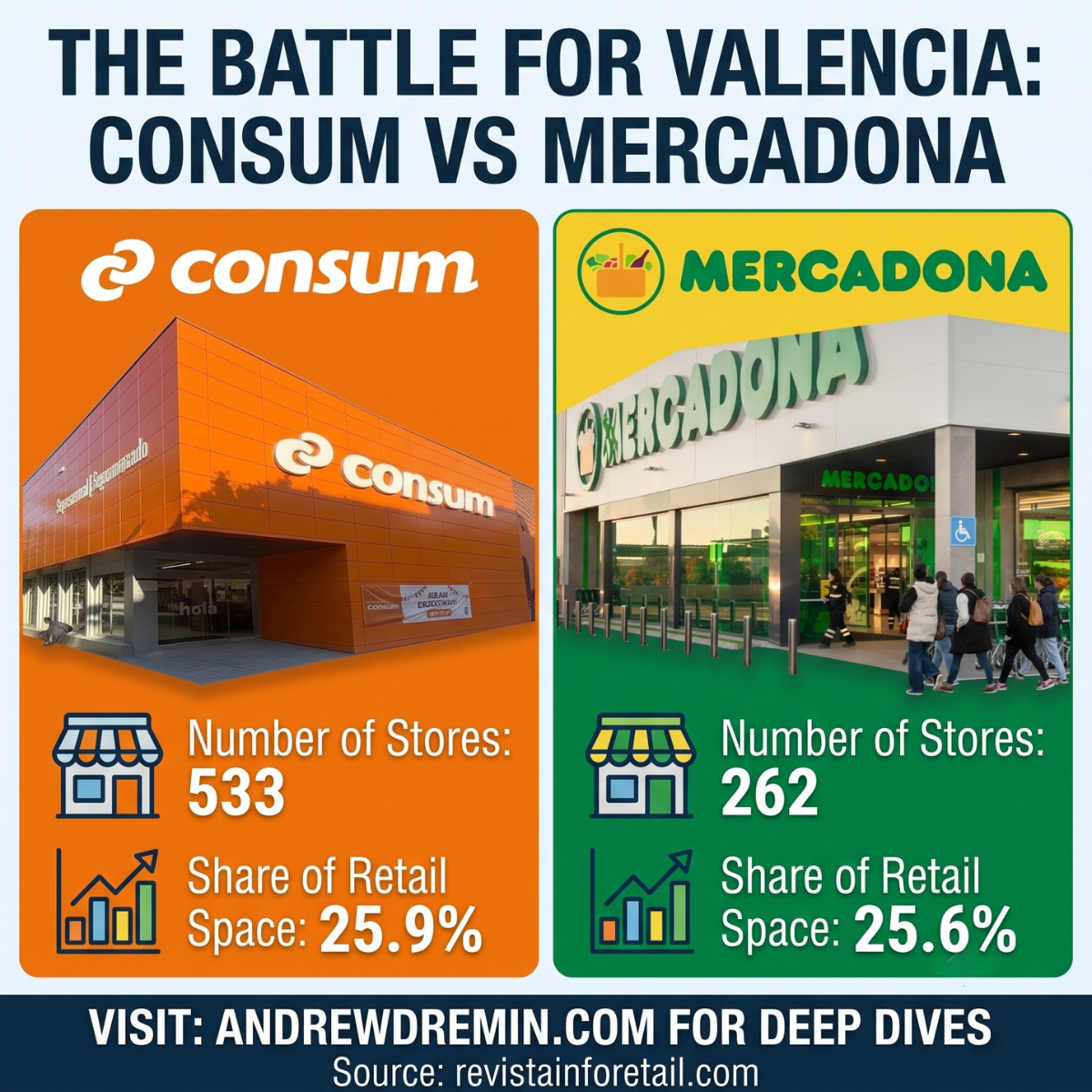
533 stores against 262. That is the new retail map in Valencia, the home turf for both retailers. In Q1 2026, Consum officially overtook Mercadona in total sales floor space, capturing a 25.9% share of the region’s supermarket arena against Mercadona’s 25.6%.
This is a historic shift. For decades, Mercadona was considered completely untouchable in its own birthplace. But a fundamental difference in operational philosophy has flipped the leadership of the region. Consum achieved this milestone by executing what can be called a “mosquito fleet” strategy. Instead of relying only on massive destination stores, they deployed hundreds of small boats swarming the urban neighborhoods, entering the dense streets where the big ships physically cannot navigate.
This strategy is not just a regional anomaly; it is showing clear results at the national level. In H1 2026, Consum gained 0.2% of the entire Spanish market share, while Mercadona lost 0.1%. In a mature, highly consolidated grocery market like Spain, these decimal points represent millions of euros in shifted consumer spending.
Mercadona’s Calculation: Logistics over Proximity
To analyze this shift accurately, we must recognize that Mercadona did not lose this space due to poor management. They left the urban streets on purpose.
Over the last few years, Mercadona executed a deliberate network optimization plan. Their core objective is to simplify the supply chain and maximize sales efficiency per square meter. They systematically closed older, smaller urban shops that lacked underground parking or efficient unloading zones for large trucks. Instead, they concentrated their capital on high-sales, standardized store formats (“Tienda Eficiente”) with large layouts, wide aisles, and easy highway or main-artery access.
From a purely financial and logistical standpoint, the logic is strong. Supplying one massive store processing huge volumes is significantly cheaper than supplying three small shops scattered across narrow, traffic-congested residential streets. It reduces multi-stop delivery costs, simplifies inventory management, and maximizes the sales-to-labor ratio of store employees.
The Proximity Paradox in Daily Grocery
However, this optimization strategy creates a critical commercial vulnerability. Mercadona is not a hypermarket operator like Carrefour or Auchan. Consumers do not typically go there for a massive, once-a-month stock-up using a large vehicle. Mercadona built its entire market dominance on daily basics, fresh products, and routine household items under its private label.
This is where the urban battle becomes critical. When your business model relies on daily essentials, the physical distance to the consumer’s front door dictates the purchase decision.
When a retailer moves its store from the immediate neighborhood corner to a commercial zone outside the high-density residential center, the difference in convenience is up to 10 to 15 minutes of walking time. In modern urban logistics, 15 minutes is a massive barrier.
Look at the basic human behavior behind the data. A professional walking home from the transit station or office at 8:00 PM is tired. He needs a loaf of bread, some fresh cheese, and fruit for the next morning. He will not walk an extra 15 minutes to the highly optimized, large-format Mercadona just because it has a better loading dock for corporate logistics. He stops at the Consum or the Charter franchise located on his exact block. The small boats capture the daily routine because they intercept the consumer before they can even consider traveling to the big ship.
The Sunday Hack and Franchise Regulations
The second layer of this proximity victory is how Consum handles strict trading regulations. Spain maintains highly rigid laws regarding opening hours, particularly for large supermarket formats on Sundays and national holidays.
Consum solves this regulatory challenge by using its Charter franchise model. These smaller, entrepreneur-operated proximity stores fall under different regulatory thresholds due to their limited square footage and independent ownership structure. Consequently, they can legally stay open on Sundays.
Step into any Valencian neighborhood on a Sunday afternoon, and you see the practical result: long queues at the Charter doors. Consum uses these small franchise boats to own the weekend convenience market completely. While the large corporate competitor is locked by state law, the mosquito fleet is open, active, and capturing high-margin emergency purchases.
The Macro Shift: The Rise of Regional Density
This specific battle in Valencia reflects a much larger macroeconomic trend visible across the Iberian peninsula. Regional density is proving to be a safer, more resilient retail bet than aggressive, generalized geographical expansion.
The latest financial figures from the IFA group confirm this reality. IFA, which clusters various regional supermarket chains across Spain, just reached €19 billion in total revenues, growing at a solid 5.4%. Modern consumers are showing a clear preference for regional operators who understand the micro-geography, local product preferences, and specific neighborhood structures of their territories. Proximity is successfully defending its commercial margins against extreme centralization.
The Operational Trade-Off: Margin vs. Share
As a critical analyst, one must look at both sides of the ledger. The mosquito fleet strategy is not a flawless victory. Operating hundreds of small urban stores introduces clear structural costs:
- Logistics Complexity: Higher distribution costs due to multi-stop urban deliveries in small trucks.
- Real Estate Costs: Higher rent prices per square meter in dense city centers compared to suburban commercial parks.
- Labor Efficiency: Lower sales volume processed per employee hour compared to a hyper-efficient 1,500-square-meter store model.
Mercadona achieves incredible operating margins precisely because it cut out these inefficiencies. Consum, on the other hand, accepts higher operational friction in exchange for market share and raw physical dominance of the consumer’s daily path.
Strategic Manual for FMCG and Brands
What does this structural split between centralized giants and neighborhood fleets mean for FMCG manufacturers, key account managers, and trade marketers? If the retail map is splitting, your commercial strategy must split too.
- Shift your trade spend allocation: For decades, brands designed commercial activations for massive layouts. Large cardboard islands, complex promotional displays, and heavy palleted placements. These traditional marketing tools do not work inside a 400-square-meter urban store. They physically block the narrow aisles. If your trade marketing budget is still tied to massive physical structures, you are losing access to the urban shopper. Shift that capital into micro-formats, compact modular display units, or targeted digital proximity applications.
- Pay for primary shelf visibility: In a small neighborhood store, secondary placements like extra end-cap displays or promotional bins are rare or non-existent. There is only one territory where the purchase decision occurs: the primary shelf. The probability of purchase is highest there because the proximity consumer is in a hurry; they want to complete their shopping trip in under 10 minutes. If your brand is dropped to the bottom shelf or lacks clear facing, you disappear from the consumer’s daily routine entirely.
- Adapt packaging for the urban pedestrian: A consumer walking home with a reusable tote bag buys differently than a consumer loading a car trunk. Large family packs or heavy, bulky configurations do not perform well in the proximity fleet. Manufacturers must optimize their portfolios for lighter, high-frequency packaging options that match the “walking home” use case.
Conclusion
A big ship looks powerful, stable, and highly profitable on a corporate spreadsheet. But small boats hold the physical streets where the actual citizens walk every single day.
If you are managing an FMCG brand or a retail portfolio, you cannot rely solely on the volume of the top centralized retailer. You must learn how to supply, negotiate, and win inside the high-frequency environment of the mosquito fleets.
What is your strategy for proximity retail? Are you adjusting your commercial terms for regional chains, or are you still betting your entire future on the big ships?
Source for the sales floor share and number of the stores: revistainforetail
Related posts:
 A Strategic Portfolio Analysis of the 2026 FIFA World Cup Contenders
 The €3.90 Gourmet Threat: How Supermarket Meal Kits are Disrupting Fast Casual Dining
 GLP-1 Retail Impact: How Weight-Loss Drugs Are Shrinking Supermarket Sales
 Ikea’s marketing football move
 Inditex Q1 2026 Performance
 The Billion-Dollar Illusion: How a Fake Movie Parade Transformed Global Retail and Tourism