
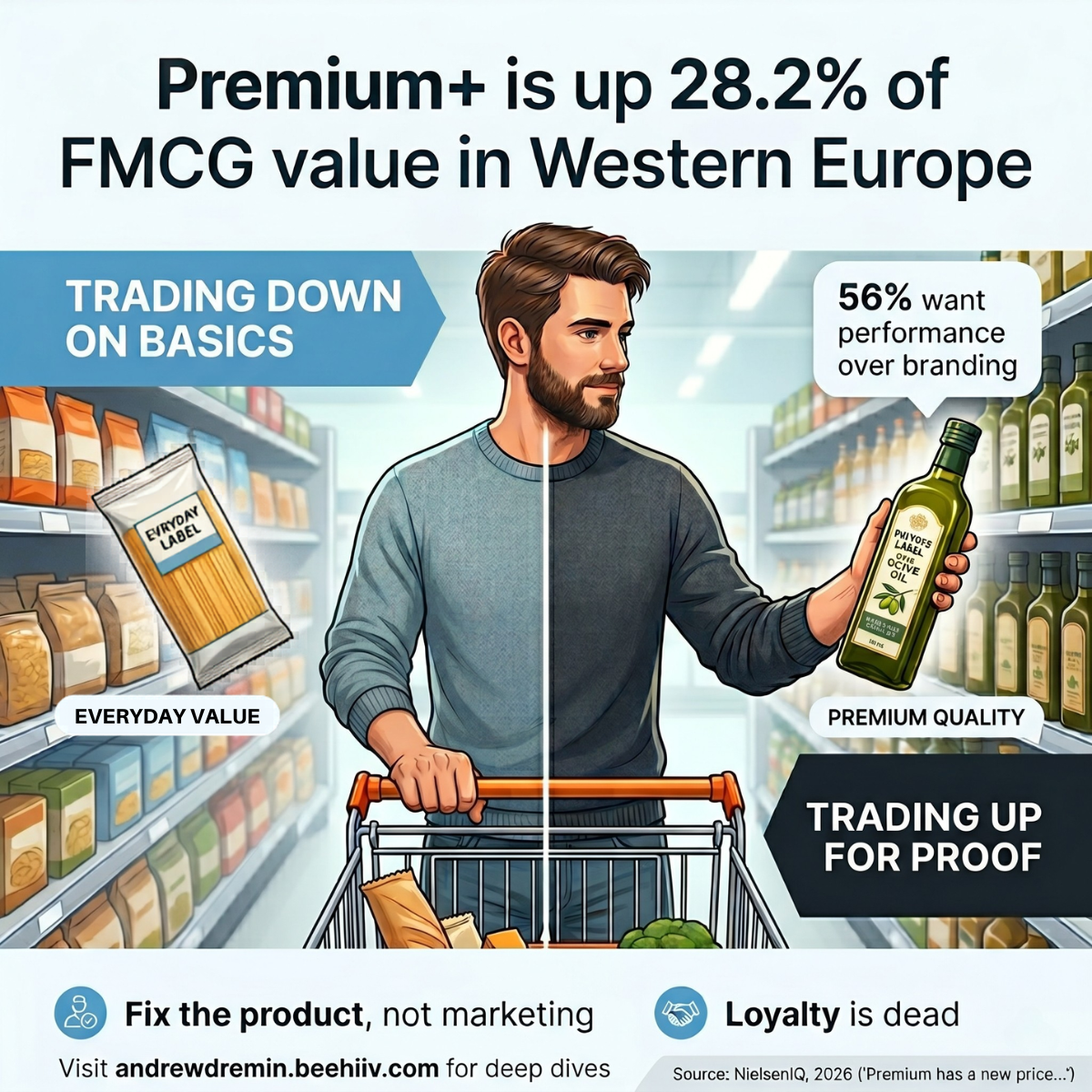
Private label premium growth hit +€514 million in Europe. At the same time, big legacy brands dropped by -€170 million. These are not minor shifts. This is a structural change in how people buy food and daily goods.
If you talk to most brand managers at large FMCG (Fast-Moving Consumer Goods) companies, they are in denial. They look at the sales reports and point to inflation. They build a comfortable hypothesis: consumers have less money, so they are forced to trade down to cheap products.
This logic is flawed. It is defensive thinking. Blaming the economy is easier than admitting your product is no longer competitive. If shoppers were simply out of cash, only the bottom-tier budget products would grow. But the data shows massive growth in premium private labels. Consumers are not just broke; they are calculating.
Trading Up and Down at the Same Time
Shoppers are executing a split-basket strategy. They trade up and down on the exact same shopping trip.
Look at the average guy in the supermarket. He walks down the pasta aisle and buys the cheapest budget macaroni to save cash. He does not care about the brand on the bag. To him, basic pasta is just basic carbs. There is no reason to pay a premium.
Then he goes to the next aisle and drops €5 on a premium, store-brand extra virgin olive oil. Or he buys a €4 single-origin store-brand coffee. Why does he do this? Because the quality is real. He saves money on commodities so he can fund small, daily luxuries. He is willing to pay more, but only when the product actually delivers a superior experience. A famous logo printed on a plastic bottle is no longer enough to justify a high price.
What Does Premium Actually Mean Now?
According to data from NielsenIQ, 56% of shoppers say premium products must prove their value through actual performance.
Ten or twenty years ago, “premium” meant heavy glass packaging, a massive television advertising budget, and a high price tag. Consumers trusted the TV commercial. Today, premium means tangible ingredients and clear origins. Is the chocolate actually 70% cocoa? Does the olive oil come from a specific region in Spain? Does the yogurt have a clean ingredient list with no artificial thickeners?
Consumers read labels now. They compare the back of the big brand package with the back of the retailer brand package. If the legacy brand has more sugar, more water, and less real fruit, the marketing cannot save it. The shopper sees the truth.
The Cost of Laziness for Big FMCG
Big brands got lazy. Over the last few years, inflation gave them an excuse to act poorly. They hiked prices by 10%, 15%, or 20% to protect their profit margins. But they did not improve the product. They kept the exact same recipes.
In some cases, they actually made the product worse. They practiced “skimpflation”—quietly replacing high-quality ingredients with cheaper alternatives, like using sunflower oil instead of butter, or reducing the amount of real meat in a frozen meal. They expected blind loyalty. They assumed consumers would just keep buying out of habit.
Meanwhile, private labels caught up. Retailers did not just copy the big brands; they started innovating.
How Retailers Built a Better Trap
Retailers like Mercadona, Lidl, and Aldi are winning because their premium tiers actually deliver real value. They have a structural advantage.
First, they own the physical shelf space. They decide where products sit. They place their premium store brand at exact eye level, right next to the struggling legacy brand.
Second, they own the raw sales data. They know exactly what is selling today. If they spot a trend – like high-protein snacks or gluten-free bread – they can develop and launch a premium store-brand version in a few months. Big FMCG companies often take a year just to clear internal meetings and approve a new package design.
Third, retailers do not have to pay global advertising agencies or fund massive corporate overhead. They take the money they save on marketing and put it directly into the product. This means they can sell a better-tasting product for less money. The math is simple and brutal for legacy brands.
Zero Switching Costs
The physical distance between a €4 famous brand and a €3 premium store brand on the shelf is two centimeters. The switching cost for the consumer is zero.
Loyalty is dead. 49% of people buy a wider variety of brands now. A 100-year brand history means nothing if the price is wrong and the taste is average. If the store brand looks good, the shopper grabs it to test it. If it tastes better than the legacy brand, that shopper is gone forever.
The Brutal Truth for Brand Managers
My conclusion for FMCG and retailers is simple: stop relying on legacy names.
You cannot market your way out of a bad product. A new social media campaign will not fix a recipe that tastes like cardboard. You have two seconds to convince the shopper. If your product does not look or feel superior in those two seconds, the shopper walks away.
Fix the product, not just the marketing. Put your item on a table next to the retailer’s premium private label. Test it blindly. If your product does not win clearly, you have no right to charge a higher price.
What is the premium products share in your business? If you rely entirely on mid-tier products with average quality and high prices, you are a target. The market is splitting into cheap basics and true premium. The middle is dying. Adapt the product, or lose the shelf.


Leave a Reply