
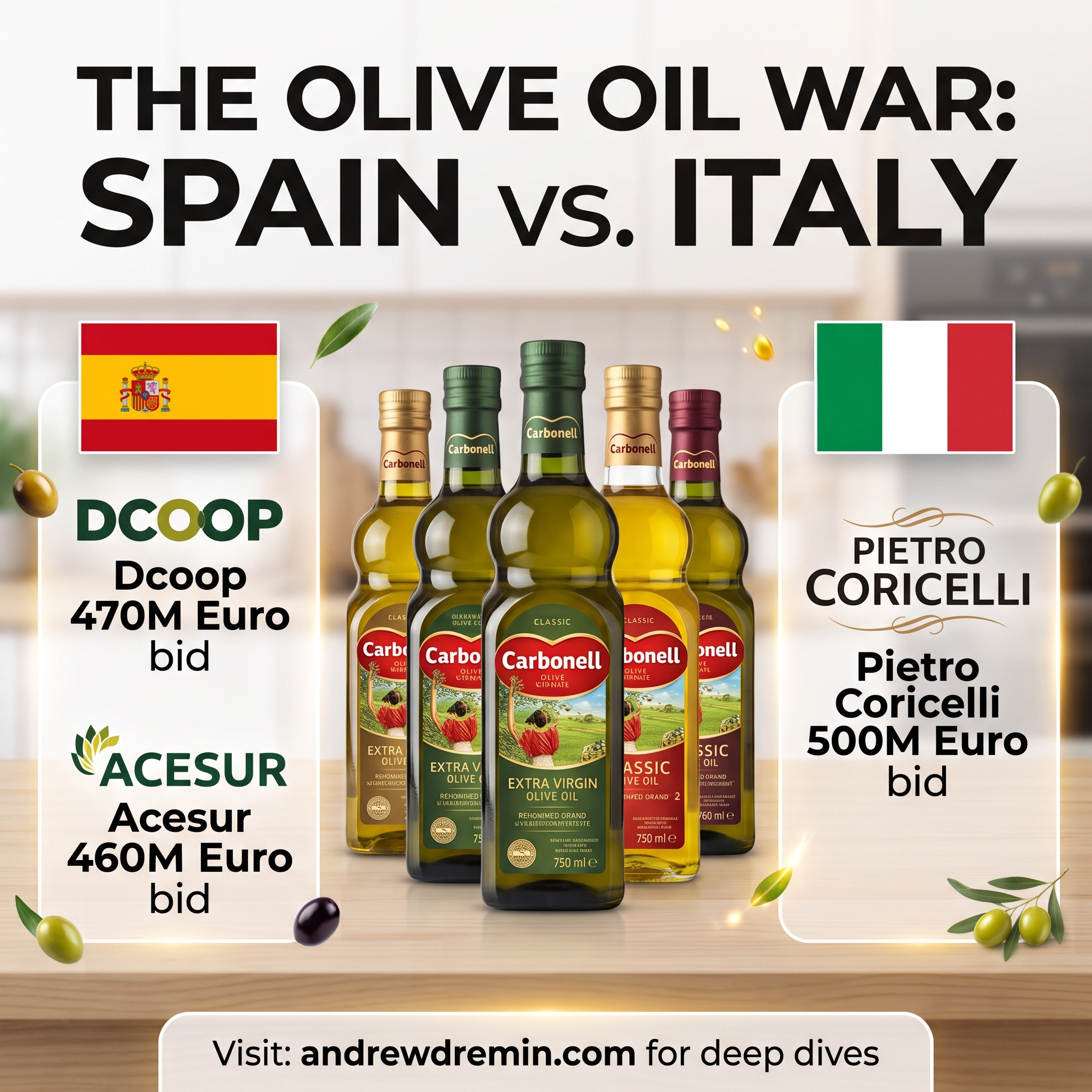
€500 million. That is the latest cash bid for Deoleo, the bottling giant behind 158 million liters of olive oil every year.
This private equity exit has turned into an open political and commercial olive oil war Spain and Italy are now embroiled in.
If you have a bottle of Bertolli, Carapelli, or Carbonell in your kitchen, you hold a tangible piece of European industrial strategy. Spain grows nearly half of the world’s olive oil. Yet for decades, Italian commercial houses bought cheap Spanish bulk oil, bottled it under heritage Italian names, and captured the premium supermarket retail margins.
Now, Spanish agricultural cooperatives want those global brand margins back. Italian industrial buyers are fighting to keep them. And private equity owners are looking for the highest bidder.
The Geopolitics of Olive Oil: Spain vs Italy Trade Conflict
To understand this deal, you must look at the supply balance in the Mediterranean.
Spain is the undisputed agricultural factory of olive oil. In normal harvest years, Spanish olive oil production accounts for between 40% and 45% of total global supply. A single Spanish province, Jaén, regularly produces more olive oil than the entire country of Italy.
Italy produces only 10% to 15% of global volume. However, Italian companies mastered international branding, bottle design, and US shelf distribution decades ago.
- The Spanish position: Spain has acted as a low-margin raw material supplier. Spanish farmers take all the agricultural risk – drought, extreme heat, harvest labor costs – while foreign brand houses capture the downstream profit.
- The Italian position: Italian groups built global brand equity over a century. Consumers in the US, Germany, and the UK pay a premium for Italian-sounding names, even when the liquid inside the bottle is a blend from Andalusia, Greece, or Tunisia.
Deoleo is the strange bridge between these two worlds. It is a Spanish-headquartered company based in Córdoba, but its crown jewel assets are historic Italian brands like Bertolli and Carapelli, alongside Spain’s domestic leader, Carbonell.
Deoleo Acquisition: Key Bidders and The €500M Price Tag
Deoleo’s current majority owners – British private equity fund CVC Capital Partners (holding ~57%) and Alchemy Partners (~40%) – have spent years restructuring the company’s debt, closing redundant plants, and preparing an exit. After olive oil price spikes restored the company to operating profit, the owners opened a formal sale process.
Three primary industrial Deoleo acquisition bids have surfaced:
- Pietro Coricelli (€500 Million): The Italian family-owned oil group submitted a €500 million cash offer through its Spanish holding vehicle, Farmers Elite Global (headquartered in Seville), demanding exclusive negotiation rights.
- Dcoop (€470 Million): The giant Andalusian cooperative, representing tens of thousands of Spanish olive farmers, offered around €470 million to bring the bottling and branding operations under direct farmer ownership.
- Acesur (€460 Million): The Seville-based producer behind La Española and Coosur, which already owns a ~5% industrial stake in Deoleo, submitted an initial €460 million offer.
Bertolli is the prize that drives these valuations. Bertolli alone accounts for roughly 41% of Deoleo’s total revenues and holds a standalone brand valuation above €230 million. Whoever controls Bertolli controls the entry point into North American retail shelves.
US Olive Oil Market Share: The Antitrust Hurdle
While Dcoop wants to control the value chain from farm to fork, their corporate structure hits a major legal wall in the United States.
The US is the most profitable olive oil market in the world. Supermarket market share there is concentrated:
- Pompeian: Holds roughly 20% of the US extra virgin olive oil market. Dcoop currently owns a 50% stake in Pompeian and has explored acquiring full control from the Devico family.
- Bertolli (Deoleo): Holds roughly 14% of US retail sales.
If Dcoop buys Deoleo without structural changes, a single entity would control over 34% of all US supermarket olive oil sales.
That level of concentration triggers automatic scrutiny from the US Federal Trade Commission (FTC) and Department of Justice (DOJ), highlighting the challenges of US market antitrust regulations.
- Divest its 50% stake in Pompeian, or
- Carve out and sell the US rights to the Bertolli brand to a third party.
Either remedy destroys a core economic reason Dcoop made the bid. Pietro Coricelli has no such concentration issue in the US, giving the Italian group a cleaner path through global antitrust reviews.
Food Sovereignty and Government Protectionism in Europe
This is no longer a simple private transaction between investment funds and corporations. Both the Spanish and Italian governments have intervened directly.
In Rome, Giorgia Meloni’s administration treats agribusiness brands as core components of national identity and economic sovereignty. Italian officials do not want historic Italian names like Bertolli and Carapelli managed indefinitely by Spanish interests or foreign private equity.
In Madrid, the Ministry of Agriculture and regional Andalusian leaders face domestic pressure from farming labor unions (such as CCOO). The Spanish government holds a legal foreign investment screening mechanism – the “anti-takeover shield” originally created during the pandemic. Madrid can veto or place strict conditions on foreign acquisitions of strategic domestic companies.
Spain’s dilemma is clear:
- Deoleo’s headquarters and largest bottling facilities are in Alcolea (Córdoba), Spain.
- Carbonell is an iconic 150-year-old Spanish national brand.
- Spanish politicians do not want to see domestic factories downsized or national heritage sold off to Italian competitors.
3 Possible Scenarios for the Deoleo Sale
1. The Clean Sale to Coricelli
Coricelli secures exclusivity, pays €500 million, and CVC and Alchemy exit completely. To appease Madrid’s foreign investment screening, Coricelli uses its Seville-registered holding entity (Farmers Elite Global) and signs binding legal guarantees protecting Spanish factory jobs and processing volume in Andalusia.
2. The Spanish Government Veto
Madrid classifies Deoleo as critical agrifood infrastructure, refuses clearance for a foreign takeover, and forces the sellers to negotiate exclusively with Dcoop or an all-Spanish consortium (Dcoop + Acesur). Dcoop accepts the deal and files a planned carve-out of its US Pompeian assets to satisfy American competition regulators.
3. The Structural Asset Split
Private equity breaks Deoleo apart to maximize total payout:
- The Spanish package: Carbonell, Koipe, and domestic packaging plants in Córdoba go to Dcoop or Acesur.
- The International package: Bertolli and Carapelli go to Coricelli for global distribution.
This split eliminates both Spanish political vetoes and US antitrust obstacles, though it adds transaction complexity for the sellers.
Strategic Takeaways for Retailers, FMCG Leaders, and Agribusiness
- Upstream agricultural producers want downstream margins. Selling unbranded bulk commodities is a race to the bottom. Agricultural cooperatives are pooling capital to buy international retail brands, cutting out middleman distributors.
- Food security is treated like defense and telecom. Cross-border food M&A inside the European Union is no longer purely governed by free-market competition. Governments routinely step in to defend supply chains, domestic production capacity, and historical brands.
- Consumer brand power is the ultimate margin hedge. When olive oil spot prices hit record highs due to climate volatility, unbranded bottlers suffered margin collapse. Companies owning tier-one brands (like Bertolli and Carbonell) successfully passed price increases directly to consumers on supermarket shelves.
Frequently Asked Questions (FAQ)
Deoleo is the world’s largest olive oil bottling company by volume. It owns major international brands including Bertolli, Carapelli, Carbonell, Koipe, and Hojiblanca. It is valuable because it controls shelf placement and brand recognition across supermarket chains in North America, Europe, and Asia.
Spain produces 40% to 45% of global olive oil but historically exported bulk oil with lower margins. Italy produces only 10% to 15% but built high-margin global retail brands. Dcoop (Spanish) wants to own the brands to capture downstream profits, while Coricelli (Italian) wants to keep global brand dominance under Italian control.
Dcoop owns 50% of Pompeian, which holds about 20% of the US market. Deoleo owns Bertolli, which controls roughly 14% of the US market. Combined, Dcoop would control 34% of US sales, triggering antitrust challenges from US regulators (FTC/DOJ).
Yes. Under Spain’s foreign investment screening laws, the government can review and block foreign acquisitions of strategic assets or attach strict conditions regarding domestic employment, headquarters location, and factory operations.


Leave a Reply