
Mercadona spent 290 million euros on a massive logistics hub in Almeirim. Their Portuguese sales crossed 2 billion euros, and their net profit in the country reached 26 million euros. Over 55% of Portuguese households now walk through their doors at least once a year.
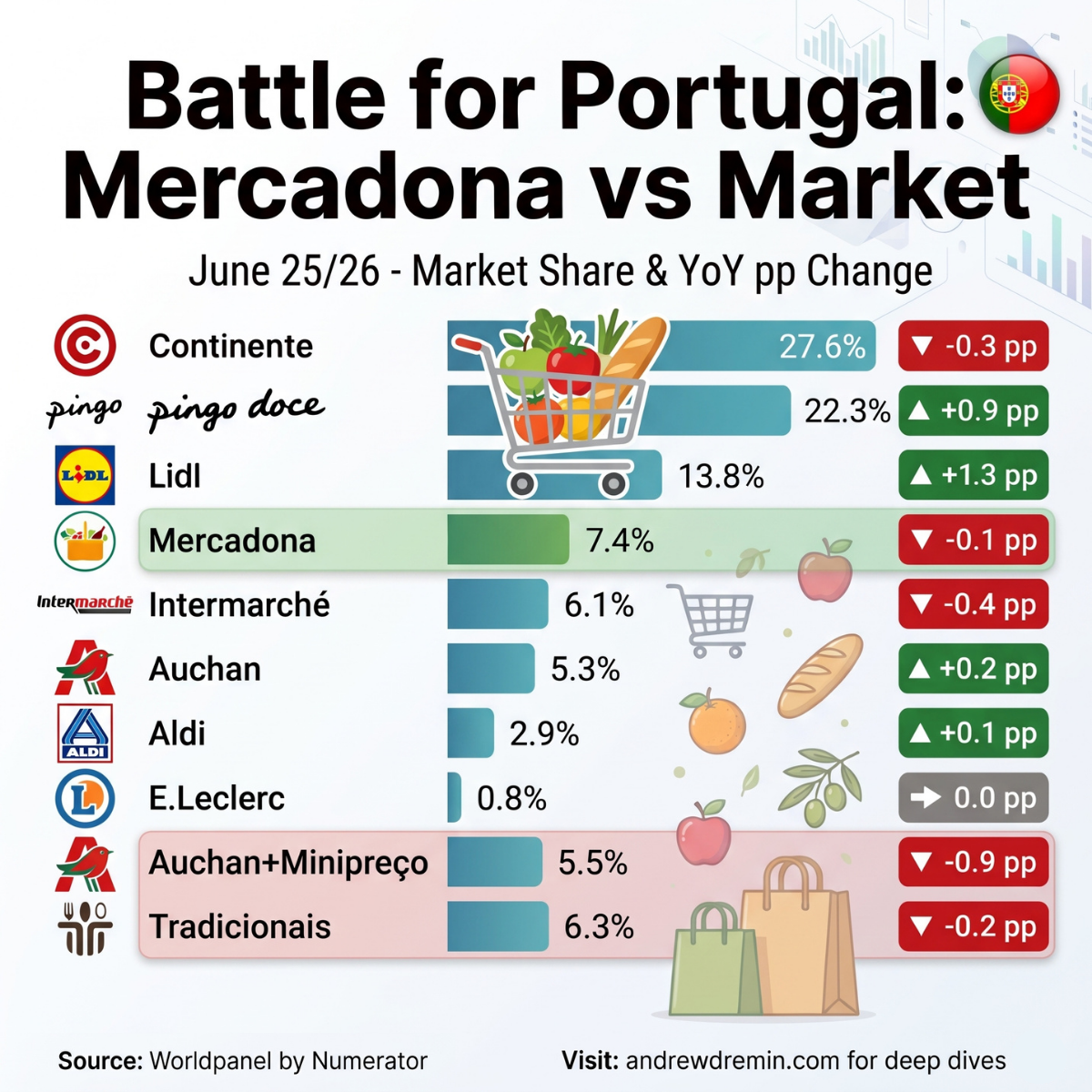
Yet, data from Worldpanel by Numerator shows their grocery market share recently slipped from 7.5% to 7.4%.
Battle for Portugal: Mercadona vs Market
June 25/26 — Market Share & YoY pp Change
How do you open modern supermarkets, invest hundreds of millions, stay profitable, and still lose market share?
A retail executive asked me this exact question last week: “Did Mercadona hit a wall in Portugal?”
The short answer is no, Mercadona is not failing. Their operations are clean, their cash flow is solid, and their store expansion is steady. But they did hit an assortment wall.
To understand why their market share stalled, you have to look at how Portuguese families actually shop.
The Core Problem: Why Portuguese Shoppers Split Their Baskets
Meet Maria. She represents the typical middle-class grocery shopper in Porto, Braga, or Lisbon.
Maria visits Mercadona on a Tuesday morning. She likes the wide aisles, the clean shelves, the fresh pastries, and the affordable Deliplus skincare products. She spends 25 euros on specialty items, treats, and cleaning supplies.
Then she walks out to the parking lot, gets into her car, and drives straight to Continente or Pingo Doce to spend another 90 euros.
Why does Maria do two grocery trips instead of one?
- National brand loyalty: Maria wants Delta coffee, Mimosa milk, and Oliveira da Serra olive oil. Her family refuses private label substitutes for these daily staples.
- Fuel discount coupons: At Continente, Maria scans her Cartão Continente to get money off her next Galp fuel bill. At Pingo Doce, she scans her Poupa Mais card to save money at BP petrol stations.
- Aggressive promotions: She looks for the 50% discount stickers and weekly flyer specials (folhetos) on meat, fish, and personal care.
Mercadona gives her none of these three things.
The chain’s private label strategy means it sells an assortment that is roughly 90% private label (Hacendado, Bosque Verde, Deliplus). They do not run temporary price promotions. They do not offer a loyalty app with cash-back coupons.
That playbook turned Mercadona into a retail powerhouse in Spain. In Portugal, it makes them a secondary destination for curiosity trips and top-up shopping.
Portugal Grocery Market Share Breakdown
The Portuguese supermarket sector is competitive, consolidated, and heavily focused on promotions:
| Retail Group | Estimated Market Share | Assortment Strategy | Loyalty & Promo Model |
|---|---|---|---|
| Continente (MC Sonae) | ~27.5% | Large mix of A-brands and private label | Heavy promotions, Cartão Continente, Galp fuel discounts |
| Pingo Doce (Jerónimo Martins) | ~21.7% | Strong private label + key national brands | Poupa Mais card, BP fuel discounts, aggressive weekly flyers |
| Lidl Portugal | ~13.8% | Hybrid discount: private label + local hero brands | Lidl Plus digital app, weekly seasonal discounts |
| Mercadona Portugal | ~7.4% | ~90% private label (EDLP model) | No promotions, no loyalty discounts (Siempre Precios Bajos) |
| Intermarché / Auchan / Others | ~29.6% | Brand-heavy hypermarkets and independent supermarkets | Regional loyalty programs and trade promotions |
The Spanish EDLP Playbook vs. The Portuguese Retail Reality
In Spain, Mercadona holds over 27% market share. Spanish consumers trust Hacendado and Bosque Verde as default national staples. They prefer Mercadona’s Siempre Precios Bajos (Everyday Low Prices) over hunting for discounts across multiple stores.
When Mercadona crossed the border into northern Portugal in 2019, leadership assumed Portuguese shoppers would behave the same way once they experienced the store format.
That assumption ignored two structural differences in the Portuguese FMCG landscape:
1. Heritage Brand Power
In Portugal, 8 out of the top 10 FMCG brands are local heritage names.
Portuguese consumers have decades of emotional connection with national producers:
- Coffee: Delta Cafés is an institution. For many shoppers, buying store-brand roasted coffee feels like a downgrade.
- Dairy: Brands like Mimosa, Agros, and Terra Nostra dominate breakfast tables.
- Cooking Oils & Condiments: Oliveira da Serra and Gallo hold the olive oil market.
- Beverages: Super Bock, Sagres, and Compal are standard basket items.
When a supermarket refuses to stock these iconic SKUs, families leave the store with an incomplete basket.
2. The Promotion and Fuel Ecosystem
Portugal is one of the most promotion-driven grocery markets in Western Europe. More than 45% of all grocery sales happen on discount.
Retailers like Sonae (Continente) and Jerónimo Martins (Pingo Doce) built sticky grocery loyalty programs and ecosystems. Linking supermarket spending directly to fuel savings at the pump created a defensive barrier. For a Portuguese family managing rising living costs, getting 10 to 15 euros back on petrol every month is a tangible benefit that simple “everyday low prices” cannot easily replace.
How Lidl Cracked the Full Weekly Basket
To see what Mercadona is missing, look at Lidl Portugal’s strategy and track record.
Lidl entered Portugal in 1995 as a pure hard discounter. In the early years, their shelves were filled almost exclusively with German private label goods. Their market growth was slow.
Then Lidl changed course:
- They added Portuguese hero brands: Lidl opened shelf space for Delta coffee, Sumol sodas, Sagres beer, and regional cheeses.
- They localized fresh sourcing: Over 70% of Lidl’s fresh fruit, vegetables, and meats in Portugal are sourced directly from domestic producers.
- They launched a digital loyalty app: Lidl Plus offers weekly scratch cards, personalized coupons, and partner perks without killing their discount DNA.
The result? Lidl climbed to roughly 13.8% market share. Portuguese shoppers do not treat Lidl as a snack shop or a soap stop – they do their complete weekly grocery shopping there.
Strategic Takeaways for Retailers and FMCG Brands
Mercadona’s situation in Portugal provides clear lessons for commercial directors, category managers, and retail leaders navigating retail expansion challenges into foreign markets:
- New store openings do not equal wallet share: High footfall and rising revenue can be misleading. If your household penetration reaches 55% but customers only buy five or six items per visit, your share of the total grocery budget stays capped.
- Local hero SKUs are mandatory for primary baskets: You cannot force a market to give up its heritage brands overnight. If you want the full family cart, you must carry the top 1 or 2 market leaders in essential categories like coffee, dairy, and beer.
- Loyalty ecosystems beat standalone price tags: In markets where grocery spending is tied to fuel, utilities, or telecom points, an EDLP model without rewards struggles to capture the main shopping trip.
- Assortment adaptability is strength, not compromise: Protecting brand purity is good, but adapting category assortment to local culture is what drives long-term volume.
The Road Ahead: Almeirim Hub and the Push South
Mercadona’s 290-million-euro logistics hub in Almeirim is a massive operational asset. Covering 120,000 square meters, it gives the company the supply chain muscle to serve up to 150 stores across Central Portugal, Greater Lisbon, the Alentejo, and the Algarve.
Opening stores in the Algarve and around Lisbon will bring immediate revenue growth. Summer tourist traffic and expat shoppers will fill store baskets with ease.
However, seasonal shoppers will not solve Mercadona’s core structural challenge. To move from 7.4% market share toward 15%, Mercadona will eventually have to decide: keep running a rigid 90% private-label model, or open shelf space to Portugal’s favorite heritage brands.
Frequently Asked Questions
Why is Mercadona’s market share flat in Portugal despite opening new stores?
What is the difference between Mercadona’s strategy in Spain vs. Portugal?
Why do Portuguese consumers prefer local FMCG brands over private label?
How does Lidl compete differently than Mercadona in the Portuguese grocery market?
Related posts:
 Spain Furniture Retail Pricing Strategy 2026: IKEA €53.4M Cut
 Seasonal Retail Inventory Management: 85/15 Buffer Model
 Spain Grocery Market Share 2026: Why Giants Flatline
 GLP-1 Retail Market Trends 2026: Food vs Apparel Data
 Aldi vs Tesco Sainsbury Loyalty Schemes: 2026 Analysis
 2030 Global GDP Forecast: The $6.2 Trillion Illusion
Leave a Reply