
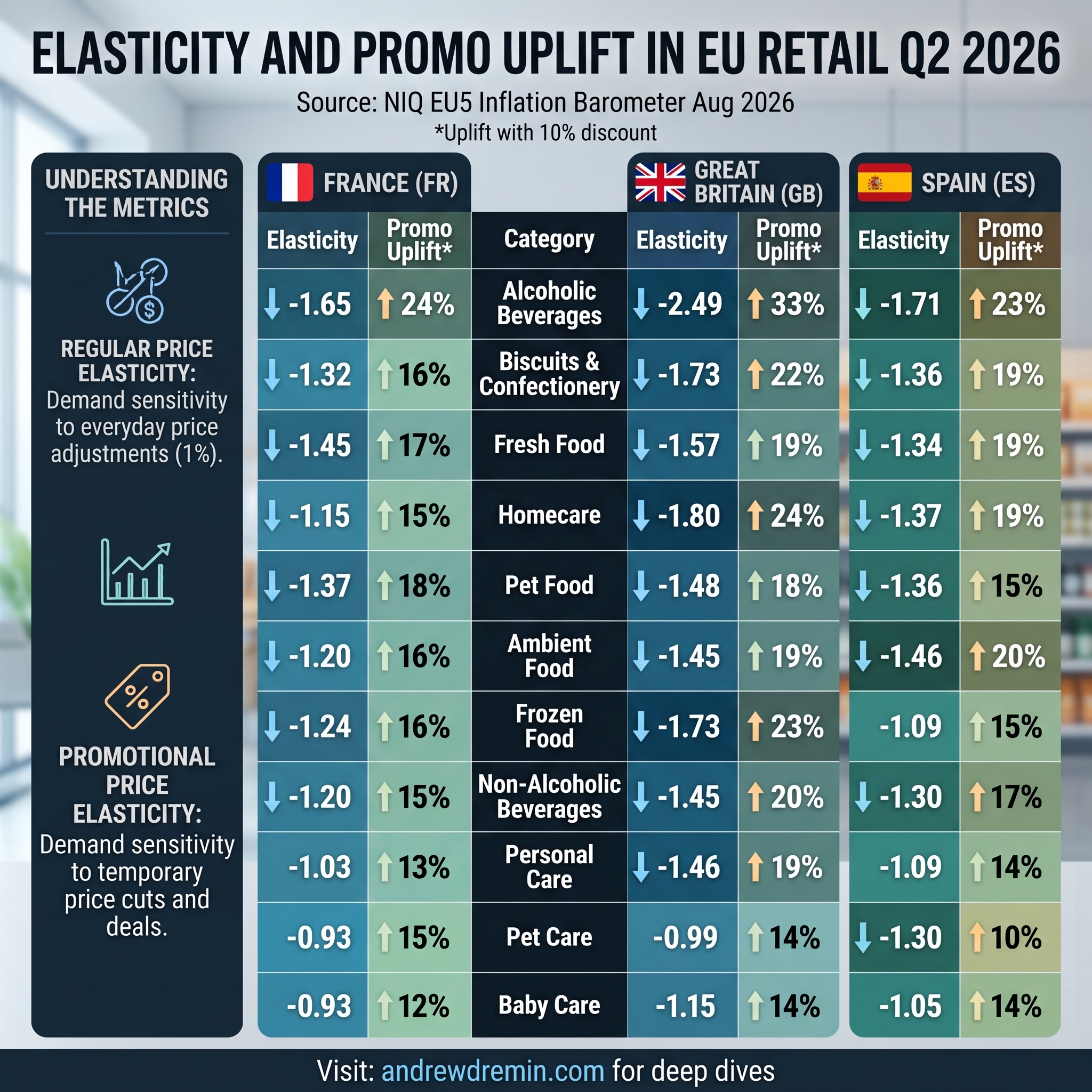
A 10% discount drives a 33% volume jump in UK alcohol sales in 2026. On a commercial spreadsheet, that looks like a major success. In reality, it reveals severe financial stress across British households. Shoppers are not just waiting for good deals; persistent inflation means many consumers cannot afford regular shelf prices anymore.
Today, people stand in supermarket aisles checking loyalty apps on their phones before buying a six-pack of beer. If the product is not on promotion, it stays on the shelf.
Understanding how different product categories react to discounts is the difference between making a profit and burning margin.
The Illusion of High-Volume Promotions: Why a 33% Uplift Destroys Margins
High promotional uplift often hides a margin trap. When a brand runs a 10% price cut to gain a 33% volume increase, commercial teams celebrate. But high volume does not automatically equal higher gross profit, often eroding promotional uplift margins.
| Scenario | Price | COGS | Margin (£) | Margin (%) |
|---|---|---|---|---|
| Base | £10.00 | £7.00 | £3.00 | 30.0% |
| 10% Promo | £9.00 | £7.00 | £2.00 | 22.2% |
| Volume Uplift Needed to Match Base Gross Profit: +50% | ||||
If a category has a promotional volume uplift of 33%, but requires a 50% increase to maintain gross cash profit, the brand loses money on every additional unit sold, highlighting the critical need for protecting profit margins.
When FMCG manufacturers fund deep price cuts on highly price-sensitive items, three negative events occur:
- Shopper Stockpiling: Consumers buy three months of supply at a discount, killing regular full-price sales in subsequent weeks.
- Brand Devaluation: Constant discounts train consumers to reject standard retail prices.
- Retailer Dependency: Supermarkets demand higher promotional funding year after year to maintain footfall.
European Price Sensitivity: NIQ 2026 Data Across EU5 Markets
Data from the NIQ EU5 Inflation Barometer (Q2 2026) shows how price elasticity differs across major European markets. Great Britain faces sustained FMCG inflation at +2.3%, whereas continental markets like France have entered FMCG deflation at -0.4%, and Spain sits at +1.2%.
| Market | FMCG Inflation | Context |
|---|---|---|
| UK | +2.3% | Sustained High |
| Spain | +1.2% | Moderate |
| France | -0.4% | Deflationary |
The table below breaks down regular price elasticity and promotional uplift for a 10% discount across key grocery departments in Great Britain, France, and Spain:
| FMCG Price Elasticity and Promotional Uplift Comparison (Q2 2026) | ||||||
|---|---|---|---|---|---|---|
| Grocery Department | Great Britain | France | Spain | |||
| Elasticity | Uplift | Elasticity | Uplift | Elasticity | Uplift | |
| Alcoholic Beverages | -2.49 | +33% | -1.65 | +24% | -1.71 | +23% |
| Homecare | -1.80 | +24% | -1.15 | +15% | -1.37 | +19% |
| Frozen Food | -1.73 | +23% | -1.24 | +16% | -1.09 | +15% |
| Biscuits & Snacks | -1.73 | +22% | -1.32 | +16% | -1.36 | +19% |
| Fresh Food | -1.57 | +19% | -1.45 | +17% | -1.34 | +19% |
| Pet Food | -1.48 | +18% | -1.37 | +18% | -1.36 | +15% |
| Personal Care | -1.46 | +19% | -1.03 | +13% | -1.09 | +14% |
| Ambient Food | -1.45 | +19% | -1.20 | +16% | -1.46 | +20% |
| Non-Alcoholic Drinks | -1.45 | +20% | -1.20 | +15% | -1.30 | +17% |
| Baby Care | -1.15 | +14% | -0.93 | +12% | -1.05 | +14% |
| Healthcare | -1.07 | +13% | -0.68 | +9% | -0.90 | +13% |
| Pet Care | -0.99 | +14% | -0.93 | +15% | -1.30 | +10% |
(Source: NIQ EU5 Inflation Barometer, August 2026)
Key Takeaways from the Data:
- Alcohol is the most volatile department: Great Britain (-2.49) and Italy (-2.62) show extreme sensitivity to price. British shoppers dramatically cut alcohol intake unless a promotion is active.
- Deflation changes dynamics in France: French shoppers are buying more total category volume (+1.9%) because non-food items are experiencing price drops (-1.6%).
- Healthcare and Baby Care are resilient: Across all countries, Healthcare and Baby Care stay near or below an elasticity of -1.0, making them structurally inelastic.
Emotionally Locked Categories: Why Baby Care and Pet Care Behave Differently
Look at the bottom of the elasticity chart. Baby Care in France sits at -0.93 elasticity (+12% uplift), and Pet Care in Great Britain sits at -0.99 elasticity (+14% uplift).
| Shopper Trade-Off Hierarchy | |||
|---|---|---|---|
| Level | Action | Category | Shopper Behavior |
| 1 | Protect | Baby Milk & Diapers | Will not compromise |
| 2 | Protect | Pet Food & Pet Health | Will skip personal treats first |
| 3 | Delay | Household Cleaning & Homecare | Wait for deals |
| 4 | Cut / Discount-Only | Beer, Wine, Spirits | High sensitivity |
These categories are emotionally locked:
- Parents do not swap baby formula or specialty diapers to save 50 pence if they trust a specific brand.
- Pet owners skip buying beer or snacks for themselves before they buy lower-grade food for their dogs or cats.
- Shoppers view healthcare and basic hygiene products as non-negotiable necessities.
Running flat 10% to 20% discounts on inelastic items does not generate meaningful extra volume. A mother does not use twice as many diapers in a week just because they were 15% cheaper. Giving away discounts on low-elasticity categories simply burns cash margin without creating new demand, underscoring the importance of a tailored inelastic product strategy.
Strategic Playbook for FMCG Brands: Smarter Revenue Growth Management (RGM)
FMCG commercial directors often discount inelastic products for two bad reasons, often overlooking effective FMCG pricing strategies: Defending market share against private label store brands. Hitting rigid sales volume targets in annual Joint Business Plans (JBPs).
- Defending market share against private label store brands.
- Hitting rigid sales volume targets in annual Joint Business Plans (JBPs).
Here is how brands should adjust their promotional mechanics:
| FMCG BRAND ACTION PLAN | |
|---|---|
|
High Elasticity Categories
(Alcohol, Snacks, Homecare)
|
Low Elasticity Categories
(Baby Care, Healthcare, Pets)
|
|
|
1. Stop Universal Price Cuts on Low-Elasticity SKUs
If your product has an elasticity between -0.70 and -1.15, eliminate blanket price reductions. Instead of flat price cuts, offer extra volume packs (e.g., “100ml Free” or “+20% Extra Sheets”). This protects the product’s regular cash price point while still offering clear perceived value.
2. Use Loyalty-Gated Mechanics for Elastic Categories
For highly price-sensitive lines (like craft beer, wine, or laundry detergent), avoid unconditioned shelf discounts. Require app-based loyalty scans (e.g., Tesco Clubcard, Sainsbury’s Nectar). This prevents non-loyal deal-hunters from taking margin without leaving valuable shopper data behind.
3. Replace Single-Unit Discounts with Multi-Buys
Instead of offering “10% off one bottle,” move to “Buy 2 for £X” or “Buy 3 for £Y.” Multi-buy mechanics force the consumer to increase their basket size, which secures your brand’s share of pantry inventory and delays their next purchase cycle from a competitor.
4. Fix Joint Business Plans (JBPs) Around Net Profit
Stop signing retailer joint business plans based entirely on gross volume targets. Reframe trade terms around category value growth and net margin retention. If a supermarket demands promotional support on an inelastic SKU, trade that budget for better shelf placement or off-shelf feature displays on high-elasticity SKUs instead.
Strategic Playbook for Retailers: Basket Building Tactics
Supermarket category managers must run promotions that grow the entire basket rather than subsidizing products customers were already planning to buy.
|
High-Elasticity Items
(Alcohol, Frozen Food, Soda)
|
Inelastic Anchor Items
(Baby Formula, Pet Health)
|
|
↓
|
↓
|
|
Drive Footfall into Aisle
|
Hold Everyday Shelf Margin
|
|
↘
↙
|
|
|
[ Profitable Basket ]
|
|
1. Deploy High-Elasticity Items as Footfall Drivers
Categories like Alcoholic Beverages (GB elasticity -2.49) and Homecare (-1.80) should carry your headline discount marketing. Use competitive pricing on these lines in digital leaflets, window posters, and app banners to get shoppers through the front door.
2. Maintain Everyday Pricing on Emotionally Locked Goods
Keep shelf prices firm on Baby Care, Pet Care, and Healthcare. These products act as margin anchors. Shoppers who enter the store for discounted beer and frozen food will buy their baby supplies and pet food at full price during the same trip.
3. Prevent Private Label Cannibalization Intelligently
Do not try to match discount retailer prices across every single SKU. Use private label brands to offer a clear opening price point for budget-constrained shoppers, while maintaining premium national brands at full margin for brand-loyal shoppers.
Category Strategy Matrix
Use this matrix to set pricing and promotion rules across your portfolio:
| Elasticity Tier | Elasticity Range | Core Categories | Promotion Rule | Pricing Strategy |
|---|---|---|---|---|
| High Elasticity | Below -1.70 | Alcohol, Homecare, Frozen Food, Snacks | High frequency, loyalty-gated, multi-buys | Competitive; use as promotional traffic driver |
| Moderate Elasticity | -1.20 to -1.69 | Fresh Food, Pet Food, Soft Drinks, Ambient | Selective promotions, seasonal feature displays | Balanced pricing; protect baseline cash margin |
| Low Elasticity | Above -1.20 | Baby Care, Healthcare, Pet Care | Minimal price discounting; value-add packs only | Premium, firm shelf pricing; margin generator |
Frequently Asked Questions (FAQ)
What is regular price elasticity in retail?
Why is UK alcohol sales price elasticity so high in 2026?
What is promotional uplift?
Why shouldn’t brands promote inelastic goods like baby formula?
How can FMCG brands protect market share without price cuts?
Related posts:
 Car Color Market Share Trends 2025: Grayscale Hits 80.4%
 The Most power passports 2016 vs 2026
 Purchasing power of 100$: 2019-2026
 Seasonal Retail Inventory Management: 85/15 Buffer Model
 World GDP Share 1820 to 2025: The Economic Transition
 The Illusion of the iPhone Index: What Viral Charts Miss About Consumer Purchasing Power
Leave a Reply