
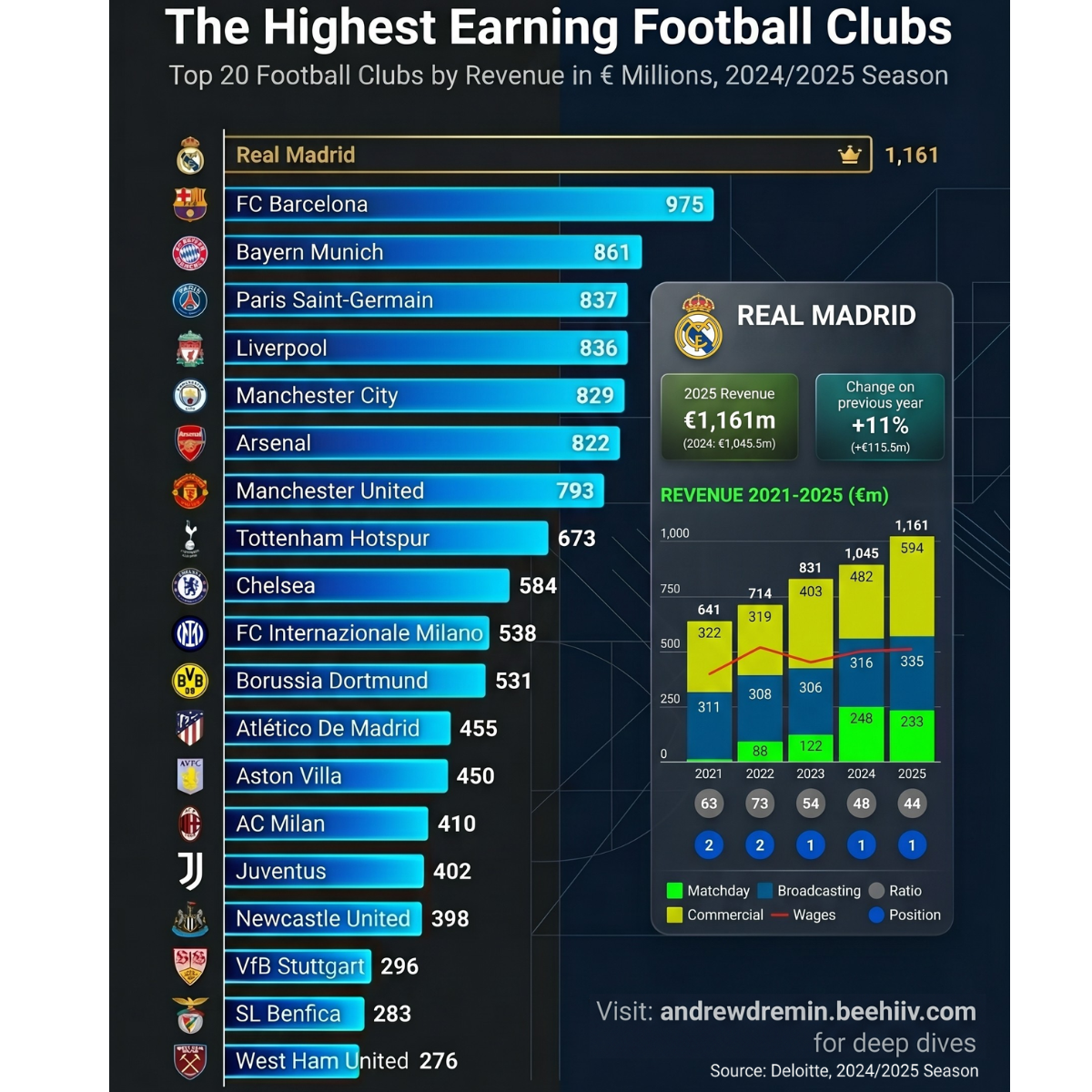
€5.3 billion. That is what the top 20 football clubs made just from commercial operations and retail last season, according to the 2026 Deloitte Football Money League report. Out of their €12.4 billion total revenue, commercial streams now make up 43%, overtaking broadcast income as the primary financial engine.
The Highest Earning Football Clubs (2024/2025 Season)
| Rank | Club | Revenue (€ Millions) |
|---|---|---|
| 1 | Real Madrid | €1,161M |
| 2 | FC Barcelona | €975M |
| 3 | Bayern Munich | €861M |
| 4 | Paris Saint-Germain | €837M |
| 5 | Liverpool | €836M |
| 6 | Manchester City | €829M |
| 7 | Arsenal | €822M |
| 8 | Manchester United | €793M |
| 9 | Tottenham Hotspur | €673M |
| 10 | Chelsea | €584M |
| 11 | FC Internazionale Milano | €538M |
| 12 | Borussia Dortmund | €531M |
| 13 | Atlético De Madrid | €455M |
| 14 | Aston Villa | €450M |
| 15 | AC Milan | €410M |
| 16 | Juventus | €402M |
| 17 | Newcastle United | €398M |
| 18 | VfB Stuttgart | €296M |
| 19 | SL Benfica | €283M |
| 20 | West Ham United | €276M |
Let us be honest about what this means. Traditional football is dead. These clubs are no longer sports teams. They are premium retail malls with a green pitch in the center.
Take Real Madrid. They retained the top spot globally, generating close to €1.2 billion in total revenue. But look closely at the breakdown. €594 million of that came purely from commercial sales, sponsorships, and merchandise.
Think about that number. That retail business alone would rank them in the global top 10 earners of football clubs, even if you stripped away every single euro of their TV and matchday income. This is not about selling replica jerseys on match days anymore. It is about a connected, global retail ecosystem. Yet, many analysts still evaluate clubs based on transfer strategies rather than their supply chain and merchandising efficiency. That is a mistake. The data shows that financial dominance now depends on retail execution, not just on-pitch success.
Historically, stadiums were open for 25 to 30 match days a year. The rest of the time, they were empty concrete bowls generating zero cash flow. That business model is obsolete. Elite clubs realized that relying on domestic TV rights is a dead end. Broadcast markets are stagnating. To survive, they had to pivot from event hosts to full-time landlords of consumer attention.
Look at Tottenham Hotspur. Their latest financial reports show commercial and other income hitting £277 million. Why? Because the Tottenham Hotspur Stadium operates 365 days a year as a commercial hub. They do not just host football. They host NFL franchises, high-profile boxing matches, and summer stadium concerts like Beyoncé and Travis Scott. They even built an F1 Drive karting track under the South Stand.
The modern fan does not just watch a 90-minute match. They buy a €150 jersey at the stadium megastore. They eat at club-owned restaurants. They stay in partnered hotels. Deloitte explicitly notes that on-site breweries, restaurants, and hotels are becoming standard revenue drivers. The venue is an entertainment zone designed to capture high-margin spending completely decoupled from football performance.
This brings us to the brands. Many FMCG companies are currently asking if stadium sponsorships are worth the high price tag. My opinion is clear: if you view football as just a logo on a shirt or a digital advertising board, you are wasting your budget.
Treating sports as a pure branding exercise is a trap. Brands sign multimillion-euro deals based on the assumption that stadium visibility equals supermarket sales. This is a cognitive bias. Visibility is just awareness. Without concrete point-of-sale integration, you cannot verify the return on investment. If there is no precise data proving your logo on a stadium board moves your product in a grocery store 10 kilometers away, you are operating on guesswork. Do not fill the gaps with marketing assumptions.
Stop looking at football as media. Look at it as a premium retail shelf with massive, highly captive foot traffic.
Supermarkets are losing their monopoly on premium consumer attention. High-spending foot traffic is moving toward these diversified entertainment zones. If your distribution strategy relies strictly on traditional grocery aisles, you are missing the emotional wallet of the consumer.
Think about the emotional wallet. Consumers spend differently in high-emotion, leisure environments. When someone is inside a stadium complex for five hours, they are not price-sensitive in the same way they are during a Tuesday evening grocery run. They are primed to consume. They want to extend the experience. This is why stadium retail commands a premium.
What are the conclusions for retailers and FMCG companies?
First, your distribution must change. You need to physically get into these entertainment spaces. If a club is building an on-site brewery or a food hall, your physical product needs to be on that shelf, not just your logo on the digital screens above it. Integration beats passive placement. You need physical availability where the emotional engagement happens.
Second, demand data from the clubs. Do not accept vanity metrics. If a club pitches you a sponsorship, test their hypothesis. Ask them for conversion metrics. These clubs now operate connected digital ecosystems – rom digital ticketing to in-seat ordering apps. They know exactly who is in the building, what they buy, and when they buy it. Ask how their fan data will drive repeat transactions for your specific product within their venue. If they can only offer generic “brand exposure” and stadium attendance figures, walk away. Say directly that there is insufficient data to justify the spend.
The financial shift is already a fact. The €5.3 billion commercial revenue figure proves that clubs have figured out how to be retailers. They built the malls. They secured the foot traffic.
The question is whether FMCG brands will figure out how to use them.
Are you still treating sports as a basic branding exercise, or are you treating it as a retail shelf? Let me know your thoughts below.


