
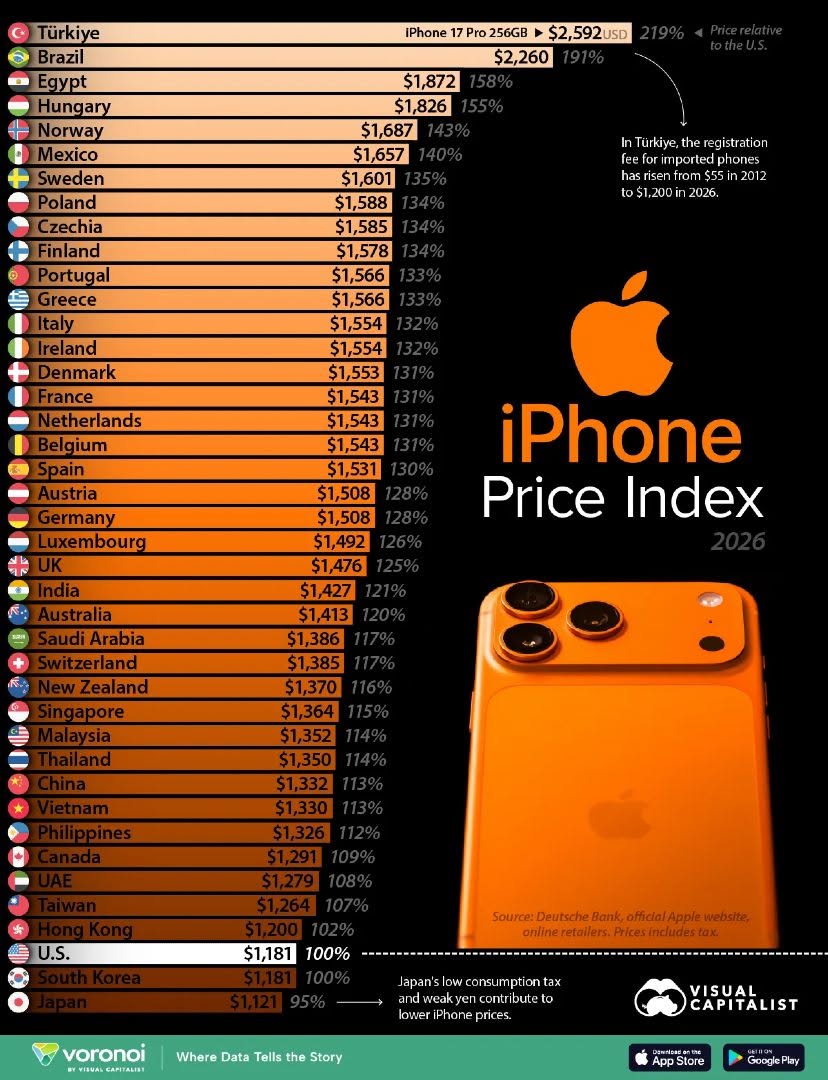
$2,592. That is what an iPhone 17 Pro costs in Turkey today. In Japan, the exact same phone costs $1,121. These dramatic differences are part of what the global iPhone price index 2026 aims to explore.
That is a $1,471 price difference for the exact same device coming off the exact same production line.
Retail executives in Istanbul look at these numbers and panic. Official store sales are down, and foot traffic is dropping. Executive teams often place the blame on cross-border grey market imports. They assume consumers are flying to Tokyo or Dubai, buying cheaper electronics, and bringing them back in suitcases to bypass local retail prices.
If you analyze the tax laws, the travel math, and actual consumer behavior, that explanation breaks down. The numbers simply do not support it.
The Real Math Behind the Turkish IMEI Tax
Turkey applies several layers of tax on imported electronics. These include Special Consumption Tax (ÖTV), Value Added Tax (KDV), radio fees, and cultural funds. On top of these retail taxes, the government charges a heavy IMEI registration fee for any mobile phone brought into the country privately.
In 2026, this IMEI registration fee is $1,200.
When an unregistered phone enters Turkey, the network allows it to connect for 120 days. After that window closes, the network blocks the phone’s IMEI number permanently unless the owner pays the registration tax to the government.
Let us look at the real out-of-pocket math:
- Buy an iPhone 17 Pro in Tokyo: $1,121
- Pay the Turkish IMEI registration fee: $1,200
- Total direct cost: $2,321
Buying the phone officially from a store in Turkey costs $2,592. The net savings from flying to Japan and registering the phone legally is $271.
A round-trip flight from Istanbul to Tokyo costs significantly more than $271. Once you factor in hotels, meals, and local transit, the trip results in a financial loss.
The legal framework makes resale even more difficult. Turkish law restricts phone registration to one device per passport every three calendar years. Furthermore, the registered IMEI is tied directly to the passport holder’s personal national ID number and their specific mobile line. You cannot bring in five phones and sell four to your friends. The suitcase arbitrage model is mathematically dead.
How Consumers Actually Bypass High Prices
If consumers are not flying to Japan to stock up on hardware, why are official retail sales falling?
Consumers do not stop wanting modern technology when prices jump. They simply adapt by finding practical workarounds or turning to shadow markets.
The Dual-Device Hotspot Workaround
During my time living in Turkey, I watched foreign expats and local residents navigate this tax barrier without paying the $1,200 fee.
Instead of registering their imported iPhone, they bought a basic, locally registered Android device – like an entry-level Xiaomi – for around $100. They inserted their local Turkish SIM card into the Android phone and turned on a continuous Wi-Fi hotspot.
The main iPhone stayed in airplane mode with Wi-Fi active. The user carried two devices in their pocket, keeping the main iPhone completely disconnected from the local cellular network tower. It adds minor operational friction, but it keeps $1,100 in the buyer’s pocket.
IMEI Cloning and the Illegal Market
The second path is the illegal black market. Small repair shops across major cities use software tools to overwrite hardware identification codes. They take an IMEI number from an old, broken, legally registered 2G burner phone and reflash it onto the imported iPhone.
The mobile network detects an ancient voice-only device connecting to the cell tower, while the user operates a modern smartphone.
Official retail loses sales not to international tourists with extra luggage, but to street-level hardware modifications and daily workarounds.
Japan’s Cheap iPhone is a Currency Illusion
On the other side of global pricing sits Japan at $1,121. But calling Japan “cheap” is a statistical illusion.
Japan appears at the bottom of the list because the Japanese Yen has weakened against the US Dollar. For a traveler converting US Dollars or Euros into local currency, Japan looks like a discount market.
For a local worker in Tokyo earning wages in Yen, the reality is different. Real wages have struggled to match inflation. To protect its global operating margins in USD, Apple periodically adjusts domestic retail Yen prices upwards.
A product can look like a bargain on an international price chart while becoming harder to purchase for local residents.
The Strategic Retail Lesson: Dead Demand vs. Shifted Demand
In my 15 years in retail procurement and commercial operations consulting, I have seen corporate boards make this mistake repeatedly. When sales drop after a price increase or tax adjustment, management teams often blame unfair external competition or market leakage.
They miss the core problem: dead demand.
When government taxes double the final price of consumer goods, buyer behavior shifts dramatically. People do not automatically shift their spending to another channel; they stop buying altogether. They keep their existing devices for four years instead of two. They pay for screen and battery repairs instead of buying new hardware.
The total addressable market shrinks.
My Takeaways for Retail and FMCG Leadership
- Trust the Math, Not Market Myths. Calculate the exact out-of-pocket costs and legal barriers facing the end buyer. If you ignore registration fees, travel costs, and personal quota limits, your market assumptions will fail.
- Extreme Taxes Destroy Volume; They Do Not Redirect It. Tax hikes rarely push buyers from informal channels straight into official stores. They cause consumers to defer replacement cycles. Adjust your volume forecasts downward the moment taxes rise.
- Stop Competing Purely on Base Price. Official retail will lose every price war against hardware hacks and unofficial channels. Official store networks must win on trust, immediate warranty fulfillment, fast trade-in programs, and local store financing.
What Is Your Approach?
How do you adjust your category pricing or inventory strategy when local taxes or currency swings distort your market?
Share your approach in the comments, or send me a direct message if you want to analyze your category numbers.
Infographic: Visual Capitalist


Leave a Reply