
If you follow my posts on LinkedIn, you know I don’t care for corporate marketing talk. I like logic. I like data. And right now, Nike Inc. is a case study in what happens when a giant brand loses its way and tries to fight its way back.
I’ve spent the last week digging into Nike’s Fiscal 2026 reports. The company is currently undergoing a massive structural overhaul called the “Win Now” plan. Under CEO Elliott Hill, they are trying to fix “strategic over-rotations”- a fancy way of saying they messed up their business model over the last five years.
This isn’t just a story about sneakers. It’s a story about global wars, shifting cultures in China, and a fight for shelf space in local malls. Here is the deep analysis of where Nike stands today.
The Q3 2026 Financials: “Running in Place”
The third quarter of 2026, which ended February 28, shows a company that is working very hard just to stay still. On paper, revenue was $11.3 billion. That sounds impressive, but it’s essentially flat. When you look at currency fluctuations, revenue actually fell by 3%.
Nike is currently cleaning its “balance sheet.” They are intentionally pulling “stagnant” classic shoes off the market. This removed about five points of revenue growth. They are choosing “marketplace health” over making a quick buck.
Primary Financial Performance Metrics: Q3 FY2026
| Metric | Reported Value | Year-over-Year Change | Analyst Consensus | Surprise/Variance |
| Total Revenue | $11.28 Billion | +0.1% | $11.23 Billion | +0.43% |
| Diluted EPS | $0.35 | -35.2% | $0.29 | +20.69% |
| Net Income | $0.52 Billion | -35.0% | N/A | N/A |
| Gross Margin | 40.2% | -130 bps | N/A | N/A |
| Inventory | $7.5 Billion | -1.0% | N/A | N/A |
| Cash & Equiv. | $8.1 Billion | -22.1% | N/A | N/A |
The Earnings Per Share (EPS) hit $0.35. It beat the expert guess of $0.29, but it’s a massive drop from the $0.54 they made last year. Why the 35% plunge in net income? Two reasons:
- Restructuring: They spent $230 million on employee severance (firing people).
- Trade War: They are facing a $1.5 billion annual tariff headwind.
Furthermore, their tax rate jumped from 5.9% to 20%. Last year, they had a one-time tax benefit that made them look better than they were. Now, the reality is setting in.
The “Win Now” Strategy: A Dangerous Gamble?
Elliott Hill says this is the “middle innings” of a comeback. The plan is to sharpen the “Sport Offense” and modernize technology. But as a critical analyst, I see some contradictions here.
1. The Technology “Brain Drain”
Nike is cutting 1,400 roles, mostly in Global Technology and Operations. They are moving everything into two hubs: Oregon (USA) and India.
- The Logic: Save money and use advanced automation to be faster.
- The Problem: You don’t win a digital war by firing your tech team. Critics argue these cuts are just to save profit today, but they might make Nike less “agile” than small, digital-native brands in the future.
2. Operational Modernization
Nike is moving production closer to its partners. They are modernizing “Air” manufacturing in Oregon, Missouri, and Vietnam. They are also moving Converse engineering to Asia so they can collaborate with factories in real-time. This is an admission that their old model was too slow and centralized.
3. The Pivot Back to Wholesale
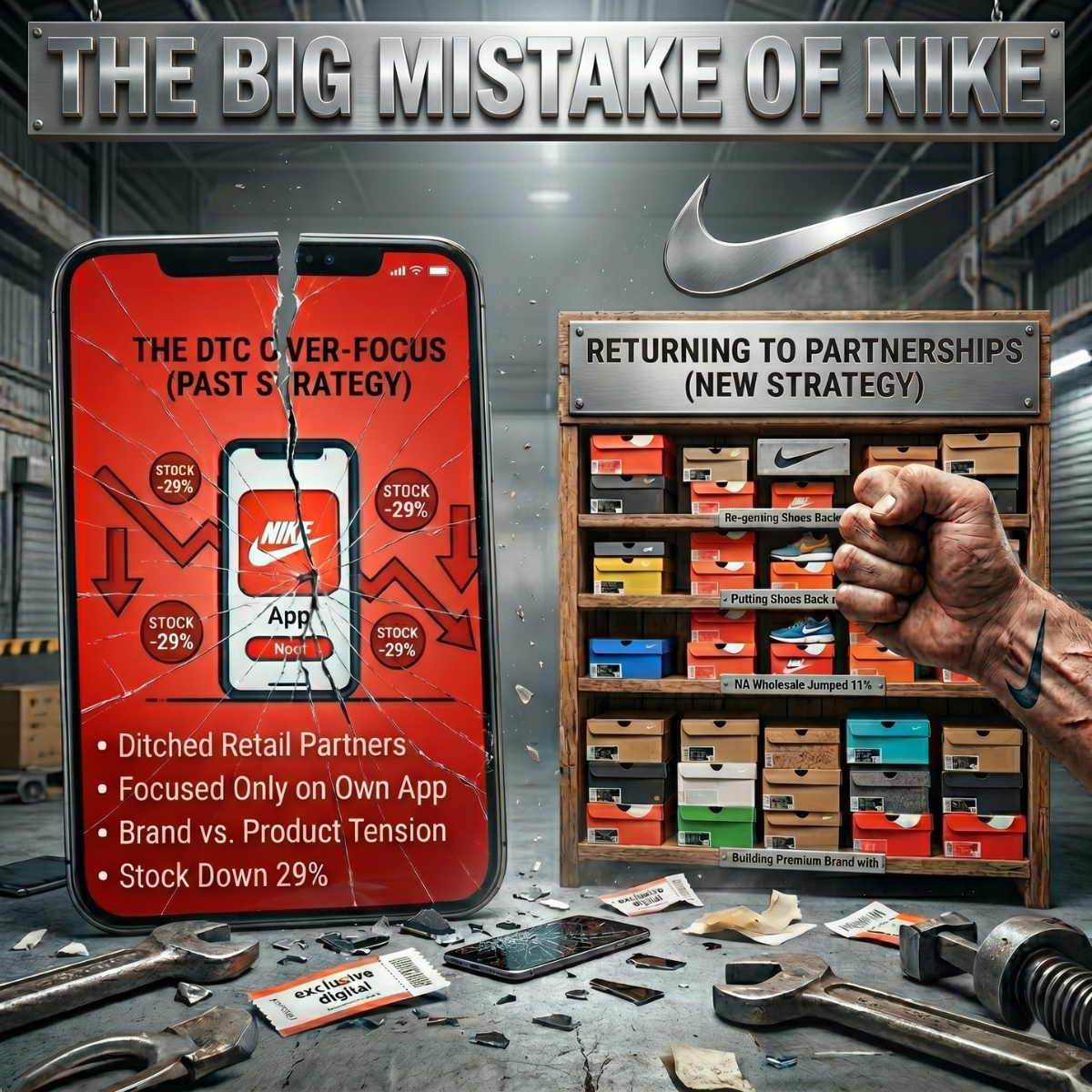
For years, Nike pushed “Consumer Direct Offense” – trying to sell only on their own website. This was a strategic disaster. It left empty shelves at stores like Foot Locker, which allowed brands like Hoka and On to move in.
Now, Nike is begging for those shelves back. In Q3 2026, wholesale revenue grew 11% in North America. But retail experts warn that stores won’t just give that space back for free. Nike has trained consumers to look for discounts, and regaining “pricing power” will be a long fight.
The New Retail Reality: The DKS + FL Merger
The most visible part of Nike’s recovery is the return to partners. In September 2025, Dick’s Sporting Goods and Foot Locker merged. This created a retail giant that now controls a huge chunk of Nike’s business.
Impact of Wholesale Consolidation
| Factor | Impact Detail | Implication for Nike |
| Market Control | DKS + FL controls ~$5B of Nike revenue. | Simpler shipping and logistics. |
| Shelf Space | Nike penetration is ~38% in the new entity. | Restores dominant physical visibility. |
| Synergies | $100M – $125M in cost savings for the retailer. | Allows for more “shop-in-shop” investments. |
| Channel Mix | Nike Direct fell 4%; Digital fell 9%. | Shift from high-margin web to high-volume stores. |
Nike even went back to Amazon in 2026. They realized they cannot grow big enough just by using their own apps. However, selling through partners means lower profit margins (~28% vs higher web margins).
Geography: North America vs. The China Crisis
Nike’s stock is swinging wildly because of two different stories.
The Good News: North America
North America is “healing.” In February 2026, Nike saw positive growth across all channels for the first time in two years. Their running category grew 20%. This shows the brand still has power at home.
The Bad News: Greater China
China is a “thorn.” Revenue there fell 10% this quarter. This is the seventh quarter in a row that China has declined.
The problem is cultural. The “Guochao” (National Wave) movement means Chinese shoppers want brands that feel Chinese.
| Competitor | Strategy | Recent Performance |
| Anta | Multi-brand (FILA, Salomon). China-first. | Revenue is 1.7x higher than Nike’s China sales. |
| Li-Ning | High-performance running focus. | Sold 11 million pairs of top running shoes in 2025. |
Nike’s “Lunar New Year” ads are often seen as fake or “performative.” Local brands like Anta feel authentic. Also, as the Chinese economy slows, people prefer the lower prices of local brands over Nike’s premium prices.
The Competition: A Fragmented Battlefield
Nike is the leader with a 27% market share in running, but they are being attacked from all sides.
Global Market Share and Growth (2025-2026)
- Nike (27% Share): Flat growth (+0.1%). Focusing on a wholesale rebuild.
- Adidas (19% Share): Growing fast (+14% in Q1 2026). Their “Samba” and “Gazelle” lifestyle shoes are beating Nike’s older retro models.
- On Holding (~8% Share): Growing 30%. They hit 3 billion CHF in revenue in 2025 with massive 62.8% profit margins.
- Hoka (~8% Share): Growing 13-14%. They own the “Wellness as Status” market with thick, cushioned shoes.
- Brooks: Growing 23% globally. In China, they grew 136% by focusing on biomechanics and science.
Nike used to ignore these “niche” brands. Now, these brands are mainstream powerhouses, and Nike is forced to use discounts to compete.
Macroeconomics: The Iran War and Inflation
We have to talk about the elephant in the room: The 2026 Iran War. The closure of the Strait of Hormuz has caused the largest oil disruption in history.
Oil prices are over $120 per barrel. Nike relies on oil for everything – synthetic polyester, rubber, and foam. Higher oil prices mean higher costs to make shoes and higher costs to ship them.
Risk Factors for Nike
| Risk Factor | Mechanism | Specific Outcome |
| Energy Costs | High fuel/heat prices. | People have less “fun money” for shoes. |
| Supply Chain | Rerouting ships around blockades. | Higher shipping costs and shortages. |
| Tariffs | US-China trade tensions. | $1.5 Billion annual cost to Nike. |
CFO Matthew Friend noted that the war has already hurt sales in Europe (EMEA), where revenue fell 7%. Nike is trying to raise prices by $2 to $10 per pair, but they risk losing customers who are already struggling with inflation.
Innovation: Reclaiming the “High Ground”
To fight back, Nike is moving away from “lifestyle” shoes and back to “performance” technology. The “Everyday Runner” is their target.
The “Nike Mind” platform (Mind 001 and 002) is their big hope. These shoes focus on “Aero-FIT” cooling and responsive soles. They sold out globally in January 2026. Nike is doubling production to meet the demand. This is a move away from just “changing colors” and back to actual science.
The 2026 World Cup Blueprint
The World Cup in North America is a $1.3 billion revenue opportunity. Nike is the sponsor for the US Men’s National Team and several others.
World Cup Innovations
- Aero-FIT Tech: 200% more airflow. This matters in the extreme summer heat of North America.
- Chemical Recycling: They are making kits from 100% textile waste – not just plastic bottles. This is a new industry standard.
- Cinematic Branding: Nike is treating ads like movies. Campaigns like “Guts 2 Glory” (England) and “Wild Cards” (USA) use “transmedia engagement” to tell stories over time, rather than just 30-second commercials.
Market Performance: A “Scared Crowd”
If you own Nike stock (NKE), it has been a rough year. The stock is down 29%, trading at decade-lows of $44–$47.
Analyst Consensus
| Firm | Rating | Price Target | Thesis |
| Goldman Sachs | Neutral | $55.00 | Worried about near-term profit. |
| Piper Sandler | Neutral | $50.00 | Recovery is slower than promised. |
| TIKR Model | N/A | $90.81 | Sees 103% upside based on long-term recovery. |
| MarketBeat | Hold | $62.34 | Market is waiting for proof. |
The stock is “priced for a stalled comeback.” While some models see huge upside, the reality is that Nike is currently “tripping over hurdles while jogging.”
The Path to 2027: Final Verdict
CEO Elliott Hill says the full impact of these new shoes won’t be seen until Spring 2027. This means 2027 is the real “proving ground.”
Projections for the Next 12 Months
- Inventory Cleanup: By early 2027, the old, bad inventory should be gone.
- Margin Recovery: They want to get back to double-digit profit margins by cutting costs ($230M saved).
- Revenue: Expect revenue to be “down low single digits” as China continues to plunge (-20% projected for China).
My Conclusion: Nike has recognized its failures. The plan is logical: focus on performance, fix wholesale, and use the World Cup to show off tech.
But the “Integrated Marketplace” is a double-edged sword. Nike’s own digital dream is dead—they need stores to survive. And with a war in the Middle East and a cultural shift in China, the road to recovery is much longer than the “earnings beat” suggests.
Nike is an icon at a low point. It’s a generational buying opportunity only if you believe they can innovate their way out of a world that is becoming more expensive and more competitive every day.
Disclaimer: This is an analysis, not financial advice. Test these hypotheses yourself.
Related posts:
 European Retail Self Checkout Shrinkage 2026: 22% Loss
 Testing the Limits of Brand Power: Nivea in an Inflated Economy
 Strategic alliance: Estée Lauder-Puig
 Lidl is now your phone operator
 The €100 Billion Milestone: Inside the Rise of Europe’s Silent Retail Giant
 The Supermarket Grocerant Trend: Why Retailers Are Stealing Restaurant Profits