
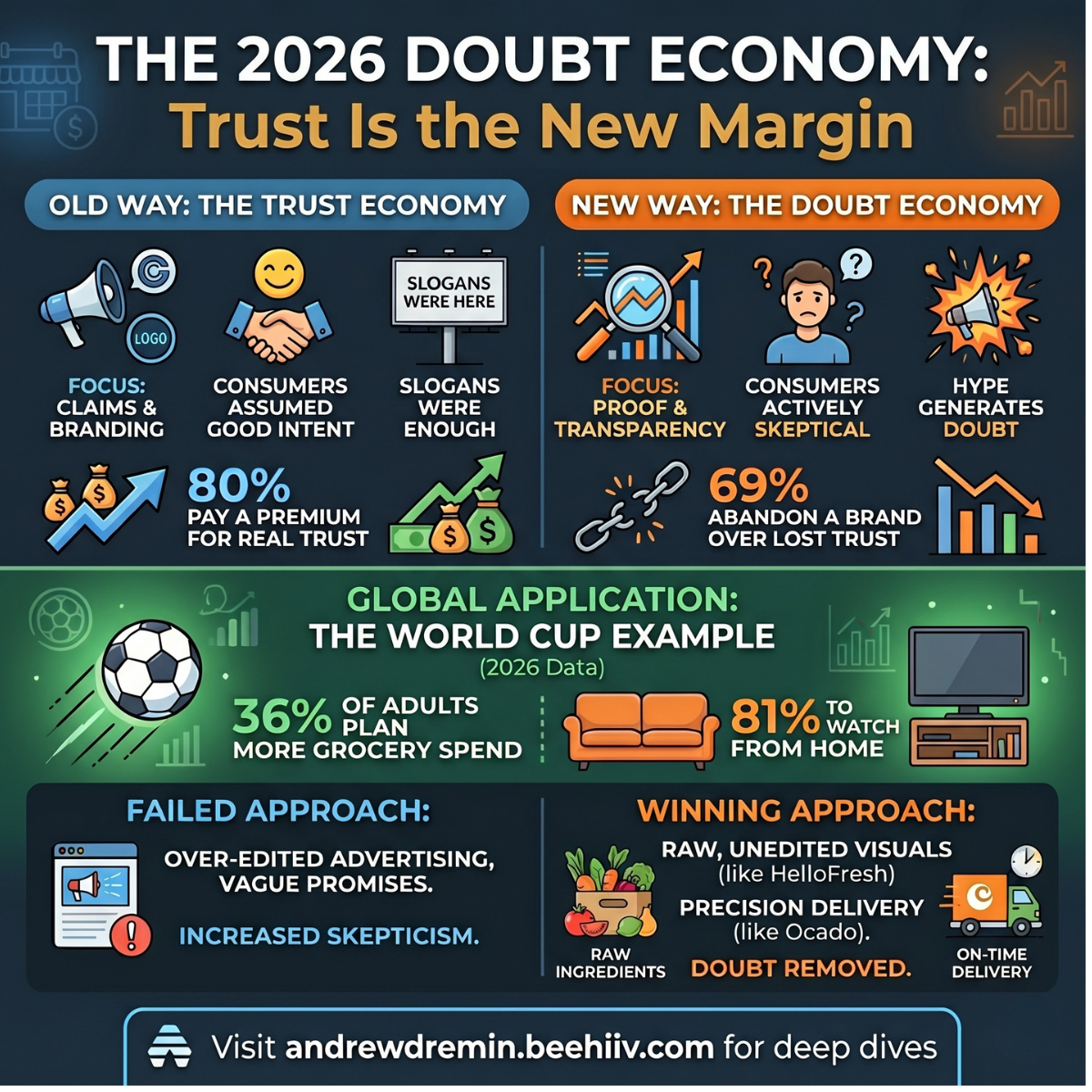
69% of consumers have completely dumped a brand because they stopped trusting its business practices. A new report on global retail trust metrics 2026 shows this trend is only expected to continue as shoppers become even more selective.
This is not a temporary dip in customer satisfaction. This is a permanent loss of revenue.
Yet, most retail marketing remains stuck in the past. Brands continue to spend millions on shiny slogans, polished TV ads, and corporate fluff. The reality on the ground is different: shoppers are no longer impressed by grand claims. They are actively looking for reasons to doubt you.
We have officially entered the “Doubt Economy.”
The Business Cost of Consumer Skepticism
Why are shoppers so skeptical today? Because retail history is full of broken promises.
Over the last few years, consumers experienced constant friction:
- Shrinkflation: Paying the same price for smaller package sizes.
- Skimpflation: Cheaper ingredients hidden behind unchanged packaging.
- Fake Sustainability: Vague green claims with no supporting data.
- Delivery Failures: Promised delivery windows missed without updates or compensation.
As a result, a consumer’s default reaction to marketing is now suspicion. When a brand says, “We offer the highest quality,” the shopper assumes you are hiding a flaw.
The McCann Study: Trust as Margin Protection
McCann recently released a global study covering more than 20,000 consumers. The data confirms a direct financial link between trust and profitability.
Key Data Points
- 80% of shoppers state they will pay a higher price if they genuinely trust the brand.
- 69% of shoppers walk away permanently when trust is broken.
In low-margin industries like retail and FMCG (Fast-Moving Consumer Goods), competition usually turns into a price war. But constant discounting destroys your margins.
This data proves that trust acts as a direct margin shield. If consumers believe your claims, you do not need to cut prices to make the sale. Trust is the premium currency.
Case Study: The World Cup Reality Check
A retail client recently asked me how to build a massive “hype campaign” for the World Cup.
My advice was direct: Stop hyping. Start proving.
Let us look at the actual numbers around major sporting events:
- 81% of adults watch the matches from their own living rooms.
- 36% of adults plan to spend more money on groceries during the event.
What the Home Viewer Actually Cares About
The guy sitting on his couch does not care about an expensive, emotional 60-second commercial about sportsmanship.
He cares about basic operational execution:
- Are the items in stock?
- Is the price accurate?
- Will the snacks and drinks arrive at his door before kickoff?
If the delivery is late, a beautiful advertisement will not save the customer relationship. Operational execution is your marketing.
How Leading Retailers Are Replacing Fluff with Proof
The retail brands winning market share right now are cutting fake promises and focusing on operational transparency.
1. HelloFresh UK: Unedited Reality
Instead of using studio lighting, food styling tricks, and heavy photo editing, HelloFresh UK began showing raw, unedited photos of real meal kit ingredients.
- The Result: Shoppers see exactly what will arrive in their delivery box.
- The Insight: Removing unrealistic expectations reduces disappointment and builds long-term trust.
2. Ocado: Precise Delivery Windows
Ocado stopped relying on general slogans about “convenience.” Instead, they focused heavily on exact halftime delivery time slots during major matches.
- The Result: Fans can order food and know it will arrive precisely during the break in the game.
- The Insight: Solving a specific operational friction point creates far more loyalty than emotional branding.
The 4-Step Playbook: Moving from Hype to Proof
For retail and FMCG executives, shifting strategy from hype to proof requires simple, practical changes across your operations.
Step 1: Use Raw Visuals
Stop over-editing your products. Show real items in real settings. If you sell fresh food, show how it looks under standard lighting, not studio setups.
Step 2: Make Logistics Your Headline
If you promise fast shipping, show real-time tracking metrics on your site. If 98% of your orders arrive within 30 minutes, state that exact stat instead of using vague terms like “fast delivery.”
Step 3: Be Transparent About Pricing and Sizes
If supply chain costs force a change in product size or price, communicate it clearly. Consumers notice shrinkflation immediately. Hiding it breaks trust permanently; explaining it retains respect.
Step 4: Fix Mistakes Proactively
When a delivery fails or a product is out of stock, do not hide behind automated customer service bots. Issue an immediate refund or notification before the customer has to lodge a complaint.
The Bottom Line
In 2026, selling perfection is a dead strategy. Perfect does not look real to a modern consumer.
The brands that succeed are not the ones with the loudest campaigns or the biggest ad budgets. The winners are the brands that systematically remove doubt, reduce friction, and back up every claim with hard operational proof.
Stop selling perfection. Sell proof. In today’s economy, the company that removes the most doubt wins the wallet.
Question for your team: How are you showing real, unedited proof to your customers today?
Related posts:
 Global Beer Market Trends 2026: The $41B Zero-Alcohol Shift
 The Small Appetites Economy: How Weight-Loss Drugs Are Rewriting the Rules of Retail
 The Billion-Dollar Illusion: How a Fake Movie Parade Transformed Global Retail and Tourism
 The battle for US grocery market.
 EU international trade 1Q 2026
 Global iPhone Price Index 2026 and Consumer Behavior
Leave a Reply