
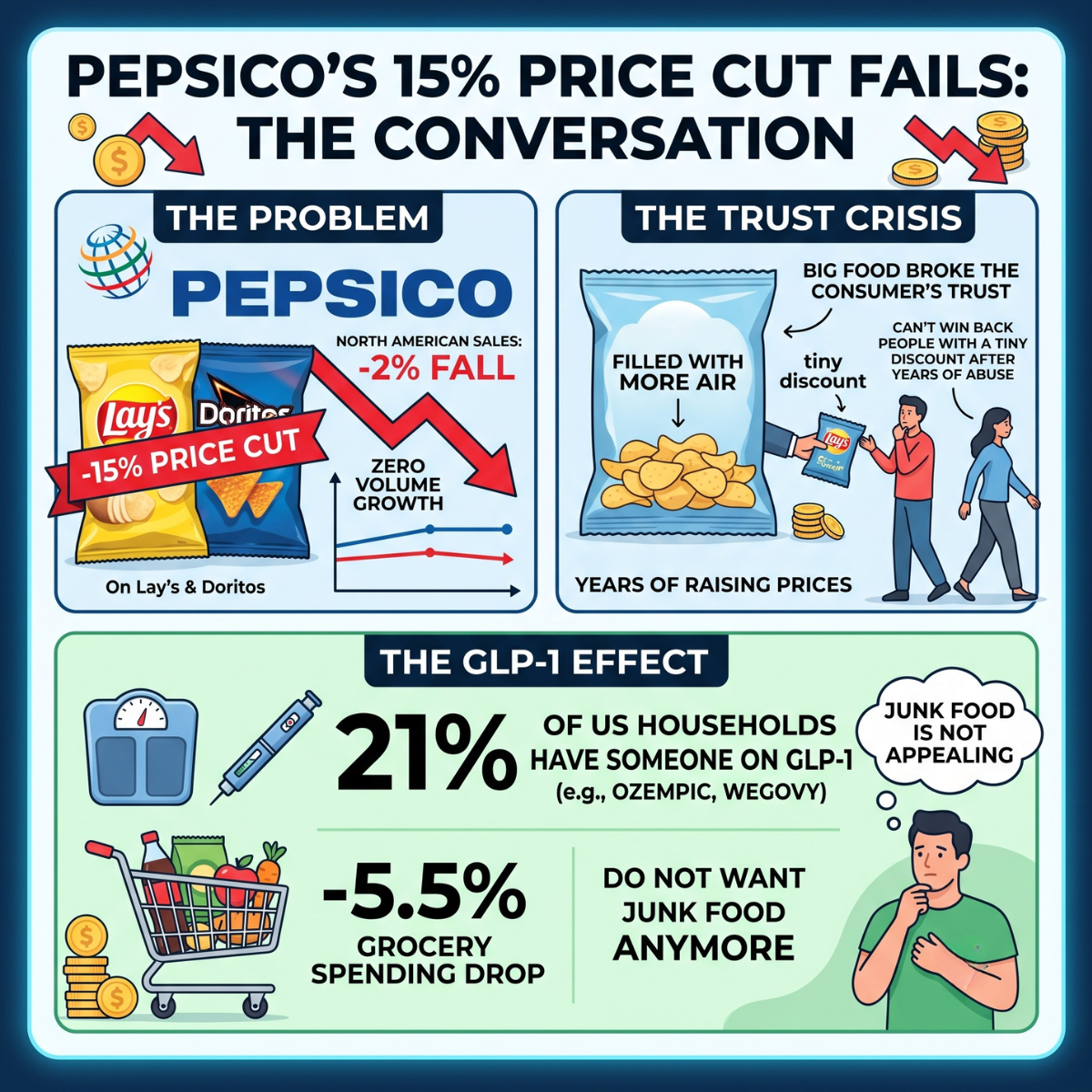
On July 9, 2026, the global food and beverage giant PepsiCo published its second-quarter financial results, which included the announcement of a PepsiCo 15 percent price cut on select products. At first glance, the numbers looked like a solid victory. Net revenues rose 6.4% year-over-year to $24.18 billion, beating Wall Street expectations. Core earnings per share (EPS) came in at $2.20, slightly ahead of the analyst consensus of $2.19. Global organic volumes grew at their fastest rate since 2022.
But beneath these bright global headlines, a dark domestic reality was unfolding. In subsequent trading in New York, PepsiCo’s stock price plunged by as much as 5.5%.
Investors were not looking at PepsiCo’s fast-growing international markets. Instead, their attention was locked on a deeper crisis in the company’s home market. Frito-Lay North America (PFNA), the legendary salty-snack division that has long served as PepsiCo’s ultimate cash machine, had stalled.
On July 15, 2026, a performance analysis by the Grocery Gazette confirmed the worst. Despite slashing prices by up to 15% on core brands like Lay’s, Doritos, and Cheetos, PepsiCo’s North American food revenues fell by 2%. More alarmingly, sales volumes remained completely flat. Frito-Lay’s volume growth has now contracted or stayed flat in four of the past six quarters.
This persistent domestic fatigue has triggered intense, public pressure from the activist hedge fund Elliott Investment Management. Holding a massive $4 billion stake in PepsiCo, Elliott has spent months pushing for aggressive cost-cutting and the potential spin-off of underperforming food assets.
For retail and fast-moving consumer goods (FMCG) professionals worldwide, PepsiCo’s domestic struggle is not just a temporary rough patch. It is a historic case study. It marks the death of a long-held corporate assumption: that price elasticity is a simple, bi-directional volume dial that can be turned up to maximize margins and trimmed down to win back shoppers.
1. The Great Divide: Domestic Stagnation vs. International Momentum
To understand the crisis at Frito-Lay, we must first look at the widening gap between PepsiCo’s international operations and its North American business.
Globally, PepsiCo is performing exceptionally well. International markets are increasingly carrying the weight of the entire company, with the segment projected to surpass $40 billion in revenue for the full year 2026. International operating margins expanded by a full 100 basis points in the second quarter of 2026 due to aggressive local efficiencies. Today, international markets contribute two-thirds of PepsiCo’s total beverage volume and over half of its total food volume.
But in North America, the consumer has hit a wall. Households are exhausted by years of cumulative inflation, rising interest rates, and high fuel costs. This pressure is most visible in the high-margin “impulse” channels, such as convenience stores and independent gas stations.
On the Q2 2026 earnings call, CEO Ramon Laguarta admitted that the domestic consumer is “worse than what we had anticipated,” pointing directly to elevated gasoline prices as a key driver. High fuel prices are reducing the conversion of convenience store foot traffic into impulse food and beverage purchases.
The following table outlines the performance divergence across PepsiCo’s key product segments in Q2 2026:
| Product Segment | Price Action | Volume & Revenue Impact | Margin & Cost Drivers | Future Strategic Focus |
| Core Salty Snacks (Lay’s, Doritos, Cheetos) | Price cuts up to 15% on medium-sized bags | Volumes flat; segment revenue down 2% | Frito-Lay operating margins fell 40 bps due to high promo and distribution costs | Transition toward portion-controlled multipacks and opening price points |
| Health-Conscious Snacking (Baked, SunChips, Quaker) | Maintained standard pricing | Strong volume and organic growth; permissible snacks reached $3B | High-margin portfolio insulation; strong consumer alignment with structural better-for-you shifts | Portfolio expansion into “permissible” snacking occasions and clean-label offerings |
| North American Beverages (Pepsi, Gatorade) | Standard pricing adjustments | Volumes declined by 4% | Operating margin fell 90 bps; driven by Alani Nu commercial arrangements and convenience channel declines | Supply-chain restructuring, Texoma regional mixing centers, and autonomous middle-mile delivery |
2. Asymmetric Price Elasticity: The Failure of the Volume Dial
Why did a 15% price cut fail to stimulate buying among Frito-Lay’s core consumer base? The answer lies in the psychological reality of behavioral economics.
For years, FMCG executives have relied on traditional, symmetric price elasticity models. These models assume that consumer behavior is perfectly reversible: if a 10% price hike reduces sales volume by 5%, then a subsequent 10% price cut should bring that 5% volume right back.
However, real humans do not calculate value in a vacuum. Instead, we evaluate prices based on a shifting psychological benchmark known as a “reference point”. In behavioral economics, this is modeled through Prospect Theory, famously developed by Daniel Kahneman and Amos Tversky.
Under Prospect Theory, consumers do not see pricing as a neutral number; they view changes as either “gains” or “losses” relative to their reference point. Crucially, the human response to these changes is highly asymmetric: the psychological pain of a loss is roughly twice as intense as the pleasure of an equivalent gain.
This can be expressed mathematically through the loss aversion value function:

Here, the loss aversion coefficient $\lambda > 1$ (typically measured around 2.0 to 2.5) guarantees that the negative utility of a price hike is felt far more acutely than the positive utility of a discount.
When PepsiCo implemented aggressive, double-digit price hikes across its North American snack portfolio from 2021 to 2025, consumers registered these hikes as severe financial losses. They felt exploited. To cope with these perceived losses, shoppers were forced to break their decades-long, habitual snack-buying routines. They did something they had avoided for years: they walked away from Frito-Lay and reached for private-label or store-brand alternatives.
Once a consumer breaks a habit and tries a private-label product, a dangerous threshold is crossed for the brand. The consumer realizes that the store-brand chip – often priced 30% to 50% lower – tastes almost identical to the national brand.
At this exact moment, the consumer’s psychological reference point permanently resets. The store brand’s lower price becomes the new standard of “fair value”.
When PepsiCo finally rolled back prices by 15% in mid-2026, consumers did not view it as a generous favor or an attractive incentive. They looked at the discounted price, compared it to the new, lower private-label reference point, and kept walking. The expensive discount campaign was rendered highly ineffective because the emotional and economic connection with the brand had already been severed.
3. The Backlash Against Shrinkflation and Deceptive Packaging
To make matters worse, the consumer’s reluctance to return is fueled by deep-seated anger over “shrinkflation” – the practice of reducing a product’s size or volume while keeping its price the same.
Over the past few years, snack food bags have felt increasingly filled with empty air rather than actual product. In late 2023, French supermarket giant Carrefour sparked a global public relations crisis for PepsiCo by placing warning labels on supermarket shelves next to products that had shrunk in size but increased in price. By January 2024, Carrefour took the ultimate step, removing PepsiCo snacks and beverages entirely from its stores in France, Italy, Belgium, and Spain. While products eventually returned after intense negotiations in April, the reputational damage was done.
In the United States, consumer frustration reached the highest levels of government. US Senators Elizabeth Warren and Representative Madeleine Dean sent letters to PepsiCo’s leadership expressing deep concerns over the systematic downsizing of core products. They specifically pointed to PepsiCo’s replacement of its classic 32-ounce Gatorade bottles with 28-ounce bottles for the exact same retail price – a subtle move that represented an implicit 14% price hike.
A recent national survey by LendingTree revealed the scale of the consumer backlash:
- 71% of American consumers reported actively noticing shrinkflation in their grocery aisles over the past year.
- 82% of those who noticed the practice stated they felt personally deceived by the manufacturers.
- 66% of affected shoppers made the deliberate decision to stop buying from the offending brands altogether.
In an attempt to mend its frayed relationships with consumers, PepsiCo announced “bonus packs” in late 2024, adding 20% more chips to select bags of Tostitos and Ruffles, and throwing two or three extra bags of Doritos into its popular multipacks without raising prices.
But consumer advocates like Edgar Dworsky, a consumer protection lawyer who runs Mouseprint.org, quickly exposed these initiatives. Dworsky pointed out that these “bonus bags” are merely temporary marketing promotions that fail to address the permanent, structural downsizing of the core product portfolio. The underlying trust gap remains wide open.
4. The Biological Headwind: The Shock of GLP-1 Medications
While inflation and shrinkflation have damaged brand loyalty, PepsiCo’s domestic volume stagnation is also colliding with a powerful, permanent, and biological headwind: the rapid rise of GLP-1 weight-loss medications like Ozempic, Wegovy, and Mounjaro.
These highly effective drugs mimic naturally occurring gut hormones to slow gastric emptying and suppress appetite, leading to an average 30% reduction in a patient’s daily caloric intake. What began as a clinical treatment for type-2 diabetes has rapidly transformed into a massive lifestyle shift across North America.
According to data compiled in May 2026:
- 21% of all households in the United States now include at least one active GLP-1 user – a massive leap from just 9% in January 2025.
- 54% of these surveyed users have been on GLP-1 therapies for more than a year, indicating that this is not a temporary diet trend, but a permanent structural shift in eating behavior.
- Average household grocery expenditures for GLP-1 users have declined by 5.5%.
More importantly, GLP-1 medications alter what people actually want to eat. The brain’s cravings for highly processed, calorie-dense foods – specifically high-fat, high-sodium, and high-sugar snacks – are heavily suppressed.
| Consumer Metric | Impact of GLP-1 Adoption (May 2026 Data) | Structural Consequence for CPG Portfolios |
| Household Penetration | 21% of US households contain a current GLP-1 user (up from 9% in Jan 2025) | Broad, cross-demographic suppression of impulse food purchasing decisions |
| Sustained Usage | 54% of surveyed users have been on GLP-1 therapies for more than a year | Permanent restructuring of eating habits rather than temporary dieting behavior |
| Grocery Expenditure | Average household grocery spend declined by 5.5% | Decline in total unit movement; rebalancing of wallet share toward protein and produce |
| Salty Snack Consumption | 56% of active users report purchasing fewer salty snacks | Volume stagnation in Frito-Lay’s core category despite targeted price cuts |
| Sweet Treat Purchasing | 61% of active users report buying fewer sweet treats | Underperformance of confectionery and sugary carbonated soft drinks |
| Health and Activity Integration | 36% of current users have increased physical exercise (e.g., walking, running) | Alignment with functional hydration (Gatorade, Propel) and permissible snacks |
When a consumer is physically unable to finish a standard bag of chips, or simply does not experience the craving to open one, a 15% price cut on a giant bag of Doritos becomes completely irrelevant. The purchase is no longer driven by price; it is limited by biology.
At the same time, this medical shift is opening up major growth categories. GLP-1 users are actively rebalancing their diets, purchasing 44% more fresh produce, 35% more packaged protein, and 34% more fresh protein. Adjacent categories are surging: Greek yogurt consumption is up 6.8%, jerky is up 7.9%, and nutrition bars have grown 3.4%.
Crucially, functional hydration brands like Gatorade and Propel are well-positioned to ride this wave, as 36% of GLP-1 users report increasing their physical exercise, particularly walking and running.
5. Under the Activist’s Knife: The Elliott Investment Agreement
PepsiCo’s operational challenges in its home market did not escape the attention of Wall Street’s most feared activist investor. In September 2025, Elliott Investment Management disclosed a massive $4 billion stake in PepsiCo, making it one of the company’s largest shareholders.
In a pointed letter to PepsiCo’s Board of Directors, Elliott partners Jesse Cohn and Marc Steinberg argued that years of double-digit price increases and stagnant volumes had led to a “disappointing trajectory,” characterized by a severe lack of strategic clarity and eroding profitability in North America.
Elliott initially pushed for radical structural changes, including:
- Conducting a comprehensive operational review of the entire North American supply chain.
- Refranchising or spinning off PepsiCo’s capital-intensive, operationally heavy North American bottling operations (PBNA).
- Streamlining Frito-Lay’s asset base by divesting non-core, underperforming food assets.
To prevent a highly public and destructive proxy contest, PepsiCo’s leadership moved quickly to negotiate. On December 8, 2025, the two parties finalized a formal restructuring agreement. Under the terms of the deal, Elliott did not receive board seats, but PepsiCo committed to a sweeping operational overhaul:
| Restructuring Mandate | Exact Terms & Operational Details | Projected Organizational Impact |
| SKU Rationalization | Cut the United States product lineup by 20% | Streamline manufacturing; eliminate low-velocity, high-complexity variants |
| Workforce & Plant Closures | Reduce workforce across US and Canadian operations; close Frito-Lay plants in Orlando (FL), Rancho Cucamonga (CA), and Liberty (NY) | Lower structural labor overhead; consolidate production into highly automated hubs |
| Price Reinvestment | Reinvest restructuring and automation savings directly into lowering prices on core brands | Improve consumer value perception and defend market share against private labels |
| Operating Margin Targets | Execute multiyear productivity initiatives, automated supply chains, and digital logistics | Core operating margin expansion of at least 100 basis points over three fiscal years |
| Asset Portfolio Evaluation | Reject immediate bottling spinoffs; instead, conduct a state-by-state evaluation of the integrated beverage model | Optimize scale, return on investment (ROI), and local market share |
While Elliott initially demanded an immediate spin-off of the bottling business, PepsiCo’s management successfully defended its “integrated model,” arguing that owning both the food and beverage logistics networks creates unparalleled retail scale and distribution advantages. However, the state-by-state evaluation of the bottling network remains highly active, forcing local business units to justify their return on investment on a hyper-local level.
6. A Sector-Wide Squeeze: Benchmarking PepsiCo against Competitors
The volume contraction at Frito-Lay is not an isolated execution failure. It is a stark warning sign for the entire North American food manufacturing sector. Because cumulative grocery prices have soared by roughly 25% since 2019, consumers are treating food as a strictly managed budget item, aggressively cutting back on indulgent, non-essential categories.
A look at PepsiCo’s peers reveals an industry-wide struggle:
- General Mills: The maker of Cheerios and Blue Buffalo reported a 5% drop in quarterly net sales as consumers pulled back on discretionary food items.
- J.M. Smucker: Faced a 7% decline in its sweet baked snacks segment, reflecting a broad consumer retreat from high-calorie, highly processed indulgences.
- The Hershey Company: Hershey’s stock declined by 15% post-Q1 2026 as the company faced a devastating margin squeeze. Historically high cocoa prices compressed Hershey’s gross margin by a massive 17 percentage points to 37% in late 2025. Although Hershey’s management projected a “meaningful recovery” beginning in late 2026, its premium valuation of 42.6x P/E (compared to the food industry average of 20.8x) has left the company with zero margin for error.
These comparative figures prove that the era of “easy growth” through simple pricing actions is officially over. FMCG giants can no longer use inflation as a convenient cover to continuously inflate prices without suffering permanent damage to their underlying volume and brand equity.
7. The Logistics Solution: Mixing Centers and Driverless Trucks
To defend its profit margins while absorbing the financial hit of lowering prices on core brands, PepsiCo has turned to radical, technology-driven supply chain automation.
Historically, PepsiCo operated separate supply chains and delivery fleets for its food (Frito-Lay) and beverage (PBNA) divisions. To eliminate this costly duplication, the company is actively testing combined logistics through “mixing centers” in the Texoma region. These mixing centers merge food and beverage inventory under a single roof, allowing the company to test unified regional delivery systems and a single truck fleet. This consolidation drastically reduces transportation, warehousing, and fuel costs.
In parallel with supply-chain integration, PepsiCo has deployed the largest commercial autonomous trucking network in the world. On June 8, 2026, PepsiCo announced a landmark, multi-year partnership with Gatik AI to bring driverless freight to its North American regional networks.
Under this partnership, PepsiCo has deployed 41 autonomous Isuzu-branded box trucks to haul products along highly repeatable, short-and-medium-haul delivery routes:
- 35 vehicles are currently operating in Arizona.
- 5 vehicles are deployed in Texas.
- 1 vehicle is running in Arkansas.
By automating these high-frequency middle-mile routes in live, public networks, PepsiCo is driving logistics consistency and insulating its cost structure from chronic driver shortages and rising labor overhead.
This operational efficiency is vital because PepsiCo faces a volatile global trade environment. In June 2026, the Trump administration hiked tariffs on imported aluminum from 25% to 50%, putting severe pressure on beverage packaging costs.
To temporarily shield its bottom line, PepsiCo is relying on expected tariff refund claims from duties paid in 2025. Management expects these refunds to contribute approximately 1.0 percentage point of EPS growth for the full year 2026, giving them a temporary cushion to fund their domestic price investments.
Furthermore, PepsiCo’s strategic M&A integration is showing positive momentum. Siete Foods has successfully resolved the ingredient supply challenges that hampered its sales in early spring, while the newly acquired prebiotic soda brand Poppi has returned to strong growth following a major distributor transition. Poppi is scheduled for a high-profile international debut at Tesco and Pret a Manger in the United Kingdom in March 2026, expanding PepsiCo’s presence in the functional wellness space.
8. Strategic Blueprint: Key Takeaways for FMCG and Retail Leaders
PepsiCo’s experience offers critical strategic lessons for executives across the consumer goods and retail landscapes. If your business is currently grappling with stagnant volumes and margin pressures, consider the following blueprint:
Lesson 1: Respect the Asymmetry of Price Elasticity
Never assume you can easily win back consumers with standard promotions once you have forced them to break their buying habits. Broad, indiscriminate price cuts are highly inefficient and dilutive to margins.
Instead, optimize the return on your pricing investments by tailoring specific trade promotions to individual retail partners, localized customer demographics, and key shopping holidays. Differentiate your approach carefully between high-low promotional retailers and everyday-low-price (EDLP) accounts to prevent margin leakage.
Lesson 2: Rebuild Trust by Eradicating Deceptive Practices
Shrinkflation may provide a short-term margin cushion, but it acts as a long-term poison to brand equity. Consumers feel deeply deceived by air-filled bags and downsized beverage containers.
Instead of hiding price increases through smaller volumes, focus on transparent communication. If you must adjust packaging, proactively offer smaller, portion-controlled formats at accessible, opening price points, such as variety packs and multipacks. This maintains consumer goodwill while providing budget-conscious families with options they can actually afford.
Lesson 3: Pivot the Portfolio from Volume to Satiety and Wellness
The growth of GLP-1 medications is a structural, biological shift that will continue to suppress overall caloric intake and processed food volumes for the foreseeable future.
Do not waste capital trying to push high-volume, indulgent foods to a consumer base that is physically eating less.
Instead, aggressively shift your product portfolio toward “permissible” snacking and functional nutrition. PepsiCo’s permissible food portfolio (such as baked chips, SunChips, and Quaker offerings) is already a $3 billion business growing at a near double-digit rate. According to data from Innova Market Insights, consumer demand for healthier, better-for-you snacks has expanded by 33%, compared to just 15% for traditional, indulgent snacks. Reframe your marketing and product development around nutrient density, protein enrichment, functional hydration, and clean-label ingredients.
Lesson 4: Force Operational Efficiencies Through Scale Integration
If you operate multiple divisions or product categories, tear down the operational silos between them.
The integration of Frito-Lay and PepsiCo Beverages through shared mixing centers in Texoma proves that combining warehousing, fleets, and logistics is a highly effective way to remove structural costs from the business.
Additionally, embrace middle-mile automation. Implementing autonomous logistics fleets, like PepsiCo’s deployment of Gatik AI driverless trucks, can protect your supply chain from labor volatility and rising transportation overhead.
9. Future Outlook
As PepsiCo moves into the second half of fiscal 2026, its management team has reaffirmed its full-year organic revenue growth guidance of 2% to 4%. However, the company has cautioned investors that constant-currency EPS growth will likely trend toward the lower end of its original 4% to 6% target range.
The North American turnaround will be a slow, gradual climb rather than a quick rebound. But by executing a rigorous SKU rationalization of 20%, consolidating its manufacturing base through necessary plant closures, and utilizing state-of-the-art middle-mile logistics automation, PepsiCo is successfully setting up a leaner, far more efficient cost structure.
The ultimate lesson of the “Cheap-Chip Conundrum” is clear. In the modern retail environment, market leadership cannot be maintained through financial engineering or aggressive pricing power alone. To win in tomorrow’s market, consumer brands must deliver genuine, transparent value that aligns with the structural, technological, and biological realities of the modern consumer.
Related posts:
 The Billion-Dollar Illusion: How a Fake Movie Parade Transformed Global Retail and Tourism
 Lidl is now your phone operator
 The Supermarket Grocerant Trend: Why Retailers Are Stealing Restaurant Profits
 Inditex Q1 2026 Performance
 The €100 Billion Milestone: Inside the Rise of Europe’s Silent Retail Giant
 Why Tesco is Walking Away from Central Europe and What Retail Leaders Must Learn