
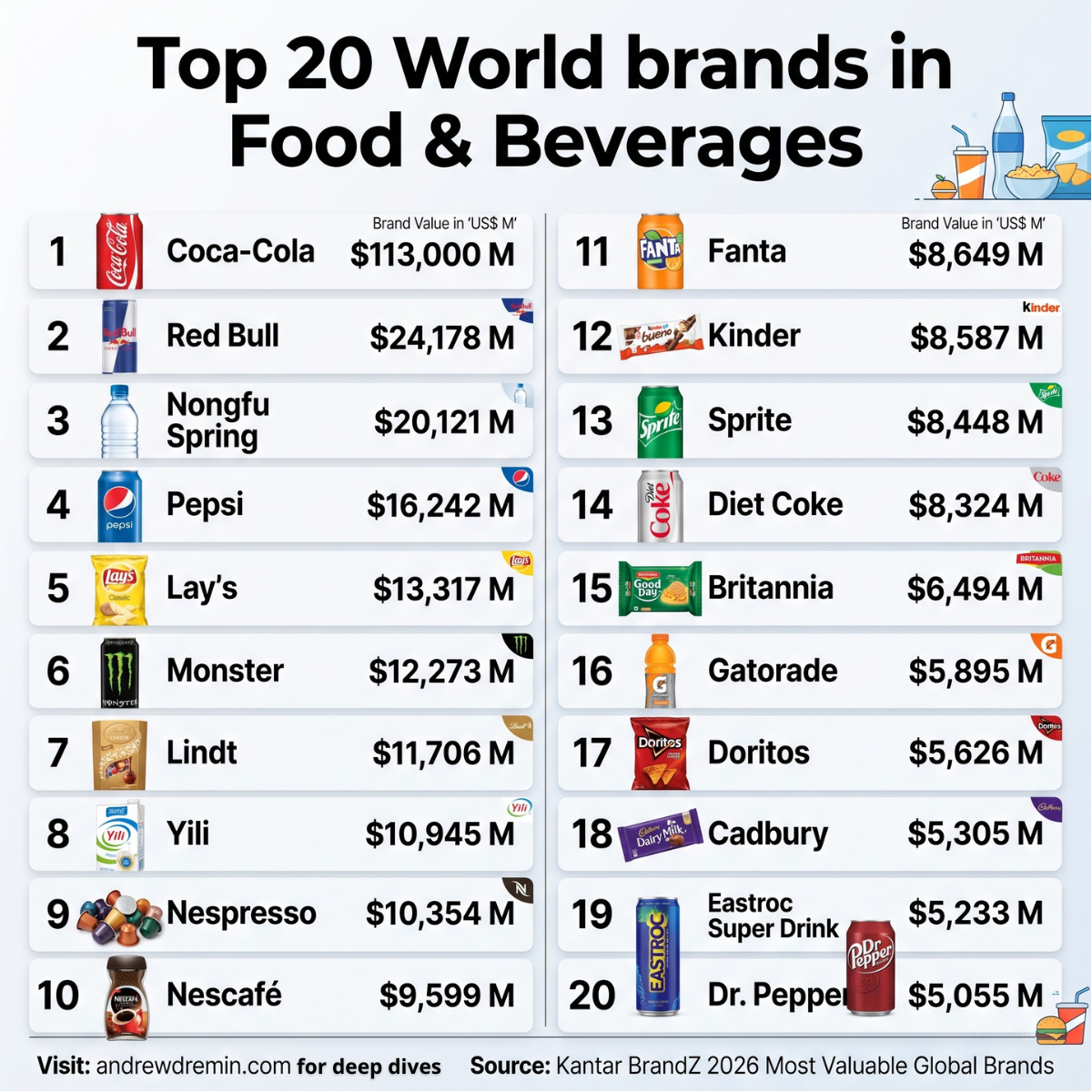
The top 20 global food and beverage brands hold a combined brand value of $309 billion, based on Kantar BrandZ data. However, this value is concentrated heavily at the very top.
The Coca-Cola Company single-handedly claims $113 billion. That represents over 36% of the entire top 20 total value combined. Behind Coca-Cola, a sharp gap opens up before reaching the rest of the market leaders.
Breakdown of the Top 20 Global Food & Beverage Brands
- #1 Coca-Cola: $113,000M
- #2 Red Bull: $24,178M
- #3 Nongfu Spring: $20,121M
- #4 Pepsi: $16,242M
- #5 Lay’s: $13,317M
- #6 Monster: $12,273M
- #7 Lindt: $11,706M
- #8 Yili: $10,945M
- #9 Nespresso: $10,354M
- #10 Nescafé: $9,599M
- #11 Fanta: $8,649M
- #12 Kinder: $8,587M
- #13 Sprite: $8,448M
- #14 Diet Coke: $8,324M
- #15 Britannia: $6,494M
- #16 Gatorade: $5,895M
- #17 Doritos: $5,626M
- #18 Cadbury: $5,305M
- #19 Eastroc Super Drink: $5,233M
- #20 Dr. Pepper: $5,055M
The data shows three specific groups dominating global brand value:
- Unreplaceable Beverage Giants: Coca-Cola, Pepsi, Fanta, Sprite, Diet Coke, and Dr. Pepper.
- High-Margin Functional Energy & Coffee: Red Bull, Monster, Eastroc Super Drink, Nespresso, and Nescafé.
- Regional and Impulse Powerhouses: Nongfu Spring and Yili in Asia, alongside global snack leaders like Lay’s, Lindt, Kinder, Britannia, Doritos, and Cadbury.
Brand Loyalty Is Split in Two
Brand loyalty is not dead, but it has polarized into two distinct extremes.
The top-tier brands remain stable because they own deeply ingrained habits, specific functional benefits, or distinct taste profiles. Consumers rarely substitute a Red Bull or a Coca-Cola with a budget alternative without noticing the difference.
The middle tier is where the damage occurs. Average brands with weak differentiation are being squeezed out by retailer private labels.
Private Label Market Numbers
- European Private Label Sales: Total annual market value reached €387 billion.
- Swiss Market Share: Private labels hold over 52% total market share in Switzerland.
- Middle-Tier Volume: Standard middle-tier national brands are losing 2% to 4% volume share annually to store brands in major European markets.
The Rise of the “Dual Shopper”
This shift is driven by a change in consumer spending habits. Today’s consumer acts as a “dual shopper.”
A typical shopper will buy a premium energy drink like Monster ($12.2B brand) or a premium coffee like Nespresso ($10.3B brand) without hesitating. Then, in the very same shopping aisle, that same buyer switches to a store-brand pasta, basic canned beans, and store-brand paper towels.
Shoppers stopped paying extra for middle-grade products. They protect their budget on basic goods so they can spend money on strong top-tier brands. Retailers noticed this change, improved their product quality, and captured market share from middle-tier manufacturers.
Why Price Cuts Are a Fatal Mistake for FMCG
When sales drop, FMCG leaders often try to protect volume by using deep trade discounts and temporary price cuts.
Having managed retail procurement for 15 years, I observe middle-tier brands making this strategic error repeatedly. Trying to win a price war against a major retailer is impossible for three distinct structural reasons:
- Shelf Control: Retailers control the physical store shelf, local inventory levels, and mobile app search rankings. They decide which item sits at eye level and which gets pushed to the bottom shelf.
- Zero Marketing Overhead: Private labels do not carry heavy global marketing or advertising expenses. The store shelf serves as their advertisement. Their cost structure is lower by default.
- Consumer Habits: Frequent price discounts teach consumers to buy your product only when it is on sale. This lowers your brand equity and turns your branded product into a basic commodity.
Strategic Roadmap for Retailers
To build long-term category profitability, retail procurement and commercial teams must focus on operational efficiency rather than copying national brand habits.
1. Eliminate Wasteful External Advertising
Do not spend retail margins on expensive TV, billboard, or digital ad campaigns for store brands. That destroys the margin advantage of private label. Use in-store display, prime shelf space, and direct loyalty app notifications instead.
2. Invest Directly in Product Formulation
Put capital straight into recipe formulation and quality testing. A private label must match or beat the national brand standard in double-blind taste tests. Once quality is secure, assign the product top position on the main shelf.
3. Build a Multi-Tier Private Label Structure
Single budget private labels limit profit margins. Divide private label offerings into three distinct levels:
- Entry/Economy Tier: Simple packaging, lowest price point, designed to block hard discounters.
- Core Tier: Direct functional equivalent to national brands at a 20% to 30% lower price point.
- Premium Tier: High-margin organic, regional, or specialty store brands that compete directly with mid-tier national brands on quality rather than price.
Strategic Action Plan for FMCG Brands
For FMCG brands operating outside the top tier, defending market share requires practical shifts in product strategy and pricing structure.
1. Stop Chronic Trade Promotions
End heavy price discounting designed to chase short-term sales targets. Deep promotions drain operating margin without creating long-term brand loyalty.
2. Focus on Product Distinctiveness
If a product tastes, looks, and functions like a store brand, it is a commodity with a label. Invest in distinct functional benefits, proprietary packaging, or specialized formulations that private labels cannot duplicate quickly.
3. Evaluate the Price Gap Matrix
Regularly assess the price difference between your product and the store brand:
- Price Gap Under 20%: Defend position using clear benefit communication and packaging updates.
- Price Gap Over 30% without Unique Features: The brand will lose volume. In this scenario, evaluate two options: switch capacity to contract manufacturing for retailer private labels, or exit the category completely to protect capital.
Key Takeaways
The food and beverage market has split into high-value top brands and efficient store private labels. The middle ground is disappearing.
What are your main business priorities in your categories for this year? Let’s discuss.
Infographic source: Kantar BrandZ 2026 Most Valuable Global Brands
Related posts:
 Europe Grocery Retail Consolidation 2026: REWE & Carrefour
 Lidl is now your phone operator
 PepsiCo 15 Percent Price Cut: Why Revenue Dropped 2%
 Global Outbound Travel Statistics by Country: Why FMCG Brands Fail
 The Tapas Wars: Mercadona vs Restaurants
 Why Mercadona’s 27.4% Market Share Is Misleading
Leave a Reply