
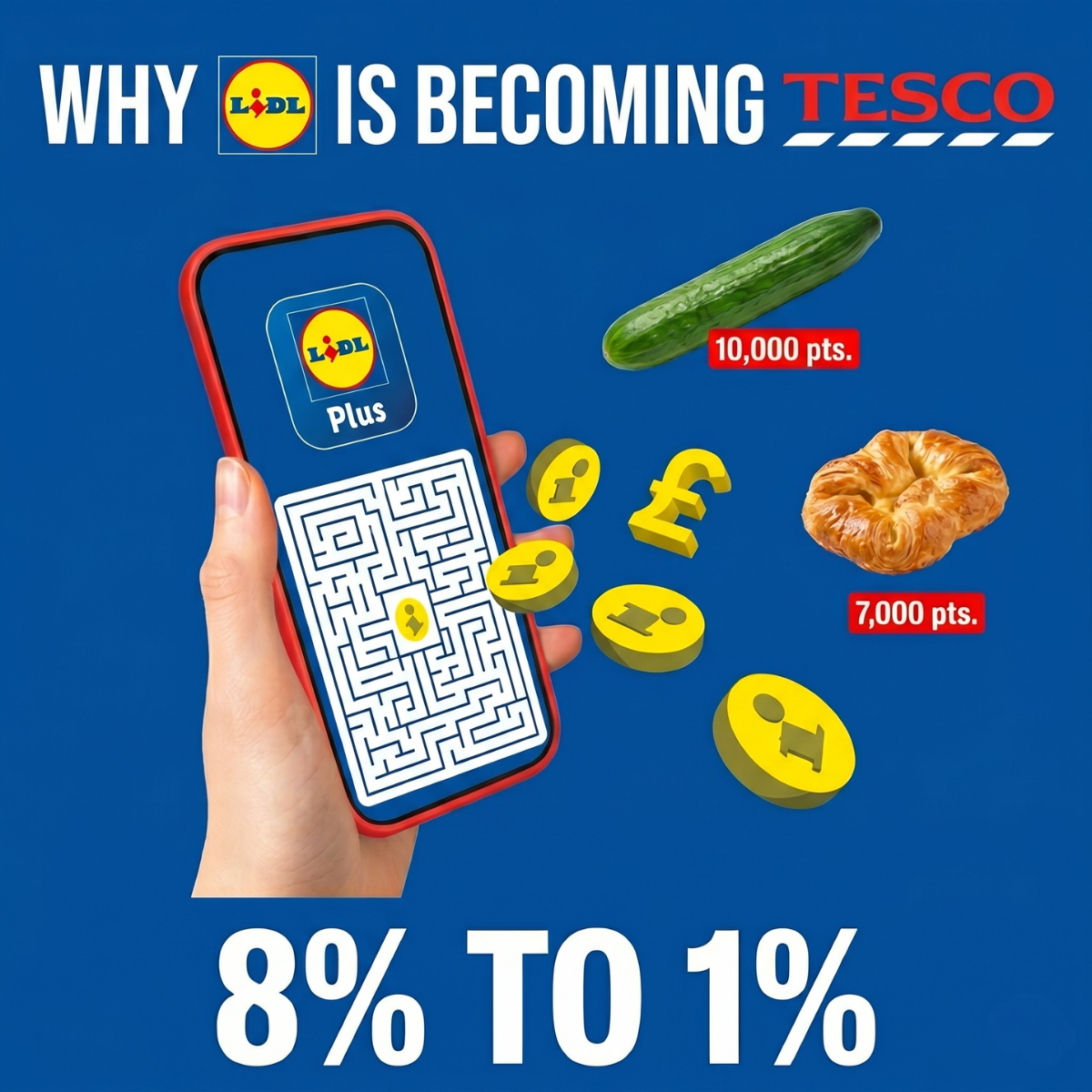
In the world of high-stakes retail, 5 May 2026 will be remembered as a masterclass in how to alienate your core customer base. Overnight, Lidl GB – a brand built on being aggressively anti-complexity – chose to complicate its core proposition. By replacing its straightforward “Coupon Plus” spend ladder with a points-based “Lidl Plus Points” scheme, the discounter did more than update an app; it broke a psychological contract with millions of British shoppers.
For retail and FMCG professionals, the Lidl story is a case study in platform decay: what happens when you prioritize data harvesting and margin clawback over the no-nonsense simplicity that drove your market share gains in the first place.
The “May 5th Massacre”: The Math of Devaluation
To understand why shoppers pushed back, look at the numbers. In retail, loyalty schemes function as secondary currencies. On May 4th, that currency held tangible value. On May 5th, it was heavily devalued.
Under the previous system, spending £10 in a calendar month unlocked a free bakery item. Under the new marketplace, that same pastry costs 70 points. With £1 earning 1 point, a shopper must now spend £70 to get the same reward – a 600% increase in qualifying spend.
For high-volume shoppers, the drop is steeper. Previously, hitting the £250 monthly spend milestone triggered a 10% discount on a subsequent shop. On a £200 basket, that saved £20. Combined with intermediate tier rewards, the total return on spend (ROS) sat near 8%. Under the new model, spending £500 yields a £5 voucher – a flat 1% return.
Table 1: The Architecture of Devaluation (Old vs. New)
| Spend Milestone | Old Reward (Coupon Plus) | New Reward (Lidl Plus Points) | Effective Value Loss |
| £10 | Free Bakery Item (~£1.10) | 10 Points (No reward) | 100% (Early win eliminated) |
| £50 | Free Fruit/Veg (~£3.50) | 50 Points (No reward) | 100% (Mid-tier win eliminated) |
| £70 | Cumulative rewards from £10/£50 | 70 Points (1 Bakery Item) | ~85% reduction |
| £100 | Free Fin Carré Chocolate | 100 Points (Cucumber or Bananas) | Significant tier downgrade |
| £250 | 10% Off Next Shop (Up to £20) | 250 Points (No voucher tier yet) | ~90% reduction |
| £500 | Full reward stack | £5 money-off voucher | Drops to 1% ROS |
The viral takeaway on social media – that a shopper now needs £100 in spend to earn a “free” cucumber – highlights the perceptual damage. For households managing tight food budgets, that shift is immediately noticeable.
Wider UK Loyalty Trends: Tesco, Sainsbury’s, and the Shift to Personalization
Lidl’s pivot didn’t happen in isolation. UK supermarket loyalty in 2026 is defined by two divergent strategies: retail media ecosystem building on one side, and pure everyday low pricing (EDLP) on the other.

Tesco Clubcard: Ecosystem Multipliers and Retail Media
Tesco has shifted the Clubcard model away from passive point accumulation toward gated pricing (Clubcard Prices) and personalized digital challenges. By partnering with third parties (hospitality, travel, entertainment), Tesco lets shoppers double or triple their point value outside grocery aisles. Crucially, Tesco monetizes this network through its retail media platform, funding member discounts through supplier advertising rather than balance-sheet margin cuts alone.
Sainsbury’s Nectar: Dynamic Pricing and Frictionless Burn
Sainsbury’s has doubled down on Your Nectar Prices, using purchase histories to serve individualized item discounts directly at the shelf edge and in the app. Unlike Lidl’s multi-step marketplace, Nectar allows points to be spent instantly at checkout like cash (0.5p per point value) across Sainsbury’s, Argos, and partner brands. The friction is minimal; the discount is immediate.
Table 2: Benchmarking UK Loyalty ROI (2026)
| Retailer | Scheme Type | Key ROI Mechanism | Ecosystem Strength |
| Tesco | Clubcard | Clubcard Prices + 2x Partner Multipliers | High (Retail Media + Third-party network) |
| Sainsbury’s | Nectar | Personalized shelf pricing + Instant spend | High (Argos, Habitat, fuel integration) |
| Lidl retail convergence strategy (New) | Lidl Plus Points | 1p per point; closed marketplace only | Low (Closed loop; zero redemption partners) |
| Asda | Asda Rewards | Mission-based cashpot | Medium (Direct cash-back into wallet) |
| Aldi | None | EDLP (Everyday Low Price) | N/A (No app required) |
By adopting Tesco’s points model without Tesco’s redemption partners, Lidl created a closed-loop system that offers neither the high rewards of legacy grocers nor the frictionless simplicity of Aldi.
Boardroom Logic: Margin, Data, and Ecosystem Expansion
Why did the Schwarz Group implement such an unpopular change? Three strategic factors explain the move:
- Margin Pressure and Reward Breakage:Operating costs across UK supply chains remain elevated. Straight percentage-based basket discounts (such as 10% off a £200 shop) are expensive to fund. Shifting to points introduces breakage — points earned but never redeemed before expiration. In a points wallet system with 30-day coupon windows, unredeemed rewards flow straight back to the retailer’s bottom line.
- Granular Behavioral Profiling:The old milestone system tracked gross spend, not basket composition. The new Rewards Marketplace acts as a segmentation engine. When a customer spends 780 points on a specialty protein item rather than a cash voucher, Lidl captures intent and taste preferences. This SKU-level behavioral data fuels supplier negotiations and targeted promotions.
- Cross-Service Integration (Lidl 1Global):With Lidl expanding into telecom services (Lidl 1Global MVNO), a unified points system creates a single currency across grocery, utilities, and mobile data. However, ecosystem plays require customer buy-in — something hard to secure when the initial launch feels like a downgrade.
The “No-Faff” Chasm: Lidl vs. Aldi
The primary beneficiary of this friction is Aldi. Aldi has deliberately avoided loyalty apps, reinvesting operational savings directly into shelf prices.
In April 2026, Which? comparative price data showed an average 96-item basket cost £172.77 at Aldi versus £175.20 at Lidl — even after factoring in active Lidl Plus discounts.
Lidl has introduced transactional friction without maintaining a price advantage. If a shopper must scan an app, track a balance, select a voucher, manually activate it, and still pay more at checkout than at Aldi, the core discount proposition breaks down.

Strategic Implications for FMCG Brands and Retailers
- For Grocers & Retailers: Asymmetric reward cuts cannot be masked as “greater flexibility.” Modern shoppers calculate effective yields quickly. If you reduce loyalty return from 8% to 1%, frame it honestly or compensate with lower shelf prices.
- For FMCG Suppliers: Expect increased basket volatility. When discounters alienate frequent shoppers, footfall redistributes toward competitors. Brands relying heavily on single-retailer distribution must ensure direct consumer relevance across multiple channels.
- For Challengers & SMEs: Simplicity is a differentiator. As market leaders layer on digital gates, redemption rules, and multi-step apps, a frictionless buying experience becomes a competitive edge.
Frequently Asked Questions
How did Lidl Plus change in 2026?
On 5 May 2026, Lidl GB replaced its “Coupon Plus” spend targets with a points-based system called “Lidl Plus Points.” Instead of automatic discounts after hitting monthly spend thresholds (£10, £50, £100, £250), shoppers now earn 1 point per £1 spent. Points must be manually redeemed for specific items or vouchers in an in-app Rewards Marketplace.
What is the return on spend (ROS) for UK supermarket loyalty schemes?
Return on spend varies significantly across UK grocers:
- Tesco Clubcard: ~1% to 3% base return, increasing to 6%+ when points are redeemed through third-party Reward Partners.
- Sainsbury’s Nectar: ~0.5% base return on standard spend, scaled up through personalized Your Nectar Prices.
- Lidl Plus (2026): ~1% effective return on high spend (£5 voucher per £500 spent), down from ~8% under the previous system.
- Aldi: 0% direct scheme return, relying instead on lower baseline shelf prices (EDLP).
How are Tesco Clubcard and Sainsbury’s Nectar evolving in 2026?
Both retailers are prioritizing retail media monetization and personalized pricing over flat point accumulation. Tesco uses dual-tier Clubcard pricing backed by external reward partnerships, while Sainsbury’s leverages AI-driven dynamic discounts (Your Nectar Prices) with direct, frictionless point redemptions at checkout.
Why are supermarkets moving toward points-based loyalty schemes?
Points schemes give grocers two major financial advantages:
Behavioral Data: Forcing shoppers to pick specific rewards in an app generates granular consumer preference data, which retailers monetize through supplier media partnerships.
Breakage: A portion of points expire or go unredeemed, reducing the retailer’s reward liabilities.
Related posts:
 UK Grocery Discounter Trends 2026: What the CMA Ruling Means for Aldi and Lidl
 Electronic shelf labels wars
 Global Food Beverage Brand Value 2026
 Spain Grocery Market Share 2026: Why Giants Flatline
 Why Nike Sales Are Dropping: D2C Failure & Win Now Plan
 The Billion-Dollar Illusion: How a Fake Movie Parade Transformed Global Retail and Tourism
Leave a Reply