
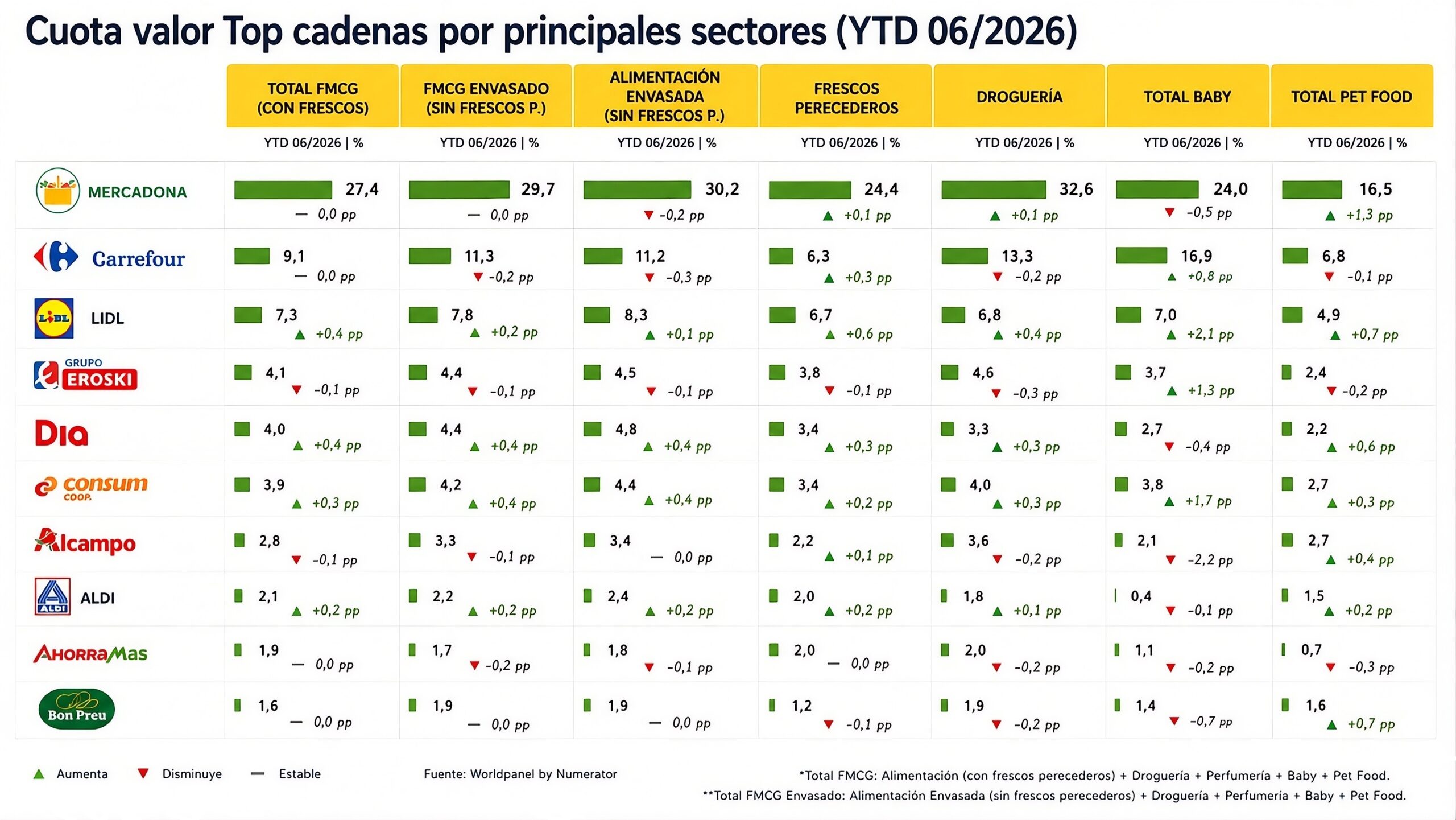
Mercadona holds a 27.4% market share in Spain in 2026. On paper, that number makes them look untouchable. Industry analysts look at the top line and claim the competition is over.
That view is wrong. Top-line market share is a vanity metric. It looks impressive in a presentation, but it hides what is really happening on the shop floor.
Real retail battles happen category by category. If you only look at overall market share, you miss major shifts in consumer habits. The standard narrative about Spanish grocery retail does not fit the actual data.
The Myth of the Hard Discounter Takeover
We hear the same story every year: hard discounters are destroying legacy supermarkets. People claim that chains like Lidl and Aldi are taking over the entire market while traditional stores just lose ground.
Look at the YTD June 2026 data from Kantar, and you see a very different picture.
The market is not a simple story of discounters winning and legacy stores dying. Some traditional retailers are fighting back effectively. More importantly, strong regional chains are taking market share from both sides.
The Baby Care Battleground
To understand real market movements, you have to look at high-frequency categories. Baby care is a clear example. Parents buy diapers, wipes, and baby food every week. When a family changes where they buy baby products, their weekly grocery budget follows.
Who Gained Ground?
- Lidl España: Gained +2.1 points in baby products. This shows their discount strategy for high-frequency family items is working.
- Carrefour: Gained +0.8 points in the exact same category. Carrefour is not losing across the board; they are fighting back and retaining key family shoppers.
Who Lost Ground?
- Alcampo: Dropped -2.2 points in baby care. This is a heavy loss in a category that drives regular store visits.
- Mercadona: Dropped -0.5 points.
Mercadona still leads total retail share by a large margin, but losing half a point in baby care is a clear signal. Even the market leader loses ground when shoppers look for better value or convenience in specific categories.
The Forgotten Power of Regional Chains
National market reports often ignore regional supermarket chains. In Spain, that is a huge mistake.
Look at Consum Cooperativa Valenciana. Consum grew its share across total retail. But in baby care, they recorded a massive +1.7 point jump.
Think about how a shopper acts today:
- A young family buying diapers does not care about retail brand history or corporate scale.
- They want three simple things: proximity, fair prices, and the right products on the shelf.
- They want to walk to a nearby store, buy what they need fast, and get home.
Regional chains like Consum deliver on proximity and local trust. They are capturing families just as effectively as discounters. And when a regional store wins a family’s baby care routine, it gets their food basket too.
The Data Trap: Value Share vs. Volume Share
We must look at market data with a critical eye.
The Kantar numbers in this report track value share (total money spent), not volume share (total units sold).
That distinction matters. High inflation distorts value share numbers.
If Retailer A raises prices by 10% and sells 2% fewer items, their value share might still go up. On paper, it looks like growth. In reality, they are moving fewer physical units off the shelf. They are simply charging their remaining customers more money.
A higher value share driven by price increases is not real growth. If unit volume drops, foot traffic drops. Eventually, that operational reality catches up with you.
Strategic Takeaways for FMCG Brands
If you manage brands in fast-moving consumer goods, adjust your commercial strategy:
- Stop ignoring regional players: National chains matter, but regional players like Consum are where family spend is actually moving.
- Reallocate sales resources: If your sales team focuses only on top national accounts, you will miss regional volume growth. Build direct relationships with regional buyers.
- Track unit volume, not just revenue: Make sure price increases are not masking a decline in actual product units sold.
Strategic Takeaways for Retail Leadership
If you run retail operations, focus on category-level reality:
- Stop relying on total market share: Total share tells you where you were yesterday. Category share tells you where your customer traffic will be tomorrow.
- Protect high-frequency categories: If you lose points in categories like baby care or basic food items, your foot traffic is already leaving your store.
- Fix category leaks immediately: Once a family builds a shopping habit with a competitor, winning them back costs serious money.
Final Questions
Look at your category data today. Are you funding past history or building for future growth?
What volume trends are you seeing on your shelf right now?
Source / Infographic’s source: Kantar (WorldPanel by Numerator) / InfoRETAIL
Related posts:
 The Most power passports 2016 vs 2026
 The map of the national football team kit suppliers
 The Real Estate Mechanics Behind the $195.1 Billion Valuation
 The Billion-Dollar Illusion: How a Fake Movie Parade Transformed Global Retail and Tourism
 The Supermarket That Wants to Be a Restaurant
 Spain Grocery Market Share 2026: Why Giants Flatline
Leave a Reply