
The End of the Old Marketing Rules
For a long time, the rules for selling everyday consumer goods were simple. Companies built a brand, people trusted it, and customers happily paid a higher price for it. When people had extra money in their pockets, they were happy to pay more for brand loyalty.
But lately, I have seen inflation change everything. Prices went up a lot, and people lost their extra spending money. So, what did they do? They tried cheaper store brands. And they found out these cheaper products were perfectly “fine.”
As a retail expert, I know that “fine” is a very dangerous word. If a customer finds a cheap store brand that works fine, they do not need your expensive brand anymore. The trust and loyalty you built over many decades can disappear very fast.
Brand loyalty is not something you own forever anymore. It is something you just rent, and inflation made the rent too high. I call this new time the “Engagement Era,” where true brand loyalty has dropped to its lowest point in five years, and now only 68% of consumers say they are loyal to any specific brand.
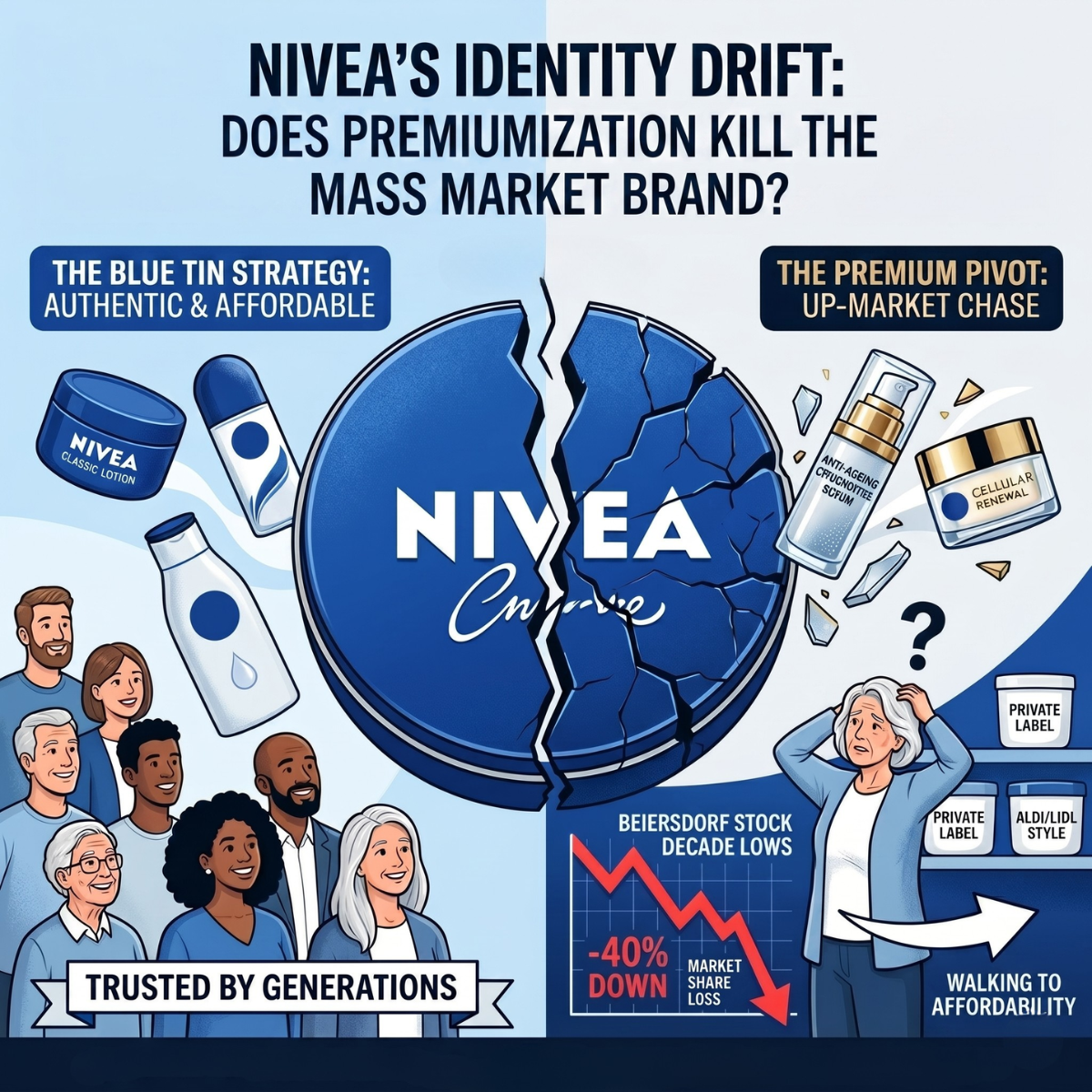
A recent 2026 study I read by Simon-Kucher surveyed 14,000 people and found that this shift is permanent. Almost half of all shoppers (47%) now buy mostly store brands, while only 16% still focus on big name brands. Even worse for big companies, 57% of people now believe branded products are overpriced without giving any real benefit, and 39% think branding is just a “money-making scheme”. The most famous example of this crisis right now is Beiersdorf, the company that makes Nivea. Let me explain what is happening to them and what it means for all of us.
Beiersdorf’s Big Financial Shock
Beiersdorf is usually seen as a very safe and stable company. But recently, I watched their stock price drop by more than 40%, hitting its lowest point in over ten years. In March 2026, I saw the stock price fall all the way down to the low €70s, which is a massive drop from when it was trading much higher a few years ago. In 2024, the company’s total market value was €27.6 billion, but by the end of 2025, it had dropped to just €20.4 billion.
Why did this happen? In early 2026, the company shared some very bad news. While their overall group sales dropped 4.6% to €2.48 billion , the consumer business (which includes Nivea) fell to €2.07 billion , and Nivea’s sales fell by a massive 7.0% in the first quarter. Other brands in the company suffered too; their luxury brand La Prairie dropped by 14.9%.
The CEO, explained that a few things caused this huge drop:
- Flat Market: People are simply not buying as much basic skincare right now.
- Store Fights: They had big fights with supermarkets in Europe. The stores wanted Beiersdorf to lower prices, but Beiersdorf said no. So, the stores stopped ordering as much.
- Bad Timing: They sent all their new products to stores at the end of 2025, so early 2026 looked very weak in comparison.
- Global Problems: There were problems in the Middle East that hurt their sales.
Even though the company tried to stay positive, investors got very worried. Financial experts at big banks like Morgan Stanley and Berenberg actually downgraded the stock. They did this because they saw that Nivea’s problem is not just bad timing; they are actually losing their customers, and their new product launches were not enough to fix the problem.
Losing the Supermarket Battle
To really understand the problem, I looked at the sales data in Western European stores from NielsenIQ. The data shows a scary picture. For 12 months in a row, from early 2025 to early 2026, Nivea lost market share every single month. Sometimes they lost up to 120 basis points of market share in a single month.
When you lose that many customers, I always ask: Where did they go?
They did not go to expensive brands like La Mer. In fact, La Mer is also losing sales because people do not want to pay luxury prices right now. Instead, the customers went to the bottom shelf. They bought the store brands.
In Europe, private store brands now make up 38.8% of all grocery sales across 17 countries, which equals a massive €387 billion. In countries like Switzerland and Spain, store brands now make up more than 50% of the market. Looking closer at the six major European markets – France, Germany, Italy, the Netherlands, Spain, and the UK – private store brands have now reached a massive 50% of all grocery items sold. They hit €324 billion in total sales in 2025, capturing 42% of the market’s total money value. In Spain, store brands now make up an incredible 59% of all items sold, while the Netherlands reached 56%, and Germany and the UK hit 52%.
This is not just a European problem, either. In the United States, I saw that store brand sales hit a record high of $282.8 billion in 2025. They grew by 3.3%, which is almost three times faster than national name brands, which only grew by 1.2%. It got so serious that major stores like Target actually had to freeze prices on over 1,000 items just to win back shoppers who were tired of inflation. I have also watched giant food companies like Kraft Heinz suffer the same fate, with sales falling for six quarters in a row because shoppers are buying cheap store-brand items instead.
In the past, brands would just offer discounts to win people back. But I see that this is not working anymore. In places like Germany and the UK, people are so focused on low prices that discounts do not make them buy extra products; discounts just make the company lose money on things people were going to buy anyway.
The Rise of Store Brands (Aldi and Lidl)
The biggest story I see right now is how strong store brands have become.
For example, people who used to buy Nivea face cream or sun lotion started looking for cheaper options to save money. They walked into Aldi and saw “Lacura” sun lotion for £2.49, or went to Lidl and found “Cien” sun spray for £3.29. They also found Aldi’s Lacura Rejuvelate Day Face Cream for just £3.49. These sat right next to Nivea products that cost twice as much.
When people tried these cheap creams, they realized something important: the creams did a good job. They are often dermatologically tested and made in the same countries as the big brands. I even read that consumer testing groups like “Which?” gave Aldi and Lidl sun lotions top “Great Value” awards because they passed strict safety tests just as well as the expensive brands.
They were not amazing breakthroughs, but they were “fine.” They moisturized the skin just like Nivea. They protected against the sun.
Once a customer sees that a £3.49 cream works fine, they stop paying a premium for Nivea. They realize they just need a body lotion, not the Nivea brand. When this happens, all the money spent on emotional ads becomes useless.
/
Category vs. Brand: Why “Educating” the Customer Fails
When I analyze a brand, I always check if the brand is growing because people love the brand itself, or just because the whole market is growing. Right now, the global skincare market is barely growing. Because of this, Nivea’s true weakness is showing. They are losing customers faster than the market is growing. Nivea only grew 0.9% in 2025, while the rest of the market grew faster.
Many brand managers make a big mistake here. They think the customer just does not understand how good their product is. They say, “We need to educate the market”.
I believe this is a terrible idea. Matthew Lerner, a famous venture capital investor, says that “educating the market” are the most dangerous words a startup or brand can use. He points out that if people do not realize they need your product, they will just ignore it completely. You cannot educate a customer who has already found a cheap product that works fine.
In fact, studies show that 28% of consumers have abandoned a brand simply because they got bored. It is a massive waste of money to run more ads if your product does exactly the same thing as the store brand. You have to fix the product, not the customer.
How Beiersdorf is Fighting Back
I am watching Beiersdorf closely to see how they fix this. They have a new plan to rebalance the company with three main steps:
- Focus on Body Care and Deodorants: Face cream is very competitive and expensive to make. So, Beiersdorf is spending more of their marketing money on body lotion and deodorants. People are more loyal to their deodorants because they do not want to risk smelling bad, so it is a safer place to protect market share.
- Make Face Care Cheaper: They are launching more affordable face creams to compete directly with Aldi and Lidl. At the same time, they still have premium products, like their new Cellular Epigenetics Age Rewind Face Serum. This new serum costs £34.99. It is very hard to convince someone to pay £34.99 when Aldi sells face cream for £3.49, so Beiersdorf must carefully balance both expensive and cheap options.
- Local Decisions: Instead of making one global plan, they are letting local teams in countries like China, the US, and Brazil make their own decisions. This helps them react faster to what local people actually want. For example, by adapting their products locally in Thailand, they managed to make their serum the number one seller there.
To understand their budget, I looked at their 2025 spending. Beiersdorf spent 35.1% of its sales money on marketing and selling, but only 3.7% on research and development. For comparison, their rival L’Oreal spent 32.2% on advertising and 3.1% on R&D. This shows me that simply spending huge amounts of money on marketing does not automatically fix a broken brand.
The Power of Real Science: The Derma Success
There is a bright side to this story. While Nivea is struggling, Beiersdorf’s medical skincare division (called Derma, which includes the Eucerin and Aquaphor brands) is booming. It grew by a massive 8.2% in early 2026. In fact, this division has enjoyed double-digit growth for five years in a row and is beating the market average by a huge amount.
Why is Eucerin winning while Nivea is losing? Because Eucerin uses patented science that Aldi and Lidl cannot copy. They have special, secret ingredients (like Thiamidol) that actually treat serious skin problems.
If a customer has a real skin problem, a cheap Lidl cream is not “fine.” They need the real science of Eucerin. Because store brands cannot copy this science legally, Eucerin keeps its customers and can charge higher prices.
Beiersdorf knows this science is the future. I saw they just invested €100 million in a fund to find and buy new scientific skincare startups. This is how they will beat the store brands.
Look at Unilever
I also like to compare Beiersdorf to Unilever (the company that makes Dove and Rexona). Unilever is doing very well right now, growing its sales and the actual number of products it sells. In 2025, Unilever’s total sales were €50.5 billion.
Unilever did exactly what Beiersdorf is trying to do, but they did it earlier and better. They call their plan “Desire at Scale”. They focused all their money on their top biggest brands and decided to put all their extra merger and acquisition money specifically into the US and India. They focused heavily on their top 30 biggest ‘Power Brands,’ which now make up 78% of their total sales. Because of this focus, these Power Brands grew their sales by 4.3% and actually increased the physical volume of items sold by 2.2%.
They also put high-quality skincare ingredients into everyday products like Dove body wash. They made their basic products feel very premium, so store brands have a much harder time copying them. Because they focused on true performance, they saw great volume growth across their personal care lines.
My Blueprint for the Future
From what I have seen over the last few years, the old way of doing marketing is dead. Younger shoppers, especially Generation Z, are now the biggest champions of store brands, and they are expected to buy more store brands than older generations by mid-2026. Here is my plan for how brands can survive:
- Do something store brands cannot copy: Stop relying on cute ads and old memories. Your product must actually do something special. You need real, scientific benefits that a cheap store brand cannot legally copy.
- Play defense and offense: Defend your basic products (like deodorant) with smart pricing and local marketing. Then, go on the offense by creating highly advanced, premium products that justify a high price.
- Do not let stores control you: Supermarkets are now your biggest competitors because they sell their own brands. You must build such a strong, unique product that the stores have no choice but to keep you on their shelves, even if you fight over prices.
Brand loyalty is no longer permanent. Today, you have to earn your customers every single day by proving your product is actually better, not just “fine.”
Related posts:
 The Supermarket Grocerant Trend: Why Retailers Are Stealing Restaurant Profits
 GLP-1 Retail Impact: How Weight-Loss Drugs Are Shrinking Supermarket Sales
 Tesco and Football championship
 The €3.90 Gourmet Threat: How Supermarket Meal Kits are Disrupting Fast Casual Dining
 PepsiCo’s Strategic Paradigm Shift
 European Retail Self Checkout Shrinkage 2026: 22% Loss