
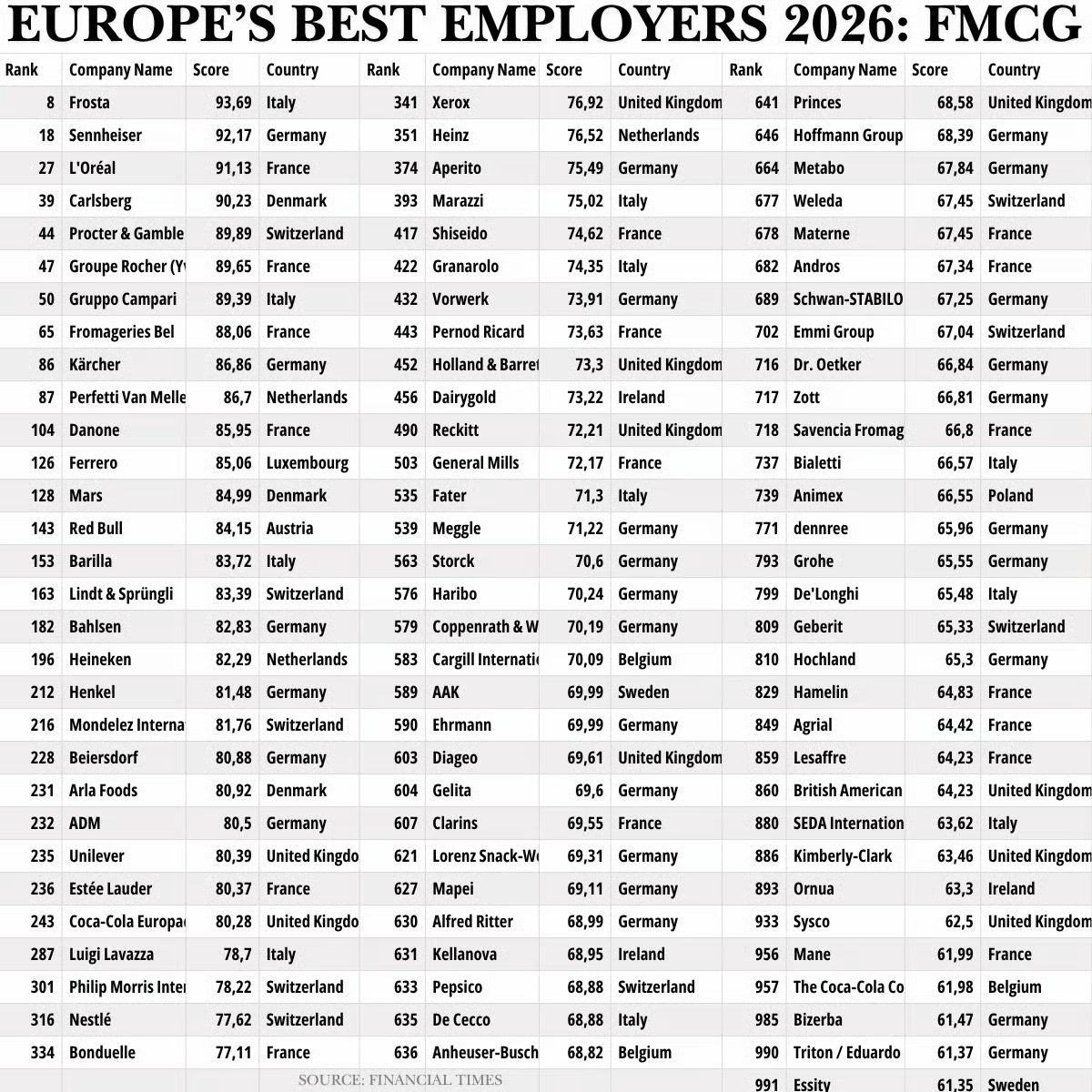
6 million employer evaluations. That is the massive data set behind the new Financial Times “Europe’s Best Employers 2026” list.
Brands like Frosta, L’Oréal, Carlsberg, and Procter & Gamble secure the top spots. On paper, these companies look like the ultimate places to build a career.
But let us be honest. As an analyst looking at the operational facts, I see a different picture. These corporate beauty contests mask a quiet crisis in the FMCG sector. The public image completely contradicts the daily reality.
The Disconnect Between HR Awards and Ground Reality
While companies celebrate their high ranks on LinkedIn, my recent consulting conversations show the brutal truth. The pressure on the ground is severe.
Last week, an FMCG commercial senior told me his team is entirely burnt out. His exact words: “HR wins awards, but we are losing people to stress.”
This is not an isolated complaint. It is a structural issue. We must separate the PR facts from the operational facts. Let us test the hypothesis that a high ranking means a good workplace. HR departments often push these employee surveys internally. They run campaigns to get high participation because their own KPIs are often tied to winning these awards.
Furthermore, the data is usually skewed. Back-office functions with lower daily market pressure often report higher satisfaction. When you average these scores together, the severe burnout in the commercial frontline gets hidden behind the general satisfaction of the wider company. A high score on a survey is just one data point. If a company scores 90 out of 100 on a culture survey, but loses 20% of its commercial staff every year, the survey is flawed. It measures intent and branding, not actual working conditions.
The Margin Squeeze and Private Label Threat
Why are FMCG teams so stressed? Because the market dynamics are squeezed, and internal expectations have not adjusted to match this reality.
First, teams are fighting high raw material costs. We have no precise data on every single commodity contract across these companies, but the general trend for ingredients and packaging remains costly.
Second, aggressive private labels from retailers like Aldi and Lidl’s promotional campaigns are taking market share. Ten years ago, private labels were just cheap alternatives. Today, they offer high quality. Consumers switch easily because their own budgets are tight.
FMCG brands are caught in a trap. Retailers refuse to accept price increases. At the same time, brands must maintain their profit margins for shareholders. To protect these shrinking margins, companies cut internal costs. They freeze hiring. They cut support staff. The workload does not shrink, but the number of people doing the work drops.
The Reality of Structural Exhaustion
This cost-cutting lands directly on middle managers and commercial teams.
In reality, these managers work 60-hour weeks just to protect the bottom line. When a Key Account Manager asks for a higher trade promotion budget to compete with a private label, finance says no. When they try to hold the price line, the retailer threatens to pull the product from the shelf. The employee is set up to fail. They spend their days in tough negotiations with retail buyers, and their nights filling out internal forecast spreadsheets.
This causes structural exhaustion. It is a permanent state of the business, not a temporary busy period.
You cannot fix structural exhaustion with a branding trophy. You cannot fix it with a free gym membership. These perks do not change the fact that an employee has 60 hours of work and only 40 hours in a week.
A Cognitive Bias in Leadership
Many executives look at the FT list and feel safe. They see their company ranked at #44 or #104 and think the culture is fine.
This is a cognitive bias. They are using an external ranking to validate their internal leadership. It is easier to post an award on social media than to fix a broken sales process or tell shareholders that growth targets are unrealistic. If multiple points of view exis – if HR says everything is great, but Sales says the targets are impossible – leadership must investigate the contradiction, not ignore it.
True Retention in 2026
My view is straightforward. True retention in 2026 is not about shiny corporate programs. It is about simplifying workloads and giving teams realistic targets in a squeezed market.
If the market is shrinking, do not demand double-digit volume growth. If you want a team to perform, remove the internal bureaucracy. Cut the unnecessary reporting. Give them the tools they need to do their jobs without working weekends.
FMCG seniors need to stop looking at HR rankings to measure morale. Look at the numbers that actually matter. Look at your staff turnover. Look at the sick leave rates. Look at the tension in your weekly commercial meetings. Are people speaking honestly, or are they just telling you what you want to hear to survive the week?
Review the list in the image again. Is your company on there? Does that high score match your daily reality?
Full rating: Source: Financial Times
Related posts:
 The 48% Price Increase: How Milka Changed the Bar
 The Billion-Dollar Illusion: How a Fake Movie Parade Transformed Global Retail and Tourism
 PepsiCo’s Strategic Paradigm Shift
 74% Leakage: Why Offline Trust is Dying Online
 The map of the national football team kit suppliers
 Why Nestlé Sold 50% of Its Water Business