
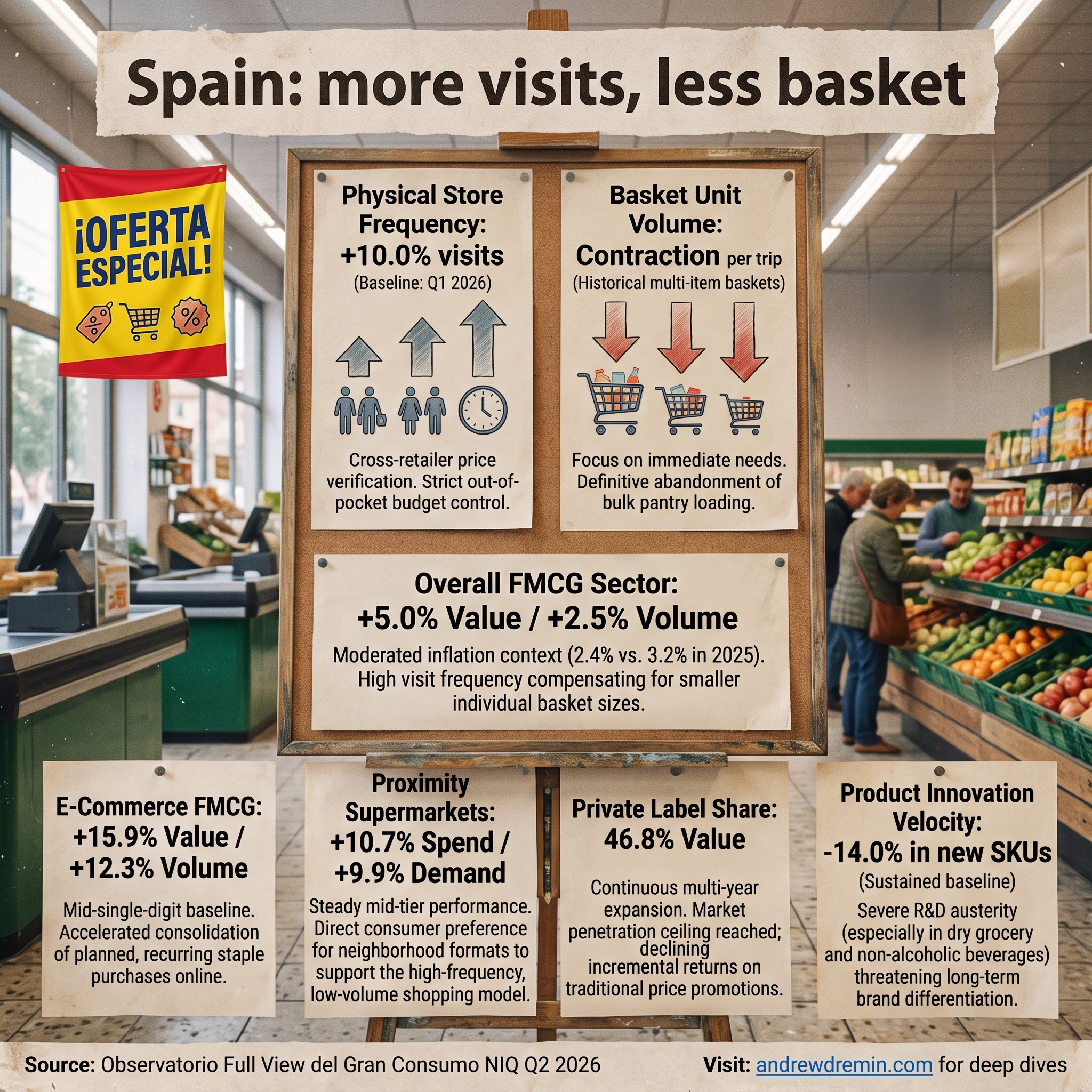
Store visits in Spain jumped 10% last quarter. E-commerce volume grew 12.3%. But physical baskets actually shrank.
If you look at the raw data, it seems like a contradiction. People go to the physical store more often, they buy more online, but they carry less out the front door of the supermarket.
Brands look at this data and think consumers are recovering from the inflation shock of the past few years. They look at the foot traffic and celebrate. They are wrong. This is not an economic recovery. This is a ruthless restructuring of the household budget.
Shoppers have changed their mechanics. They got smart. They split their channels with strict discipline. They offshore heavy, boring staples to online carts. Then, they walk to local stores for fresh food. The primary goal is to eliminate waste and control daily cash flow.
Retail Trends in Spain: How Shoppers Split Grocery Channels
Spanish consumers now treat different retail channels as completely different tools. The traditional, massive weekly shopping trip is dead. Instead, the household budget is divided based on logistics, weight, and expiration dates.
Here is how the modern household splits the grocery list:
- E-commerce for bulk and weight: Shoppers buy bottled water, toilet paper, cleaning supplies, heavy bags of rice, and pet food online. They let the delivery driver carry the heavy items. These are products with zero emotional attachment. Price and convenience dictate the purchase.
- Physical stores for precision fresh food: Consumers buy meat, fish, vegetables, and bread in person. They buy exactly what they plan to eat in the next 48 hours. If they buy less per trip, nothing rots in the fridge. The shrinking physical basket is a calculated defense mechanism against food waste.
The Rise of Private Label Brands: A 47% FMCG Market Share Reality
Private labels now hold nearly 47% of the market in value. In volume, the number is even higher. Shoppers trust the supermarket’s own brand. It is no longer seen as a cheap alternative. It is the default choice.
Supermarkets like Mercadona have dedicated co-manufacturers. They innovate faster than big brands, and they control the shelf space. When a national brand wants to place a new product on the shelf, the supermarket demands high slotting fees. When the supermarket launches its own private label version, it places it at eye level for free.
So how are national FMCG (Fast-Moving Consumer Goods) brands fighting back against this massive structural shift?
By burning their trade budgets.
Burning Trade Budgets to Steal FMCG Market Share
Big brands are running massive 25% to 35% discounts just to steal market share for a single week. They negotiate heavy promotional slots with retailers. The strategy is desperate. They slash prices to briefly look cheaper than the private label, hoping to trap a consumer.
But consumers adapt faster than corporations.
Consumer Cherry-Picking: The Death of Brand Loyalty
Consumers now walk between Mercadona, Lidl España, and Aldi on the same day just to cherry-pick these exact deals. They use store apps and digital flyers. They know exactly which item is discounted where.
The modern shopping route looks like this:
- Check the digital flyer for national brand promotions on a smartphone.
- Go to Store A just to buy the heavily discounted olive oil or laundry detergent.
- Walk across the street to Store B to buy private label dairy and fresh produce.
I tracked these exact deal-hunting behaviors when I managed category strategy at Metro Cash & Carry. At Metro, we saw restaurant owners do this to protect their thin margins. A pizzeria owner would buy flour from us because it was on a volume deal, but buy tomatoes from a local supplier. They split the basket to survive.
Five or ten years ago, this was a niche tactic. It was behavior you saw only in professional B2B buyers or extreme couponers. Today, regular households in Madrid, Barcelona, or Reus are operating like small businesses. They manage their household P&L (Profit and Loss) just like a restaurant manager. They track unit prices per kilo or liter. It is a daily household routine.
Renting Volume Instead of Building Equity
Shoppers are buying the discount, not the brand.
When standard shelf prices return, shoppers go straight back to the private label. They do not stick around for the brand heritage. This creates a dangerous cycle for FMCG companies. The brand drops the price to hit quarterly volume targets. Shoppers buy large quantities and stockpile the product. When the promotion ends, sales completely crash because the consumer has enough stock, or they simply switch back to a cheaper private label.
Brands are not building equity. They are just renting volume. They pay for a temporary spike in sales with their profit margins. This destroys the baseline sales data and makes forecasting impossible.
FMCG Innovation Crisis: Why New Product Launches Dropped 14%
Instead of fixing their core value proposition, big brands are giving up on the product itself.
New product launches dropped 14% this year. Corporate R&D (Research and Development) is frozen. Developing a genuinely new product takes time, money, and risk. In a market where consumers only buy discounts, corporate boards refuse to approve R&D budgets.
Instead of real innovation, brands just chase lazy micro-trends. They take an existing product and change the flavor. They launch another pistachio-flavored snack, put a bright new label on it, hope it goes viral on TikTok, and call it a strategy.
This is an illusion of activity. Changing a flavor does not solve a consumer problem. It does not give the shopper a valid reason to pay a premium price over the private label alternative.
Real Innovation vs. Lazy Micro-Trends
If FMCG brands want to survive the private label dominance, they have to provide actual utility.
- Fake innovation: A new spicy flavor of the exact same potato chip.
- Fake innovation: Shrinking the package size by 10% and adding “Now with a new look!” to the box.
- Real innovation: Packaging that extends the shelf life of fresh produce by five days to help households reduce waste.
- Real innovation: High-protein, low-sugar breakfast options that actually taste good and cost under two euros per serving.
You cannot buy sustainable growth with deep discounts and flavor swaps. The modern consumer sees right through it.
How to Win the Fragmented Tuesday Basket
You need to win the fragmented, multi-channel Tuesday basket.
What is the Tuesday basket? It is the mid-week shopping trip. It is highly rational. The weekend is over. The consumer is not buying wine or premium snacks for a party. They are buying exactly what they need to get through Wednesday and Thursday. They are strictly managing their cash flow.
To win this basket, brands need to stop looking at volume spikes and start looking at utility. Does your product justify its price gap over the private label? Does it solve a real problem for a stressed, budget-conscious household? Is your core product strong enough to sell at full price?
If the answer is no, a 30% discount will not save you. It will only delay the inevitable. The Spanish retail landscape has fundamentally shifted. The shoppers have adapted. The private labels have adapted.
Are you seeing shoppers split their grocery budgets like this in your category?
Data source: Source: Observatorio Full View del Gran Consumo NIQ Q2 2026
Frequently Asked Questions (FAQ) About Spanish Grocery Retail Trends
Why are physical grocery baskets shrinking in Spain if store visits are up?
What is a private label in FMCG?
How do massive 30% discounts actually hurt national FMCG brands?
What is the “Tuesday basket” in retail strategy?
Related posts:
 US FMCG Market Expansion: Why the United States Is Not One Market
 Emerging Megacities: FMCG Retail Trends and Consumer Shifts by 2050
 Seasonal Retail Inventory Management: 85/15 Buffer Model
 Spain Grocery Market Share 2026: Why Giants Flatline
 Aldi vs Tesco Sainsbury Loyalty Schemes: 2026 Analysis
 GLP-1 Retail Market Trends 2026: Food vs Apparel Data
Leave a Reply