
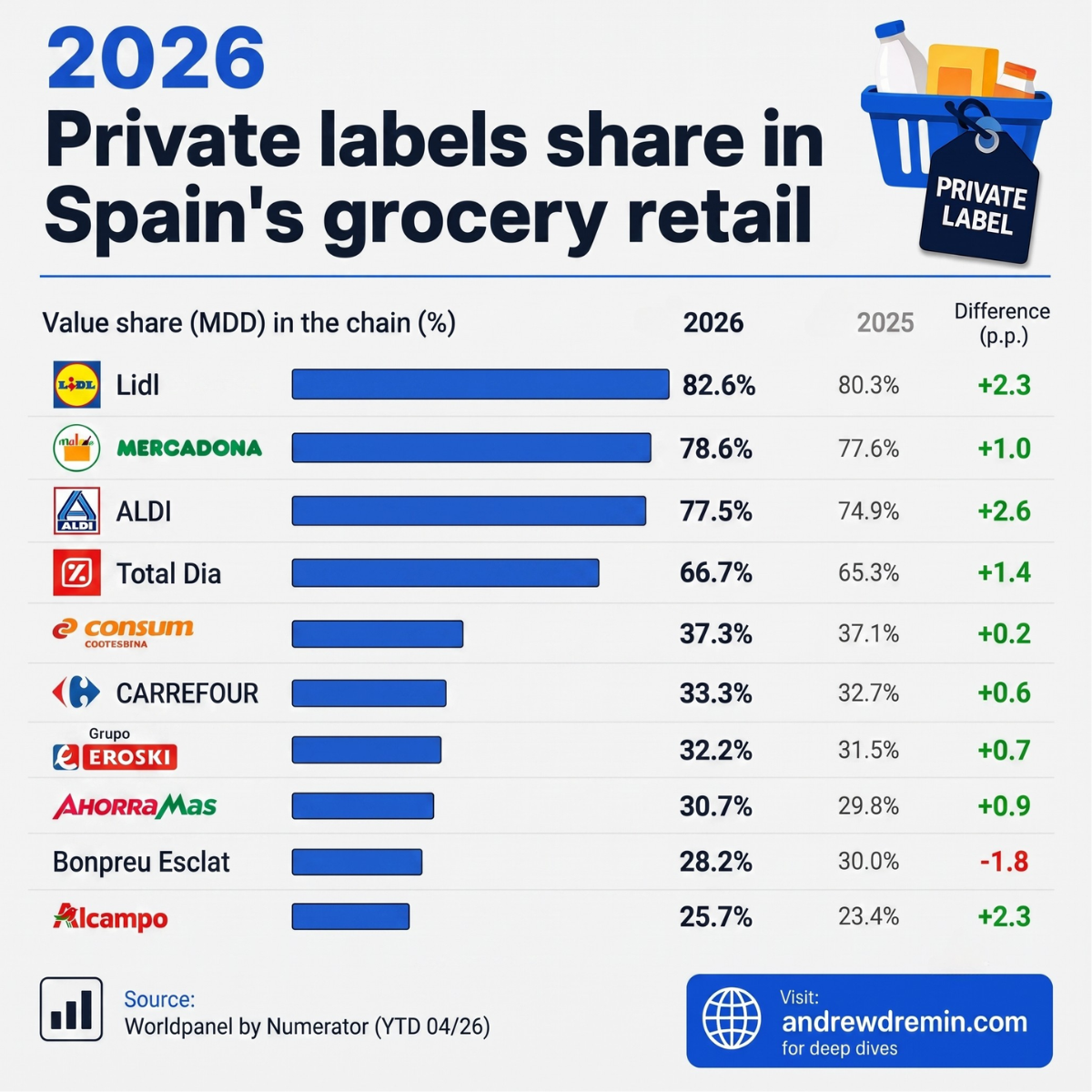
82.6%. That is the sales share Lidl España captured with its private label this year. Mercadona sits right behind at 78.6%. Aldi follows closely at 77.5%. These numbers will help shape the Spain grocery private label share 2026 outlook.
If you look only at these numbers, the headline seems clear: store brands are killing national brands across Spain.
That narrative is false.
The FMCG sales directors know these numbers. But many of them are making a strategic mistake. A client recently told me his commercial team is completely exhausted. They are burning budget, time, and team morale trying to push secondary brands into hard discounters.
With over 15 years in retail procurement and category management, my advice to FMCG leadership is straightforward: stop using a single commercial strategy for the Spanish market. We do not have one uniform retail landscape. We have two completely different business models operating side by side.
Model 1: The Gatekeepers
High Control, Low SKU Count
This group includes Lidl, Aldi, and Mercadona. Private labels control around 80% of their total sales value.
These retailers operate on high volume, fast stock rotation, and a strictly limited number of SKUs (Stock Keeping Units). They build their business around their own brands. They do not rely on manufacturer brands to pull shoppers into their stores—their own pricing and store footprint do that work.
The Tier-One Exception
If you own an undisputed market leader like Coca-Cola, Nutella, or Heineken, you keep your shelf space. Consumers expect to see those specific brands, and their absence hurts the retailer’s credibility.
However, if you own a tier-two or tier-three brand, the door is closed. The Gatekeepers do not need a third choice in olive oil or a fourth choice in laundry detergent. Trying to negotiate listing space for secondary brands in this channel is a waste of resources. It is the same hard-leverage system used by discounters in Germany.
Model 2: The Battleground
National Brands Hold 70% Share
Look at the data for traditional supermarkets and hypermarkets:
- Carrefour: 33.3% private label share
- Eroski: 32.2% private label share
- Bonpreu Esclat (Regional): 28.2% private label share
- Alcampo: 25.7% private label share
In these chains, national brands still generate roughly 70% of total sales value. This is the real arena for brand manufacturers. Consumers visit these stores specifically because they want product variety, brand choice, and specialized categories.
The Risk of the Silent Creep
While Model 2 remains favorable to national brands, there is an ongoing shift. Carrefour expanded its private label share from 32.7% to 33.3% in a single year.
As inflation pressures consumer budgets, traditional supermarkets increase their private label allocation to protect market share against Mercadona and Lidl. This “silent creep” slowly removes secondary brands from middle shelves. If a tier-two brand loses one facing per store every year, it slowly loses profitability.
Category Dynamics: Where Brands Still Hold Power
Private label penetration does not happen equally across all supermarket aisles. Understanding category characteristics helps determine where to defend market position:
- Commodity Categories (Milk, Sunflower Oil, Sugar, Basic Paper Goods): Consumers switch quickly to store brands when price gaps widen. Brand equity here is weak unless sustained by massive supply chain efficiency.
- High-Involvement Categories (Personal Care, Baby Products, Coffee, Spirits, Chocolates): Brand loyalty remains strong. Consumers look for specific formulas, tastes, and trust factors. National brands defend their market share far better in these segments.
The Co-Manufacturing Trap for FMCG
When tier-two brands get squeezed out of discounters, they often make a risky decision: they offer to manufacture the retailer’s private label products to keep their factories running.
On paper, the math looks logical. Extra production volume absorbs factory fixed overheads and lowers the cost per unit. In reality, this move carries significant structural risks:
- Margin Compression: Private label contracts operate on thin margins. Retail buyers review your input costs constantly and demand price cuts.
- Loss of Pricing Power: Once a retailer sees your production cost structure as a co-manufacturer, you lose pricing leverage for your own brand.
- Internal Cannibalization: Your factory produces a cheaper store-brand product that directly competes with your own higher-margin brand on the same shelf.
- Volume Dependency: If a retailer cancels a private label contract, your factory is left with massive sudden overcapacity.
Actionable Strategy: Where to Bet Your Commercial Budget
Strategy for FMCG Brand Owners
- Stop Forcing Secondary Brands into Gatekeepers: Do not burn trade margin or pay heavy listing fees to force a tier-two brand into Lidl or Mercadona. Accept that Model 1 stores are designed for tier-one brands or private labels only.
- Defend Model 2 Supermarkets Aggressively: Concentrate your sales team, trade marketing, and promotional budget on Carrefour, Eroski, Alcampo, and strong regional chains.
- Differentiate Through Product Formats: Build promotional pack sizes, multi-packs, and unique product formats that hard discounters do not offer.
- Focus on Real Innovation: Minor line extensions (like a new flavor variant) do not protect shelf space. Focus on structural innovations that solve clear consumer needs.
Strategy for Regional Retailers
- Do Not Copy the Discounter Playbook: Regional supermarkets cannot beat Mercadona or Lidl on scale alone.
- Protect Brand Variety: Your core competitive advantage is brand selection, fresh local produce, and service quality. If you cut national brands to copy a discount model, you lose the reason customers choose your stores over a discounter.
Conclusion
The market data does not show the total death of national brands. It shows a clear split in how Spanish retail operates.
Gatekeeper discounters control their shelves with 80% private label, but battleground supermarkets still generate 70% of their revenue from national brands. Success depends on knowing which game you are playing in each channel.
Where is your commercial team placing its bets this year?
Source / Data Reference: Worldpanel by Numerator / FRS
Related posts:
 Europe Grocery Retail Consolidation 2026: REWE & Carrefour
 Why Mercadona’s 27.4% Market Share Is Misleading
 The Real Estate Mechanics Behind the $195.1 Billion Valuation
 The Summer of 2026: A Different Kind of Retail War
 The Most power passports 2016 vs 2026
 The €3.90 Gourmet Threat: How Supermarket Meal Kits are Disrupting Fast Casual Dining
Leave a Reply