
For many years, the story of The Estée Lauder Companies (ELC) was one of “average” performance. It was a classic family business with many famous products, but it was moving too slowly. Business analysts often said the company was better at keeping old customers than finding new ones. But today, in early 2026, the story has changed completely. Under the leadership of the new CEO, Stéphane de La Faverie, the company is executing what many call a “masterclass” in Estée Lauder turnaround strategy.
The fiscal 2026 third-quarter results are spectacular. The company has successfully moved from a defensive position to an offensive one. By following a plan called “Beauty Reimagined” and a “Profit Recovery and Growth Plan” (PRGP), Estée Lauder has restored its sales growth and expanded its profit margins for the first time in four years.
Content:
- The New Financial Foundation
- The Leadership Shift – “I Can Repair the Plane While Flying”
- China – Winning in a Deflationary Trap
- The Fragrance engine and the Death of the Counter
- Competitor Benchmarking – The Global Battle
- Controversies and Hard Decisions
- Insights and Second-Order Implications
- The Path to 2027
- Conclusion: The New Playbook for Beauty
Part 1: The New Financial Foundation
To understand this success, we must look at the hard data. In the third quarter of fiscal 2026, total net sales reached $3.712 billion. This is a 5% increase compared to the previous year. More importantly, “organic” sales—which measure the growth of the existing business without help from new acquisitions or currency changes – grew by 2%.
The most impressive part of the report is the profit margin. The adjusted operating margin expanded by 360 basis points to reach 15.0%. This means the company is becoming much more efficient. They are saving money in the back office and spending it on advertising to reach more consumers.
| Key Financial Metrics | Q3 Fiscal 2026 | Q3 Fiscal 2025 | Reported Change |
| Net Sales | $3,712 Million | $3,550 Million | +5% |
| Organic Net Sales | $3,611 Million | $3,550 Million | +2% |
| Adjusted Gross Margin | 76.4% | 75.0% | +140 bps |
| Adjusted Operating Margin | 15.0% | 11.4% | +360 bps |
| Adjusted Diluted EPS | $0.91 | $0.65 | +40% |
| Operating Cash Flow (9 Mo) | $1.2 Billion | $0.7 Billion | +71% |
| Free Cash Flow | $891 Million | $276 Million | +223% |
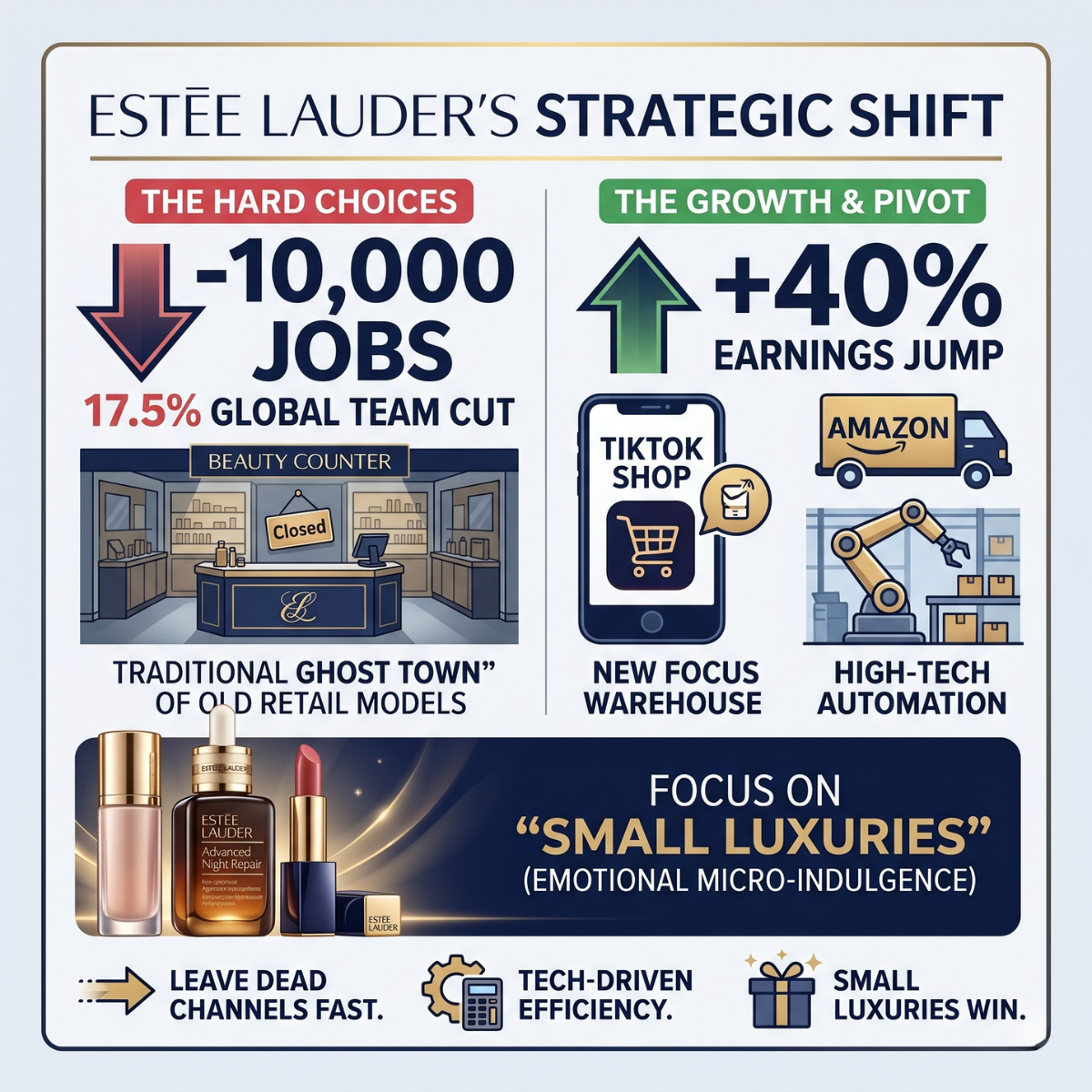
The adjusted diluted earnings per share (EPS) hit $0.91, which was 40% higher than last year. This beat the expectations of most Wall Street experts. Even with the problems caused by the conflict in the Middle East, which cost the company about $0.07 per share, the growth remained strong.
Part 2: The Leadership Shift – “I Can Repair the Plane While Flying”
The transition of power at the top has been the most important change. On January 1, 2025, Stéphane de La Faverie took over as CEO from the long-serving Fabrizio Freda. De La Faverie is an insider who knows the company well. He has over 25 years of experience in the beauty industry.
His leadership style is very different. He focuses on being “leaner” and “faster.” He once described his job by saying, “I can repair the plane while flying.” This means he is making big structural changes while the business is still operating. He replaced the old, slow regional structure with a new model called “One ELC.”
This “One ELC” model has three parts:
- One Team: Simplified layers to make decisions faster.
- One Culture: A focus on accountability and “entrepreneurial thinking.”
- One Operating Ecosystem: A unified system where brands share the same technology and data partners.
One of the biggest moves was hiring WPP as the company’s first-ever global media partner in April 2026. In the past, every region did its own marketing. Now, it is a global system powered by Artificial Intelligence (AI). This helps the company spend its advertising money with much more precision.

Part 3: China – Winning in a Deflationary Trap
Many global luxury brands are struggling in China right now. The Chinese economy is facing a “deflationary trap.” This means consumers are worried about the future, so they spend less money and look for discounts.
However, Estée Lauder achieved high single-digit organic growth in Mainland China this quarter. They are actually gaining market share from their competitors. How did they do this? They used a strategy called “In China, For China.”
The Logistics of Speed
In late March 2026, the company opened the Group Open Innovation (GOI) Center and the China Fulfillment Center in Shanghai. This facility is huge – 130,000 square meters. It is highly automated and can process 400,000 units of product every day. It even has “lights-out” factory operations that run 24/7 without humans. This allows Estée Lauder to deliver products faster during big shopping festivals like “Double 11” and “618.”
The New Consumer Logic
The way Chinese people buy beauty products has changed. In 2026, analysts see three big trends:
- Scenario Logic: People want products for specific moments, like repairing skin after a humid commute or office air-conditioning dryness.
- The Sink Aesthetic: This is a “vibe marketing” trend. People display luxury products on their bathroom sinks to show their taste and status in a quiet way. Brands like La Mer and Le Labo are very popular for this.
- High-Performance Minimalism: Consumers are buying fewer products, but they want those products to have proven medical results. This is why “Derm-Prestige” (luxury products with clinical science) is growing so fast.
| Segment Performance in China | Q3 Fiscal 2026 Highlights | Strategic Drivers |
| Luxury Skincare | High single-digit growth led by La Mer. | Focus on “VIP outreach” and anti-aging. |
| Prestige Fragrance | Double-digit growth; Le Labo and Tom Ford leaders. | “Emotional micro-indulgence” and gifting. |
| Masstige Skincare | Strong expansion of The Ordinary on Douyin. | Demand for pure ingredients at lower costs. |
| Travel Retail | Strong gains in Hainan and airports. | Outperforming the general market. |
/
Part 4: The Fragrance engine and the Death of the Counter
The Fragrance division is the fastest-growing part of the company. It reported double-digit growth across all regions. Scents have become a form of “emotional micro-indulgence.” Even if someone cannot afford a $2,000 handbag, they will spend $200 on a luxury perfume to feel good.
Brands like Le Labo (with its new Violette 30 launch) and Tom Ford (with Figue Érotique) are leading the way. Even new brands like Balmain Beauty are doing well with launches like Destin de Balmain.
Leaving the Department Store
For many years, Estée Lauder was a “department store brand.” But department stores are dying in many Western countries. In 2026, Estée Lauder is closing “unproductive doors” – meaning they are leaving stores that do not make enough profit.
Instead, they are moving to where the young people are:
- Amazon and TikTok Shop: Brands like M·A·C, Clinique, and The Ordinary are now sold here.
- Specialty Stores: M·A·C launched in U.S. Sephora locations in March 2026.
- Freestanding Boutiques: The company opened 27 new standalone stores in nine months, mostly for Le Labo and Jo Malone London.
Part 5: Competitor Benchmarking – The Global Battle
Estée Lauder is doing well, but it is not alone. The competition in 2026 is fierce.
L’Oréal: The French giant reported a 6.7% growth in early 2026. They are very strong in “Dermatological Beauty” and e-commerce. While L’Oréal’s growth in China was also in the “mid-to-high single digits,” Estée Lauder’s performance was similar, which means ELC is finally keeping up with the leader.
LVMH: Their beauty division was mostly flat, but their retail chain, Sephora, is growing by 4%. Sephora is the global leader in prestige beauty retail, and Estée Lauder must balance being a partner to Sephora while also competing with the independent brands Sephora sells.
Shiseido: After a very bad 2025 with large financial losses, the Japanese company is trying to bounce back. They are targeting a 3% growth in 2026. Like Estée Lauder, they are also cutting costs and focusing on China.
| Competitor Comparison | Performance in 2026 | Main Focus |
| Estée Lauder | +2% Organic Growth. | Beauty Reimagined; One ELC. |
| L’Oréal | +6.7% Growth. | E-commerce and Derm-beauty. |
| LVMH (Beauty) | 0% (Flat) Organic Growth. | Sephora expansion. |
| Puig | +4.7% Growth. | Charlotte Tilbury; Niche scents. |
| Amorepacific | +5% Growth. | Derma skincare; US expansion. |
Part 6: Controversies and Hard Decisions
No turnaround is easy. For Estée Lauder, the price of recovery is high.
The Job Cuts
The company is cutting between 9,000 and 10,000 jobs. That is 17.5% of their total workforce. Most of these people work at the counters in department stores. While this makes the company more profitable and “leaner,” it is a painful time for many employees.
The Debt and the Fair Value
Some analysts are still worried. The company has a high debt level, with a Debt/Equity ratio of 181.6%. Also, some experts believe the stock is currently overvalued. While the price is around $79–$81, some models suggest the real value should be closer to $50.
The Puig Merger Rumor
One of the most controversial topics in the industry is the rumored merger between Estée Lauder and the Spanish company Puig. Spanish newspaper Expansión reported that ELC has offered Marc Puig a “co-chair” role in a new combined company. They are reportedly looking for €5 billion in funding for this deal. If this happens, it would create a massive beauty superpower, but it would be very difficult to manage.
Part 7: Insights and Second-Order Implications
What does this mean for the future? We are seeing the “Skinification” of everything. Consumers no longer just want makeup; they want makeup that fixes their skin. This is why Estée Lauder’s new “Double Wear” foundation now includes skincare benefits.
Furthermore, the “social-to-retail” pipeline is faster than ever. A product can go viral on TikTok on a Monday and be sold out in Sephora by Friday. Legacy brands that used to wait months for magazine reviews are being left behind by brands that move at the speed of social media. Estée Lauder’s move into TikTok Shop and their AI partnership with WPP are desperate, but necessary, attempts to survive in this new world.
Part 8: The Path to 2027
Stéphane de La Faverie has called this turnaround a “marathon, not a sprint.” The company is now looking toward fiscal 2027 with confidence.
Their preliminary goals for 2027 are:
- Net Sales Growth: 3% to 5%.
- Operating Margin: Around 12.5% to 13.0%.
- Full Transformation: By the end of 2026, the “One ELC” system will be fully operational across all brands.
However, the road ahead is still full of risks. Trade tariffs could cost the company $100 million in profit. Geopolitical tensions in the Middle East and between China and the West could disrupt the supply chain at any moment.
Conclusion: The New Playbook for Beauty
The Estée Lauder Companies has successfully pivoted. They stopped relying on their 80-year history and started acting like a modern, digital-first business. They have learned to win in a difficult China market and found a way to make big profits from luxury fragrances.
While the 10,000 job cuts are a sad reality of the “One ELC” model, they have created a company that is finally agile enough to compete with L’Oréal and the new “clean beauty” brands. As we move into the second half of 2026, the beauty world will be watching to see if this pivot is truly permanent or just a temporary recovery. For now, the “Beauty Reimagined” strategy has given this old giant a new life.
Related posts:
 Testing the Limits of Brand Power: Nivea in an Inflated Economy
 The €100 Billion Milestone: Inside the Rise of Europe’s Silent Retail Giant
 GLP-1 Retail Impact: How Weight-Loss Drugs Are Shrinking Supermarket Sales
 PepsiCo’s Strategic Paradigm Shift
 European Retail Self Checkout Shrinkage 2026: 22% Loss
 EU Small Parcel Tax: Why the New Custom Rules Won’t Stop Shein & Temu