
National Brands vs Private Labels in Europe: The Reality Behind the Data
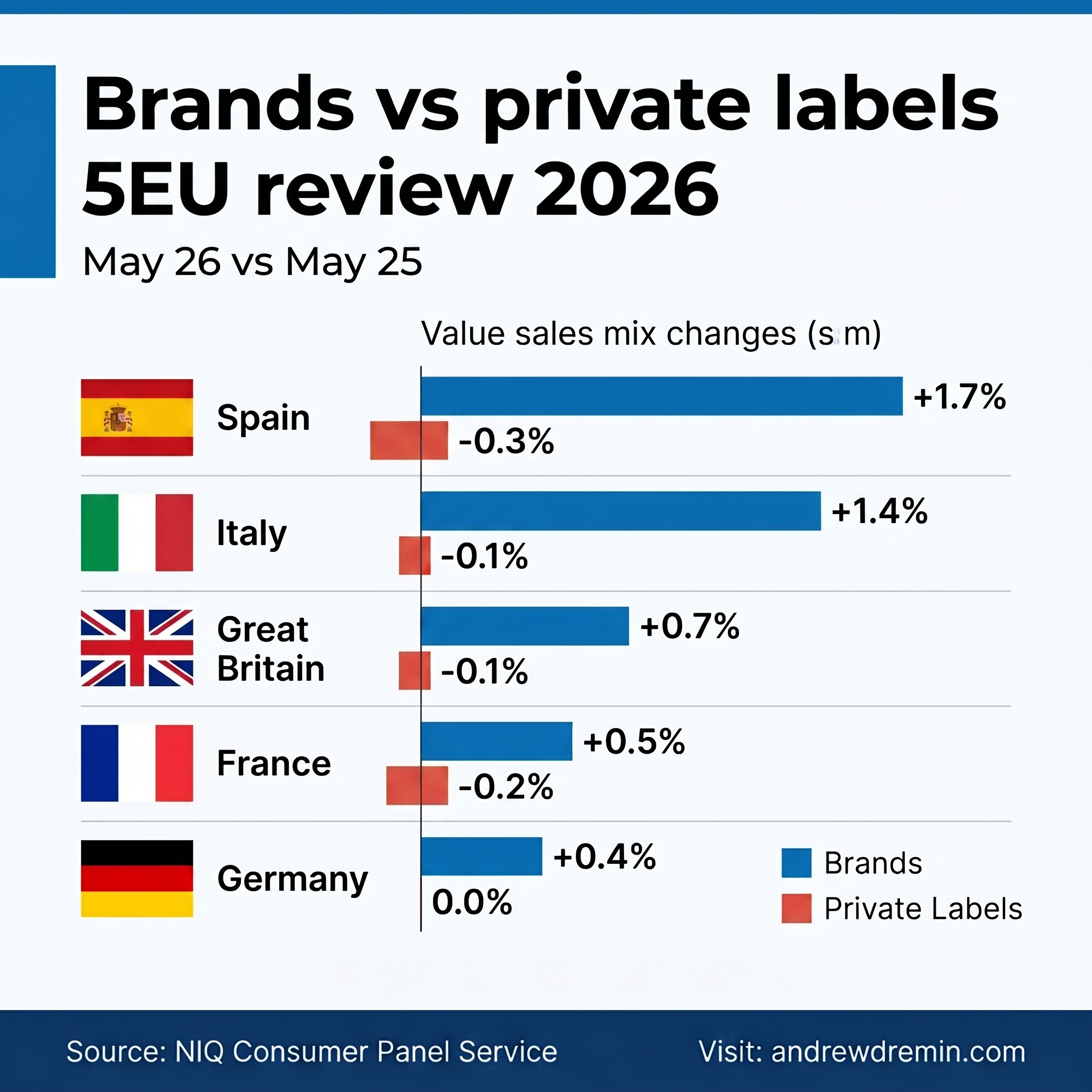
Recent retail headlines claim that national brands (A-brands) are making a major comeback across European supermarkets. If you look only at top-line market reports, that seems true. Value sales mix figures from NielsenIQ show national brands gaining ground over store brands across key European markets:
Brands vs Private Labels — 5EU Review 2026
May 26 vs May 25 • Value sales mix changes (s m)
| Country | Brands | Private Labels |
|---|---|---|
|
🇪🇸 Spain
|
+1.7% | -0.3% |
|
🇮🇹 Italy
|
+1.4% | -0.1% |
|
🇬🇧 Great Britain
|
+0.7% | -0.1% |
|
🇫🇷 France
|
+0.5% | -0.2% |
|
🇩🇪 Germany
|
+0.4% | 0.0% |
On paper, big FMCG manufacturers look like they are winning back the market share they lost during the peak inflation years of 2022 to 2025.
In reality, this is not a structural comeback. It is an expensive, promotion-funded market defense. A-brands did not win back consumers through stronger brand loyalty or product superiority. They bought short-term volume by burning their trade budgets.
Why A-Brand Growth Is Promo-Driven: Rented Volume vs Brand Equity
National brands are showing positive value numbers because they opened the discount taps. When a manufacturer runs promotions at 25% to 35% off the standard shelf price, price-sensitive shoppers buy that product.
However, buying volume through heavy discounts is very different from building organic consumer demand.
The Promotion Trap Mechanics
From tactical price activation to long-term baseline volume & brand equity destruction
| Stage | Mechanism | Shopper & Market Dynamic | Commercial Outcome |
|---|---|---|---|
| 01 • Trigger | Heavy Discounting Deep price cuts, multi-buys, temporary off-shelf feature |
Lowers purchase barrier; drives impulse acquisition across price-sensitive shoppers. | Margin Compression High funding cost, minimal incremental profit per unit. |
| 02 • Spike | Temporary Unit Spike Immediate sell-out velocity jump |
Pantry-loading and forward buying by existing consumers rather than pure brand switching. | High Top-Line Volume Creates illusory short-term ROI and distorts demand forecasting. |
| 03 • Habit | Shopper Waits for Next Promo Reference price reset & deal-seeking behavior |
Shoppers postpone full-price restocks, refusing to purchase outside promotional windows. | Collapsed Baseline Sales Every post-promo period triggers a prolonged sales dip. |
| 04 • Erosion | Baseline Brand Equity Drops Perceived value parity with private label |
Brand loses price premium justification; perceived product value resets to discounted level. | Permanent Margin Loss Retailer resists list price increases; product becomes promotionally addicted. |
How Heavy Trade Spend Creates Discount Addiction
- Rented Volume: Shoppers are buying the discount, not the brand. Once the product returns to its full retail price, those same shoppers move straight back to the private label.
- Eroding Gross Margins: FMCG balance sheets show higher revenue lines, but profitability after trade spending, slotting fees, and promotional allowances is thinning out.
- Consumer Conditioning: Constant “Hi-Lo” promotions teach shoppers never to buy at standard shelf prices. This destroys price anchoring and makes baseline sales volumes drop over time.
European Private Label Market Share: The High-Base Plateau
To understand why a 0.3% drop in private label share is not a crisis for retailers, look at the historical context.
Between 2022 and 2025, double-digit food inflation forced millions of households across Europe to change their shopping habits. Private label penetration reached historic all-time highs across the continent:
- Spain (Mercadona effect): Store brand volume share crossed 50%.
- United Kingdom: Private label volume share stabilized near 48% to 50% across major grocers like Tesco, Sainsbury’s, and Aldi.
- Germany: The discounter-heavy market maintained private label value shares above 40%.
Why a 0.3% Dip Is Market Stabilization
A small dip of -0.1% to -0.3% in private label value mix is not a consumer rejection of store brands. It is a natural market plateau after three straight years of explosive, historic growth.
Store brands have established a massive permanent baseline in European shopping baskets. Shoppers who switched to private labels in 2022 realized that the quality was comparable to A-brands, and they never left.
Category Breakdown: Where Store Brands Dominate vs Where Brands Rebound
The competition between national brands and private labels is no longer a single market-wide battle. It has split into two very distinct category types: Commodities and Emotional Products.
Commodity FMCG vs Taste-Driven Categories
Category Dynamics: Commodity vs. Emotional & Sensory
Strategic positioning where Private Labels dominate versus where A-Brands defend margin
|
Commodity Products
Private Labels Dominate
|
Emotional & Sensory Products
A-Brands Can Defend
|
|---|---|
| Driver: Functional parity & price sensitivity | Driver: Taste profile, trust & sensory reward |
|
Cooking Oils & Butter
|
Salty Snacks & Chips
|
|
Flour, Sugar, White Rice
|
Chocolates & Confectionery
|
|
Toilet Paper & Kitchen Rolls
|
Premium Coffee & Tea
|
|
Basic Dairy & Fresh Milk
|
Baby Food & Formula
|
|
Liquid Bleach & Basic Soap
|
Craft & Premium Beers
|
- Commodity Categories (Permanent Private Label Territory):
- Items like flour, long-life milk, table salt, sunflower oil, and paper towels show minimal product differentiation.
- Consumers refuse to pay a 40% premium for an A-brand logo on a bag of sugar.
- Private labels have permanently locked down these categories. A-brands running promotions here are throwing margin away.
- Emotional and Sensory Categories (Where A-Brands Win Deals):
- Categories like carbonated soft drinks, premium baby food, chocolate confectionery, and beer carry high taste sensitivity or emotional risk.
- When an A-brand drops its price close to the store brand level, shoppers willingly upgrade because they perceive a noticeable taste or formula difference.
Retail Pricing Strategy: The Dangerous 15% Price Gap
The entire battle between private labels and national brands comes down to the retail price gap, specifically the difference in shelf price.
The Price Gap Mechanic
- The 30%+ Gap (Private Label Advantage): When an A-brand costs €2.49 and the private label costs €1.49, the store brand wins easily. The value proposition is clear.
- The Sub-15% Gap (A-Brand Advantage): When the A-brand goes on sale for €1.79 while the store brand sits at €1.55, the €0.24 difference is small enough that shoppers take the premium product.
Price Gap Elasticity & Shopper Decision Matrix
How the price gap between A-Brands and Store Brands dictates volume conversion
| Pricing Scenario | A-Brand Price | Store Brand | Price Gap (%) | Shopper Choice |
|---|---|---|---|---|
| Standard Pricing Full baseline shelf price | €2.49 | €1.55 | +60% Gap |
● Store Brand Wins
Gap exceeds willingness-to-pay threshold
|
| Promotional Pricing Temporary price promotion | €1.79 | €1.55 | +15% Gap |
● A-Brand Wins
Brand equity justifies small price delta
|
Hard Discounters vs Standard Supermarket Shelves
Supermarkets using high-frequency promotional calendars (Hi-Lo pricing) create unpredictable volume swings for their own store brands. Meanwhile, hard discounters like Aldi and Lidl stick to Everyday Low Pricing (EDLP), ensuring their price gap against A-brands remains wide enough to protect their volume.
Strategic Playbook for FMCG Manufacturers
If you lead an FMCG brand, competing head-to-head on price against retail partners who own the shelves is a losing game. You cannot out-discount a private label in the long run, making effective FMCG promotional strategies crucial for sustainable growth.
- Stop Blanket Discounting: Shift promotional spending away from simple price cuts. Use volume mechanics, such as bonus packs (e.g., “3 for 2” or +20% free volume), which protect your baseline price perception.
- Redesign Pack Architecture: Introduce specific channel pack sizes. Create entry-level trial packs for cash-constrained shoppers and large value family formats where price-per-kilogram remains competitive without lowering unit shelf prices.
- Exit Low-Margin Commodity Lines: If you are selling basic staples where private label share exceeds 60%, stop burning marketing funds to defend them. Reallocate that budget into high-margin, R&D-driven product innovations where private labels cannot easily copy your formula.
Strategic Playbook for Grocery Retailers
Retailers must manage their store brand portfolios like real consumer brands, not just cheap shelf fillers.
- Protect the Entry-Level Floor: Keep your Tier-1 (basic budget) private label price tied directly to the cheapest hard discounter in the market. Never let a price gap open up at the bottom of the shelf.
- Implement Tiered Private Label Architecture:
- Tier 1 (Economy): Focus solely on rock-bottom price matching for price-sensitive baskets.
- Tier 2 (Standard Core): Match standard A-brand quality at a consistent 25% to 30% discount.
- Tier 3 (Premium Selection): Offer unique recipes, organic certifications, or local sourcing that beat standard A-brands on quality.
- Monitor Promo Gaps in Real Time: If an A-brand launches a national 30% off campaign in your aisles, monitor your Tier 2 sales volume daily. Adjust temporary placement or highlight the value of your larger basket offerings to stop trade-up bleeding.
The current uptick in national brand value mix is a classic promotional cycle, not a market transformation. As input costs remain unpredictable and FMCG management teams face pressure to restore gross margins, discount budgets will dry up. When promotional frequency drops, European shoppers will stay right where they have settled: buying high-quality private labels for their everyday staples, and picking up A-brands only when the price is artificially lowered.
Frequently Asked Questions
Private Label vs Brand Growth Market Dynamics
Why are national brands growing in value sales faster than private labels right now?
What is the average private label market share in Europe?
What is the “15% price gap rule” in grocery retail?
Which FMCG categories are hardest for private labels to take over?
Related posts:
 Aldi vs Tesco Sainsbury Loyalty Schemes: 2026 Analysis
 Emerging Megacities: FMCG Retail Trends and Consumer Shifts by 2050
 Spain Grocery Market Share 2026: Why Giants Flatline
 Seasonal Retail Inventory Management: 85/15 Buffer Model
 How Mercadona outperforms Carrefour through EDLP models and KVI consumer perception
 Global IQ Ranking by Country 2026: Top 50 Data Audit
Leave a Reply